Arkansas aging officials tell lawmakers senior centers face funding, staffing and transportation pressures
March 25, 2024 | CHILDREN AND YOUTH COMMITTEE - SENATE, Senate, Committees, Legislative, Arkansas
This article was created by AI summarizing key points discussed. AI makes mistakes, so for full details and context, please refer to the video of the full meeting. Please report any errors so we can fix them. Report an error »
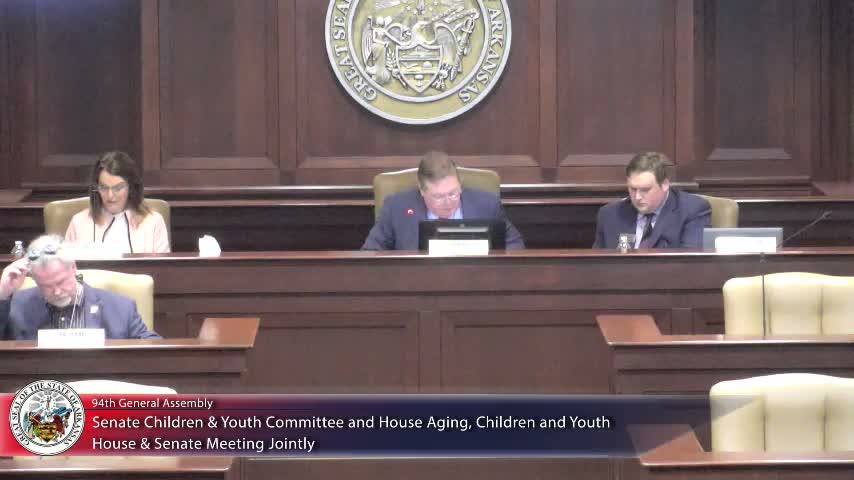
Brad Bailey, executive director of the Northwest Arkansas Area Agency on Aging and president of the Arkansas Association of Area Agencies on Aging, told the Senate committee that area agencies on aging (AAAs) provide an array of services beyond congregate meals, including home-delivered meals, caregiver supports, ombudsman services and care coordination.
"We are your senior center contacts out there," Bailey said, describing AAAs’ role in assessing needs, coordinating services and directing consumers to programs such as Medicare, Medicaid and food-stamp assistance. He said AAAs also operate nutrition and health-and-wellness programs and run an ombudsman program funded under Title III-B.
Bailey told the committee the sector relies heavily on local fundraising to bridge gaps in state and federal funding, estimating in his area "between 40–50%" of a center’s budget comes from local sources in addition to public dollars. He reported a projected total funding figure of $40,318,958 and said one‑time funding for fiscal 2024 was $7,678,878, including ARPA dollars intended to bolster home-delivered meals and public-health outreach.
The Division of Aging and Adult Behavioral Services at the Department of Human Services, represented by Jay Hill, explained that Older Americans Act funds and many federal grant lines are administered via the AAAs and that some transfer authority between specific Title III lines is limited by federal rules. Hill said the Administration for Community Living (ACL) granted greater flexibility between C1 (congregate meals) and C2 (home-delivered meals) during the public‑health emergency to keep meal services flowing.
Members pressed officials on workforce and spending data. Senator Sullivan asked for the turnover rate among direct‑care staff; Bailey said turnover was "high" and agreed to provide a precise figure to the chair and committee in a later report. Bailey and Hill attributed recruitment and retention challenges in part to insufficient Medicaid reimbursement rates for home and personal‑care services.
Lawmakers also asked about transportation and capital needs. Bailey said many vans are funded through a state grant program administered by the Arkansas State Highway and Transportation Department with a local match, and that replacement vehicles available through current grants tend to be cutaway buses priced around $70,000–$75,000. He said AAAs maintain reserve and replacement accounts to cover repairs such as roof replacements.
Committee members asked for a detailed breakdown showing how Older Americans Act dollars are allocated across program lines and how the state disperses funds to AAAs. Hill and Bailey said they would provide the committee a spending breakdown and the requested turnover data. The committee made two routine motions to approve previous meeting minutes; the chair announced those motions carried.
"We are your senior center contacts out there," Bailey said, describing AAAs’ role in assessing needs, coordinating services and directing consumers to programs such as Medicare, Medicaid and food-stamp assistance. He said AAAs also operate nutrition and health-and-wellness programs and run an ombudsman program funded under Title III-B.
Bailey told the committee the sector relies heavily on local fundraising to bridge gaps in state and federal funding, estimating in his area "between 40–50%" of a center’s budget comes from local sources in addition to public dollars. He reported a projected total funding figure of $40,318,958 and said one‑time funding for fiscal 2024 was $7,678,878, including ARPA dollars intended to bolster home-delivered meals and public-health outreach.
The Division of Aging and Adult Behavioral Services at the Department of Human Services, represented by Jay Hill, explained that Older Americans Act funds and many federal grant lines are administered via the AAAs and that some transfer authority between specific Title III lines is limited by federal rules. Hill said the Administration for Community Living (ACL) granted greater flexibility between C1 (congregate meals) and C2 (home-delivered meals) during the public‑health emergency to keep meal services flowing.
Members pressed officials on workforce and spending data. Senator Sullivan asked for the turnover rate among direct‑care staff; Bailey said turnover was "high" and agreed to provide a precise figure to the chair and committee in a later report. Bailey and Hill attributed recruitment and retention challenges in part to insufficient Medicaid reimbursement rates for home and personal‑care services.
Lawmakers also asked about transportation and capital needs. Bailey said many vans are funded through a state grant program administered by the Arkansas State Highway and Transportation Department with a local match, and that replacement vehicles available through current grants tend to be cutaway buses priced around $70,000–$75,000. He said AAAs maintain reserve and replacement accounts to cover repairs such as roof replacements.
Committee members asked for a detailed breakdown showing how Older Americans Act dollars are allocated across program lines and how the state disperses funds to AAAs. Hill and Bailey said they would provide the committee a spending breakdown and the requested turnover data. The committee made two routine motions to approve previous meeting minutes; the chair announced those motions carried.
View the Full Meeting & All Its Details
This article offers just a summary. Unlock complete video, transcripts, and insights as a Founder Member.
✓
Watch full, unedited meeting videos
✓
Search every word spoken in unlimited transcripts
✓
AI summaries & real-time alerts (all government levels)
✓
Permanent access to expanding government content
30-day money-back guarantee
