DCFS outlines rule updates, new case system and workforce priorities as foster-population declines
February 02, 2024 | CHILDREN AND YOUTH COMMITTEE - SENATE, Senate, Committees, Legislative, Arkansas
This article was created by AI summarizing key points discussed. AI makes mistakes, so for full details and context, please refer to the video of the full meeting. Please report any errors so we can fix them. Report an error »
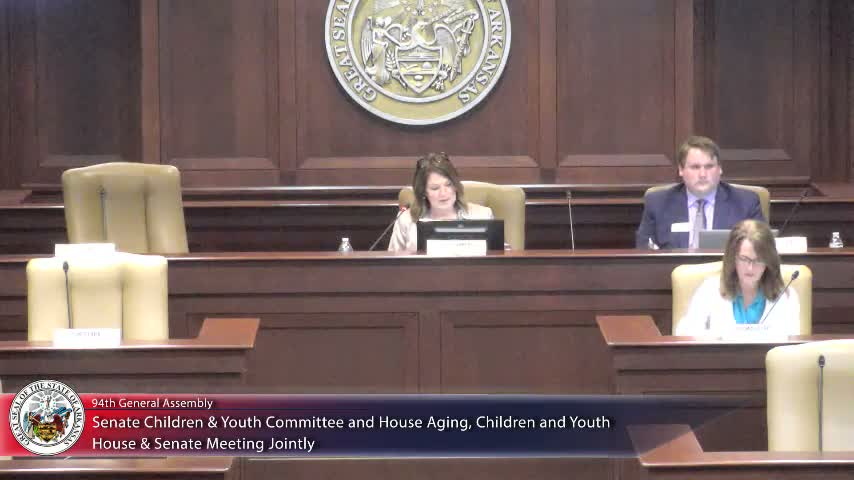
Tiffany Wright, director of the Division of Children and Family Services at the Department of Human Services, told the Senate Children and Youth Committee that DCFS has formalized increased monthly board payments for resource (foster) parents and updated agency rules to strengthen Safe Haven surrender protections.
Wright said the department increased board payment rates "by 10% in August of last year" and that the rule package clarifies mileage reimbursement and the process for requesting a special board rate. She also described changes intended to align agency rules with recent legislation and to protect parents who surrender infants under the Safe Haven Act: "if the identity of a parent or child is inadvertently released or made known to the department, that parent will still have the same protections, from criminal and civil liability as if an anonymous safe haven surrender was made," Wright said.
Why it matters: the rule clarifications affect how the state treats parents who use the Safe Haven surrender process and formalize supports intended to reduce costs for foster parents. Committee members pressed DCFS for practical details about implementation, contracting and cost impacts.
Key details and rollout
Wright described a multi-phase rollout of a new child-welfare case management system—referred to in the meeting as 'Focus'—that is intended to replace the legacy system known as 'Chris.' She said the mandated-reporter portal was the first phase, a subsequent phase rolled out in May 2023, another phase was planned for February 2024, and DCFS is targeting a full implementation in summer 2025. "This is our new child welfare, management system," Wright said, describing how the technology will put tools in staffs' hands for case plans and mobile access.
Workforce, vacancies and training
Wright told lawmakers DCFS continues to face staffing challenges. She reported vacancies (as of January 10) of 88 program assistants, 60 family service workers, and 20 supervisor positions and described turnover improvements compared with prior fiscal years but an ongoing need to recruit and retain staff.
To address staff readiness and trauma exposure, DCFS has piloted a training called CSIRT (Components of Enhancing Career Experience and Reducing Trauma) and is partnering with UAMS and university partners. Wright said the department is also revising resource-parent training, naming a new curriculum "Connecting Our Families," and is reducing some continuing-education hour requirements while aiming to improve the quality of training.
Private licensed placement agencies and costs
The committee heard from a private licensed placement agency (PLPA) representative about their role in recruiting and supporting foster homes and providing on-the-ground case management support. Wright said DCFS has contracts with PLPAs and that a portion of payments for resource parents flows through those agencies; she estimated approximately 200 children are currently placed with private agencies out of more than 3,000 children in foster care statewide. Wright offered to provide contract documents and appropriation details to the committee in writing.
Mandated reporters, audits and data
Kristen Harper, assistant director with the Division of Children and Family Services, said the Commission on Domestic Violence and Child Abuse is officially responsible for mandated-reporter training and provides a free online, self-paced course with a certificate; DCFS also provides training on request. Harper noted DCFS conducts audits of private agencies' board-payment records and continues to perform home visits for oversight. Wright said the department can provide demographic breakdowns (age, race, gender, location) and other requested reports to committee members by follow-up email.
What the committee asked for next
Multiple lawmakers pressed DCFS for written follow-ups on several items: the Pulaski County pilot's appropriation and current funding status, contract terms and percentages passed to private agencies, a cost-savings analysis tied to the decline in foster-care counts, and Garrett's Law reporting details. Wright agreed to provide those materials in writing.
Meeting outcome and next steps
The committee reviewed two rule packets (resource-parent financial support and safe-haven surrender protections); members raised questions and DCFS staff answered but no formal legislative vote on new statutory language was recorded in the meeting. Wright committed to follow up in writing on several data and contract questions and to continue working on recruitment, training and the case-management rollout.
Quotes
"We increased the board payment rates by 10% in August of last year," Tiffany Wright said about the board payment policy change.
"If the identity of a parent or child is inadvertently released or made known to the department, that parent will still have the same protections, from criminal and civil liability as if an anonymous safe haven surrender was made," Wright said describing the safe-haven rule update.
"In December, we were at 3,698 children in foster care," Wright said while presenting statewide counts.
Next steps
Wright said DCFS will provide legislators requested details (contract language, audit summaries, demographic reports and pilot-appropriation status) by email or written follow-up. The committee adjourned with no further business.
Wright said the department increased board payment rates "by 10% in August of last year" and that the rule package clarifies mileage reimbursement and the process for requesting a special board rate. She also described changes intended to align agency rules with recent legislation and to protect parents who surrender infants under the Safe Haven Act: "if the identity of a parent or child is inadvertently released or made known to the department, that parent will still have the same protections, from criminal and civil liability as if an anonymous safe haven surrender was made," Wright said.
Why it matters: the rule clarifications affect how the state treats parents who use the Safe Haven surrender process and formalize supports intended to reduce costs for foster parents. Committee members pressed DCFS for practical details about implementation, contracting and cost impacts.
Key details and rollout
Wright described a multi-phase rollout of a new child-welfare case management system—referred to in the meeting as 'Focus'—that is intended to replace the legacy system known as 'Chris.' She said the mandated-reporter portal was the first phase, a subsequent phase rolled out in May 2023, another phase was planned for February 2024, and DCFS is targeting a full implementation in summer 2025. "This is our new child welfare, management system," Wright said, describing how the technology will put tools in staffs' hands for case plans and mobile access.
Workforce, vacancies and training
Wright told lawmakers DCFS continues to face staffing challenges. She reported vacancies (as of January 10) of 88 program assistants, 60 family service workers, and 20 supervisor positions and described turnover improvements compared with prior fiscal years but an ongoing need to recruit and retain staff.
To address staff readiness and trauma exposure, DCFS has piloted a training called CSIRT (Components of Enhancing Career Experience and Reducing Trauma) and is partnering with UAMS and university partners. Wright said the department is also revising resource-parent training, naming a new curriculum "Connecting Our Families," and is reducing some continuing-education hour requirements while aiming to improve the quality of training.
Private licensed placement agencies and costs
The committee heard from a private licensed placement agency (PLPA) representative about their role in recruiting and supporting foster homes and providing on-the-ground case management support. Wright said DCFS has contracts with PLPAs and that a portion of payments for resource parents flows through those agencies; she estimated approximately 200 children are currently placed with private agencies out of more than 3,000 children in foster care statewide. Wright offered to provide contract documents and appropriation details to the committee in writing.
Mandated reporters, audits and data
Kristen Harper, assistant director with the Division of Children and Family Services, said the Commission on Domestic Violence and Child Abuse is officially responsible for mandated-reporter training and provides a free online, self-paced course with a certificate; DCFS also provides training on request. Harper noted DCFS conducts audits of private agencies' board-payment records and continues to perform home visits for oversight. Wright said the department can provide demographic breakdowns (age, race, gender, location) and other requested reports to committee members by follow-up email.
What the committee asked for next
Multiple lawmakers pressed DCFS for written follow-ups on several items: the Pulaski County pilot's appropriation and current funding status, contract terms and percentages passed to private agencies, a cost-savings analysis tied to the decline in foster-care counts, and Garrett's Law reporting details. Wright agreed to provide those materials in writing.
Meeting outcome and next steps
The committee reviewed two rule packets (resource-parent financial support and safe-haven surrender protections); members raised questions and DCFS staff answered but no formal legislative vote on new statutory language was recorded in the meeting. Wright committed to follow up in writing on several data and contract questions and to continue working on recruitment, training and the case-management rollout.
Quotes
"We increased the board payment rates by 10% in August of last year," Tiffany Wright said about the board payment policy change.
"If the identity of a parent or child is inadvertently released or made known to the department, that parent will still have the same protections, from criminal and civil liability as if an anonymous safe haven surrender was made," Wright said describing the safe-haven rule update.
"In December, we were at 3,698 children in foster care," Wright said while presenting statewide counts.
Next steps
Wright said DCFS will provide legislators requested details (contract language, audit summaries, demographic reports and pilot-appropriation status) by email or written follow-up. The committee adjourned with no further business.
View the Full Meeting & All Its Details
This article offers just a summary. Unlock complete video, transcripts, and insights as a Founder Member.
✓
Watch full, unedited meeting videos
✓
Search every word spoken in unlimited transcripts
✓
AI summaries & real-time alerts (all government levels)
✓
Permanent access to expanding government content
30-day money-back guarantee
