Senate committee clears bill allowing Kammack Village to use fees for drainage and sidewalks
January 24, 2023 | CITY, COUNTY & LOCAL AFFAIRS COMMITTEE - SENATE, Senate, Committees, Legislative, Arkansas
This article was created by AI summarizing key points discussed. AI makes mistakes, so for full details and context, please refer to the video of the full meeting. Please report any errors so we can fix them. Report an error »
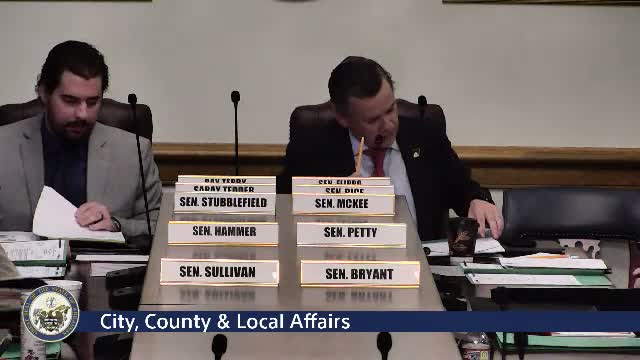
Senator Tucker, sponsor of House Bill 1,100, told the City, County & Local Affairs Committee that the measure would add drainage system maintenance and sidewalk maintenance and redevelopment, including lighting and cleaning, to the statutory list of services urban service districts may provide and fund with fees. "This is a bill. It deals with urban service districts," Tucker said, saying the change is targeted to Kammack Village, an autonomous urban service district contained within Little Rock that has no commercial tax base.
John Wilkerson, general counsel for the Arkansas Municipal League, described Kammack as "a city" in function but without traditional tax space, meaning it relies on fees for utilities and services. Wilkerson said the bill clarifies that fees already charged by the district can legally be used for the newly enumerated services. "So, again, this KMAC is a autonomous city ... and so they just have to create revenue to do the services that their city residents want," Wilkerson testified.
Committee members asked whether the bill would force a fee increase or merely clarify legal authority. Wilkerson and Tucker said the statute’s change is intended to give clear authority to spend fee revenue on drainage and sidewalks and to create the option to pursue bonding for those services when appropriate. "This makes it clear, you know, as a law ... I would be very careful in providing these services when they're not enumerated under the law," Tucker said, explaining the need to resolve statutory ambiguity for financing.
Sponsor closing: Tucker said the bill is narrowly tailored to allow the district to deliver routine municipal services to its residents. The committee moved and the bill passed by voice vote after a second was recorded. The committee did not record a roll-call tally for the voice vote.
What happens next: With committee approval, the bill advances to further consideration by the full chamber according to the legislative calendar.
John Wilkerson, general counsel for the Arkansas Municipal League, described Kammack as "a city" in function but without traditional tax space, meaning it relies on fees for utilities and services. Wilkerson said the bill clarifies that fees already charged by the district can legally be used for the newly enumerated services. "So, again, this KMAC is a autonomous city ... and so they just have to create revenue to do the services that their city residents want," Wilkerson testified.
Committee members asked whether the bill would force a fee increase or merely clarify legal authority. Wilkerson and Tucker said the statute’s change is intended to give clear authority to spend fee revenue on drainage and sidewalks and to create the option to pursue bonding for those services when appropriate. "This makes it clear, you know, as a law ... I would be very careful in providing these services when they're not enumerated under the law," Tucker said, explaining the need to resolve statutory ambiguity for financing.
Sponsor closing: Tucker said the bill is narrowly tailored to allow the district to deliver routine municipal services to its residents. The committee moved and the bill passed by voice vote after a second was recorded. The committee did not record a roll-call tally for the voice vote.
What happens next: With committee approval, the bill advances to further consideration by the full chamber according to the legislative calendar.
View the Full Meeting & All Its Details
This article offers just a summary. Unlock complete video, transcripts, and insights as a Founder Member.
✓
Watch full, unedited meeting videos
✓
Search every word spoken in unlimited transcripts
✓
AI summaries & real-time alerts (all government levels)
✓
Permanent access to expanding government content
30-day money-back guarantee
