Senate committee hears report on Act 4 21 study of election technology; officials warn on biometrics, endorse tracking options
September 20, 2022 | STATE AGENCIES & GOVT'L AFFAIRS-SENATE, Senate, Committees, Legislative, Arkansas
This article was created by AI summarizing key points discussed. AI makes mistakes, so for full details and context, please refer to the video of the full meeting. Please report any errors so we can fix them. Report an error »
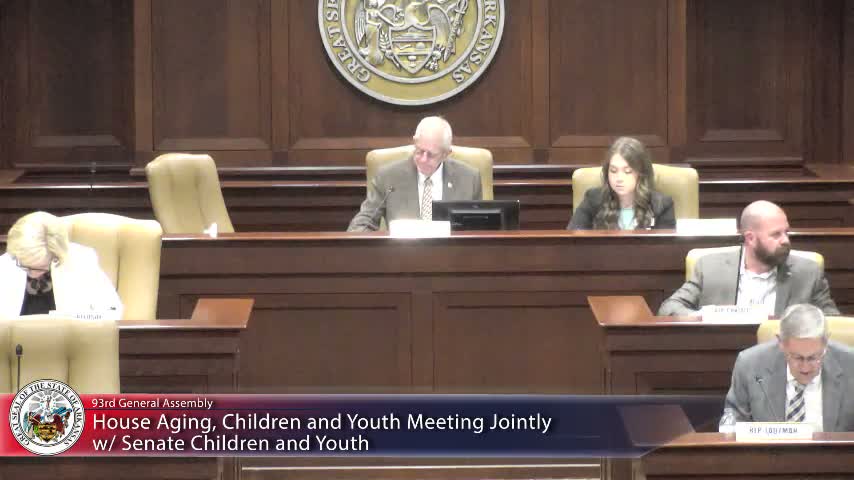
Representative Steven Meeks, sponsor of the bill that became Act 4 21 of 2021, told the Senate State Agencies & Governmental Affairs Committee the statute requires a study and a report to the legislative council by November. Meeks said the study focused on two technological areas: whether biometrics could be used to identify voters and prevent fraud, and whether absentee ballots could carry unique machine-readable identifiers so voters could confirm a ballot was received and counted.
Meeks said experts told him biometric systems are mature for small populations but not for statewide voter rolls. “The technology for biometrics is not yet mature enough to be able to handle potentially a 3,000,000 user database,” he said, adding that even if the technology improves it will require careful study of public acceptance and privacy concerns.
Officials from the Secretary of State’s office — Leslie Bellamy, director of elections; Michael Harry, managing attorney; and Daniel Schultz, director of the State Board of Election Commissioners — told the committee the state’s current voter-registration and poll-book systems lack capacity to store large-scale biometric data without substantial overhaul and vendor support. Bellamy said counties would likely have to rely on outside vendors to print and manage ballots if a new system were adopted. Schultz cautioned that voter secrecy is a constitutional right under the Arkansas Constitution, Amendment 50, Section 2, and said any ballot identifier must not allow the ballot to be traced back to how an individual voted.
Committee members probed technical safeguards and scenarios raised during the 2020–21 elections: how a unique identifier would prevent repeated scanning of the same ballot, whether scanners and paper records would reconcile, and how mobile voting centers for nursing homes would be scheduled and monitored. Meeks described a model in which each absentee ballot carries a unique identifier tied to that voter and election, and said the system could be set to ignore duplicate scans: “once that batch was run through the first time … if you try to run it through the second time … the system would know that that one’s already been read and would ignore it.”
Schultz and others suggested alternatives and complements to biometrics, including more robust post-election audits and risk-limiting audits, and better use of GIS to generate ballot styles automatically to reduce human error. Officials also noted existing tools — signature verification, ID requirements and paper ballot reconciliation — as ongoing safeguards.
The committee chair said, without objection, that the chairs will submit a draft of the meeting and the committee’s report in compliance with Act 4 21 by the November deadline.
The committee did not adopt any legislation at the hearing; instead members asked staff and the Secretary of State’s office to continue the study and supply technical details on feasibility, cost and legal limits before proposing statutory changes.
Meeks said experts told him biometric systems are mature for small populations but not for statewide voter rolls. “The technology for biometrics is not yet mature enough to be able to handle potentially a 3,000,000 user database,” he said, adding that even if the technology improves it will require careful study of public acceptance and privacy concerns.
Officials from the Secretary of State’s office — Leslie Bellamy, director of elections; Michael Harry, managing attorney; and Daniel Schultz, director of the State Board of Election Commissioners — told the committee the state’s current voter-registration and poll-book systems lack capacity to store large-scale biometric data without substantial overhaul and vendor support. Bellamy said counties would likely have to rely on outside vendors to print and manage ballots if a new system were adopted. Schultz cautioned that voter secrecy is a constitutional right under the Arkansas Constitution, Amendment 50, Section 2, and said any ballot identifier must not allow the ballot to be traced back to how an individual voted.
Committee members probed technical safeguards and scenarios raised during the 2020–21 elections: how a unique identifier would prevent repeated scanning of the same ballot, whether scanners and paper records would reconcile, and how mobile voting centers for nursing homes would be scheduled and monitored. Meeks described a model in which each absentee ballot carries a unique identifier tied to that voter and election, and said the system could be set to ignore duplicate scans: “once that batch was run through the first time … if you try to run it through the second time … the system would know that that one’s already been read and would ignore it.”
Schultz and others suggested alternatives and complements to biometrics, including more robust post-election audits and risk-limiting audits, and better use of GIS to generate ballot styles automatically to reduce human error. Officials also noted existing tools — signature verification, ID requirements and paper ballot reconciliation — as ongoing safeguards.
The committee chair said, without objection, that the chairs will submit a draft of the meeting and the committee’s report in compliance with Act 4 21 by the November deadline.
The committee did not adopt any legislation at the hearing; instead members asked staff and the Secretary of State’s office to continue the study and supply technical details on feasibility, cost and legal limits before proposing statutory changes.
View the Full Meeting & All Its Details
This article offers just a summary. Unlock complete video, transcripts, and insights as a Founder Member.
✓
Watch full, unedited meeting videos
✓
Search every word spoken in unlimited transcripts
✓
AI summaries & real-time alerts (all government levels)
✓
Permanent access to expanding government content
30-day money-back guarantee
