Committee advances bill to keep retiring Arkansas State Police canines on handler care with state-paid support
February 14, 2023 | STATE AGENCIES & GOVT'L AFFAIRS-SENATE, Senate, Committees, Legislative, Arkansas
This article was created by AI summarizing key points discussed. AI makes mistakes, so for full details and context, please refer to the video of the full meeting. Please report any errors so we can fix them. Report an error »
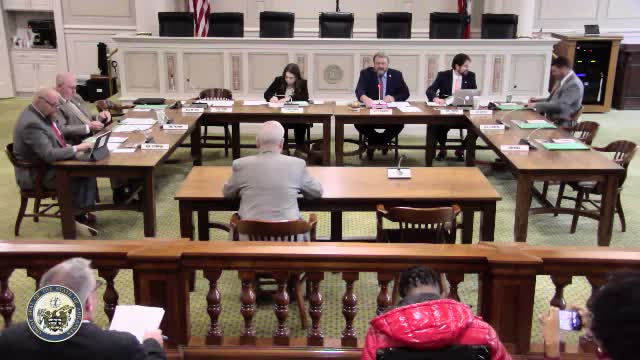
Representative Mark Berry told the Senate State Agencies & Governmental Affairs Committee that HB 13 19 would allow Arkansas State Police canine handlers to take retiring dogs home and have the Department of Public Safety continue to cover food and veterinary costs while the dog lives.
"This bill is a rather simple bill, but, it really means a lot to, a segment of the Arkansas State Police," Berry said, describing a Belgian Malinois named Rhino who was 8½ years old and retiring. He told the committee that working life for police canines is typically two to nine years and that their life expectancy is about 10–14 years.
Berry said state police canines have helped seize "over 18 and a half million dollars" in the past two years and that the proposed change would be a minimal-cost way to relieve the financial burden on troopers who adopt their former partners. He told senators that DPS already pays for food, veterinary bills and flea and tick treatments and that the bill would extend that support into retirement rather than requiring euthanasia or private payment by the handler.
Senator Payton asked whose budget would cover the continued care; Berry said the Department of Public Safety would pay and that typically only one or two dogs are in retirement at any time. The committee moved the measure to a voice vote and the motion was recorded as 'do pass' on a voice 'aye' vote; the record did not include a numeric tally.
The committee did not request a fiscal-impact statement during the hearing; sponsors described the projected cost as minimal and recurring until individual dogs die. The committee advanced the bill to the senate for further consideration.
"This bill is a rather simple bill, but, it really means a lot to, a segment of the Arkansas State Police," Berry said, describing a Belgian Malinois named Rhino who was 8½ years old and retiring. He told the committee that working life for police canines is typically two to nine years and that their life expectancy is about 10–14 years.
Berry said state police canines have helped seize "over 18 and a half million dollars" in the past two years and that the proposed change would be a minimal-cost way to relieve the financial burden on troopers who adopt their former partners. He told senators that DPS already pays for food, veterinary bills and flea and tick treatments and that the bill would extend that support into retirement rather than requiring euthanasia or private payment by the handler.
Senator Payton asked whose budget would cover the continued care; Berry said the Department of Public Safety would pay and that typically only one or two dogs are in retirement at any time. The committee moved the measure to a voice vote and the motion was recorded as 'do pass' on a voice 'aye' vote; the record did not include a numeric tally.
The committee did not request a fiscal-impact statement during the hearing; sponsors described the projected cost as minimal and recurring until individual dogs die. The committee advanced the bill to the senate for further consideration.
View the Full Meeting & All Its Details
This article offers just a summary. Unlock complete video, transcripts, and insights as a Founder Member.
✓
Watch full, unedited meeting videos
✓
Search every word spoken in unlimited transcripts
✓
AI summaries & real-time alerts (all government levels)
✓
Permanent access to expanding government content
30-day money-back guarantee
