Senate committee advances SB 250 requiring unofficial election-night results within 24 hours amid debate over DS200 tabulators and paper ballots
February 23, 2023 | STATE AGENCIES & GOVT'L AFFAIRS-SENATE, Senate, Committees, Legislative, Arkansas
This article was created by AI summarizing key points discussed. AI makes mistakes, so for full details and context, please refer to the video of the full meeting. Please report any errors so we can fix them. Report an error »
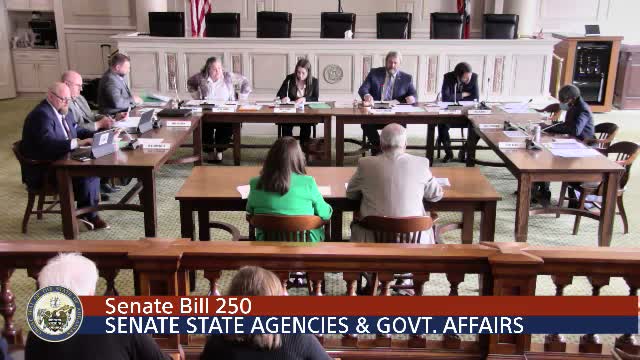
The Senate State Agencies & Governmental Affairs Committee voted to pass SB 250 as amended after a committee hearing where lawmakers and witnesses debated a new 24‑hour rule for posting unofficial election results and whether counties would be compelled to use specific tabulators.
Senator Hammer, sponsor of the measure, and committee members adopted an amendment restoring language that requires unofficial early‑voting, absentee or precinct results to be published "as soon as" they are tabulated but in any event no later than 24 hours. The committee approved the bill as amended by voice vote.
Why it matters: supporters said the change would make preliminary results more timely and ensure a consistent, accountable procedure for counties that choose to use paper ballots; critics said the timing and equipment mandates could discourage paper ballots, raise costs for some counties, and leave unresolved questions about how results flow from precinct machines to statewide reporting.
What happened in the hearing
The committee's technical questioning centered on the DS200 tabulator and how precinct results reach the Secretary of State's public site. A staff witness explained counties commonly transfer results from DS200 machines to thumb drives, aggregate them on a county laptop (Electionware/ESS), and then upload aggregated files; counties retain ballots and keep custody of them for at least 24 months. The witness said the primary tabulation systems are not connected to the Internet and that online results are "unofficial." (Daniel Schultz of the State Election Commission later echoed that the 24‑hour rule applies to unofficial reporting and that central‑count models are not bound by the precinct 24‑hour deadline.)
Opponents' concerns
Several witnesses warned the bill could have unintended consequences. Donnie Scroggins (Poinsett County) described the path he says county results take: thumb drives uploaded to county laptops, files sent to a vendor he identified as "Clarity" in Northern Virginia, and then shared with "Edison" before the Secretary of State posts numbers. "Clarity is a company sitting in Northern Virginia," Scroggins said, characterizing an external vendor loop and questioning how quickly results are posted after counties submit data.
Clint Lancaster, an attorney representing the Arkansas Voter Integrity Initiative, told the committee, "This 24 hour requirement chills that constitutional right [to vote on paper ballots]," and argued that mandating near‑immediate reporting could make it harder for counties to conduct hand counts and preserve paper‑ballot options.
Colonel Conrad Reynolds, a longtime military intelligence officer, displayed a paper ballot and said tabulators read barcodes rather than visible names on the ballot summary. "We have no way of knowing. We can't see the code," Reynolds said, urging greater transparency and stronger paper safeguards.
Supporters' and neutral testimony
Lindsay French of the Association of Arkansas Counties told the panel the Secretary of State's authority to approve machines is already established in law (cited as section "75,301" and Act 2233 of 2005) and said county officials generally welcome clearer statutory language. Daniel Schultz of the State Election Commission said online outputs are unofficial and the 24‑hour obligation, as drafted, applies to precinct counts; central‑counting systems would not be subject to the same deadline. On cost, Schultz said his reading was that if counties use existing equipment the state’s new requirement would mainly affect the cost of paper ballots, although maintenance and future acquisition allocations would have to be addressed later.
Committee action and next steps
The committee adopted a time‑limit motion (two minutes per speaker, excluding member questions) during testimony. After closing remarks by Senator Hammer defending Arkansas election officials and warning about outside interference, Senator Hester moved to pass the bill as amended; Senator Dodson seconded the motion and the committee passed SB 250 by voice vote.
What was not resolved
Witnesses and some senators pressed for specifics that were not in the bill: the hearing did not establish a fixed process for resolving any discrepancy between preliminary electronic tallies and later hand counts, and it did not identify a single, mandatory vendor or technical interface for transmitting precinct files to the Secretary of State. Several speakers recommended state bulk purchase of secure paper (watermarked/ultraviolet) to reduce county costs, but the bill does not specify that approach.
The committee passed SB 250 as amended; the transcript records a voice vote but does not provide a roll‑call tally.
Quotes from the hearing
"Clarity is a company sitting in Northern Virginia," said Donnie Scroggins, describing how he says results files move from county systems to vendors before posting.
"This 24 hour requirement chills that constitutional right," said Clint Lancaster, representing the Arkansas Voter Integrity Initiative.
"The 24 hour rule applies to the unofficial reporting," said Daniel Schultz of the State Election Commission; "what's online is always unofficial."
"We have no way of knowing. We can't see the code," said Colonel Conrad Reynolds about tabulator software and ballot barcodes.
Next procedural step
The committee passed the bill out of committee. The transcript does not record any further committee actions or a roll‑call vote.
Senator Hammer, sponsor of the measure, and committee members adopted an amendment restoring language that requires unofficial early‑voting, absentee or precinct results to be published "as soon as" they are tabulated but in any event no later than 24 hours. The committee approved the bill as amended by voice vote.
Why it matters: supporters said the change would make preliminary results more timely and ensure a consistent, accountable procedure for counties that choose to use paper ballots; critics said the timing and equipment mandates could discourage paper ballots, raise costs for some counties, and leave unresolved questions about how results flow from precinct machines to statewide reporting.
What happened in the hearing
The committee's technical questioning centered on the DS200 tabulator and how precinct results reach the Secretary of State's public site. A staff witness explained counties commonly transfer results from DS200 machines to thumb drives, aggregate them on a county laptop (Electionware/ESS), and then upload aggregated files; counties retain ballots and keep custody of them for at least 24 months. The witness said the primary tabulation systems are not connected to the Internet and that online results are "unofficial." (Daniel Schultz of the State Election Commission later echoed that the 24‑hour rule applies to unofficial reporting and that central‑count models are not bound by the precinct 24‑hour deadline.)
Opponents' concerns
Several witnesses warned the bill could have unintended consequences. Donnie Scroggins (Poinsett County) described the path he says county results take: thumb drives uploaded to county laptops, files sent to a vendor he identified as "Clarity" in Northern Virginia, and then shared with "Edison" before the Secretary of State posts numbers. "Clarity is a company sitting in Northern Virginia," Scroggins said, characterizing an external vendor loop and questioning how quickly results are posted after counties submit data.
Clint Lancaster, an attorney representing the Arkansas Voter Integrity Initiative, told the committee, "This 24 hour requirement chills that constitutional right [to vote on paper ballots]," and argued that mandating near‑immediate reporting could make it harder for counties to conduct hand counts and preserve paper‑ballot options.
Colonel Conrad Reynolds, a longtime military intelligence officer, displayed a paper ballot and said tabulators read barcodes rather than visible names on the ballot summary. "We have no way of knowing. We can't see the code," Reynolds said, urging greater transparency and stronger paper safeguards.
Supporters' and neutral testimony
Lindsay French of the Association of Arkansas Counties told the panel the Secretary of State's authority to approve machines is already established in law (cited as section "75,301" and Act 2233 of 2005) and said county officials generally welcome clearer statutory language. Daniel Schultz of the State Election Commission said online outputs are unofficial and the 24‑hour obligation, as drafted, applies to precinct counts; central‑counting systems would not be subject to the same deadline. On cost, Schultz said his reading was that if counties use existing equipment the state’s new requirement would mainly affect the cost of paper ballots, although maintenance and future acquisition allocations would have to be addressed later.
Committee action and next steps
The committee adopted a time‑limit motion (two minutes per speaker, excluding member questions) during testimony. After closing remarks by Senator Hammer defending Arkansas election officials and warning about outside interference, Senator Hester moved to pass the bill as amended; Senator Dodson seconded the motion and the committee passed SB 250 by voice vote.
What was not resolved
Witnesses and some senators pressed for specifics that were not in the bill: the hearing did not establish a fixed process for resolving any discrepancy between preliminary electronic tallies and later hand counts, and it did not identify a single, mandatory vendor or technical interface for transmitting precinct files to the Secretary of State. Several speakers recommended state bulk purchase of secure paper (watermarked/ultraviolet) to reduce county costs, but the bill does not specify that approach.
The committee passed SB 250 as amended; the transcript records a voice vote but does not provide a roll‑call tally.
Quotes from the hearing
"Clarity is a company sitting in Northern Virginia," said Donnie Scroggins, describing how he says results files move from county systems to vendors before posting.
"This 24 hour requirement chills that constitutional right," said Clint Lancaster, representing the Arkansas Voter Integrity Initiative.
"The 24 hour rule applies to the unofficial reporting," said Daniel Schultz of the State Election Commission; "what's online is always unofficial."
"We have no way of knowing. We can't see the code," said Colonel Conrad Reynolds about tabulator software and ballot barcodes.
Next procedural step
The committee passed the bill out of committee. The transcript does not record any further committee actions or a roll‑call vote.
View the Full Meeting & All Its Details
This article offers just a summary. Unlock complete video, transcripts, and insights as a Founder Member.
✓
Watch full, unedited meeting videos
✓
Search every word spoken in unlimited transcripts
✓
AI summaries & real-time alerts (all government levels)
✓
Permanent access to expanding government content
30-day money-back guarantee
