Senate committee hears testimony for SJR 1 to create independent redistricting commission
March 30, 2023 | STATE AGENCIES & GOVT'L AFFAIRS-SENATE, Senate, Committees, Legislative, Arkansas
This article was created by AI summarizing key points discussed. AI makes mistakes, so for full details and context, please refer to the video of the full meeting. Please report any errors so we can fix them. Report an error »
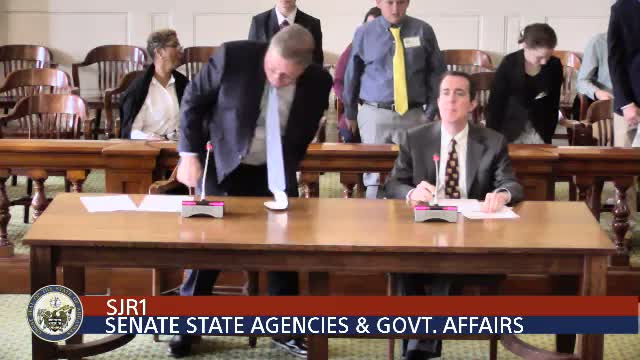
Little Rock — The Senate State Agencies & Governmental Affairs Committee heard testimony for SJR 1, a proposed constitutional amendment that would create an independent districting commission to draw Arkansas' legislative districts.
Senator Brian King, who introduced the joint resolution, said the plan would move the power to draw state House and Senate maps away from the governor, attorney general and secretary of state and require the commission to follow neutral, traditional districting criteria. "This is the heart of the proposal," King said, drawing attention to the measure's limits on what factors the commission may consider.
Josh Silverstein, a University of Arkansas at Little Rock law professor testifying in his individual capacity, told the committee: "SJR 1 would create an independent districting commission. Creating such a commission would substantially immunize state elections from the deeply harmful practice of political gerrymandering." He outlined standard criteria — equal population, respect for political boundaries, contiguity and compactness — and said several states use independent commissions.
Brady Shires, an election cartographer, urged the committee to codify districting criteria in the constitution so rules do not change with each administration. "Codifying these criteria into our constitution ensures equal application and fairness regardless of who's in charge," he said, noting rural communities such as Fairfield Bay and Magnolia had been split under prior maps.
Supporters emphasized transparency measures in the draft, including documenting communications to commission members. The draft also restricts who may serve: it requires certain expertise (law, mapping science), forbids people recently engaged in partisan politics, and bars political donations and a two-year lobbying ban after service.
Several senators pressed sponsors about how appointing officials might still introduce politics. Senator Flowers asked whether the governor, secretary of state and attorney general could select partisan proxies among their three appointees. Silverstein and King said the amendment prescribes qualification and disqualification rules intended to limit such manipulation but acknowledged no process eliminates politics entirely: "There's gonna be some politics," Silverstein said.
Committee members also questioned whether prohibitions on campaign contributions and speech would raise First Amendment concerns. Silverstein replied that constitutional rights can be limited by conditions of service and pointed to existing nonpartisan rules for judges and other public positions.
The committee did not vote on SJR 1. Supporters said the measure includes documentation requirements for commission contacts, explicit factors to be used and factors the commission may not consider, and examples of other states with independent commissions were cited.
The committee will continue reviewing language and may consult Representative Dan Greenberg, identified as the primary author of the draft text, for technical questions prior to further action.
Senator Brian King, who introduced the joint resolution, said the plan would move the power to draw state House and Senate maps away from the governor, attorney general and secretary of state and require the commission to follow neutral, traditional districting criteria. "This is the heart of the proposal," King said, drawing attention to the measure's limits on what factors the commission may consider.
Josh Silverstein, a University of Arkansas at Little Rock law professor testifying in his individual capacity, told the committee: "SJR 1 would create an independent districting commission. Creating such a commission would substantially immunize state elections from the deeply harmful practice of political gerrymandering." He outlined standard criteria — equal population, respect for political boundaries, contiguity and compactness — and said several states use independent commissions.
Brady Shires, an election cartographer, urged the committee to codify districting criteria in the constitution so rules do not change with each administration. "Codifying these criteria into our constitution ensures equal application and fairness regardless of who's in charge," he said, noting rural communities such as Fairfield Bay and Magnolia had been split under prior maps.
Supporters emphasized transparency measures in the draft, including documenting communications to commission members. The draft also restricts who may serve: it requires certain expertise (law, mapping science), forbids people recently engaged in partisan politics, and bars political donations and a two-year lobbying ban after service.
Several senators pressed sponsors about how appointing officials might still introduce politics. Senator Flowers asked whether the governor, secretary of state and attorney general could select partisan proxies among their three appointees. Silverstein and King said the amendment prescribes qualification and disqualification rules intended to limit such manipulation but acknowledged no process eliminates politics entirely: "There's gonna be some politics," Silverstein said.
Committee members also questioned whether prohibitions on campaign contributions and speech would raise First Amendment concerns. Silverstein replied that constitutional rights can be limited by conditions of service and pointed to existing nonpartisan rules for judges and other public positions.
The committee did not vote on SJR 1. Supporters said the measure includes documentation requirements for commission contacts, explicit factors to be used and factors the commission may not consider, and examples of other states with independent commissions were cited.
The committee will continue reviewing language and may consult Representative Dan Greenberg, identified as the primary author of the draft text, for technical questions prior to further action.
Don't Miss a Word: See the Full Meeting!
Go beyond summaries. Unlock every video, transcript, and key insight with a Founder Membership.
✓
Get instant access to full meeting videos
✓
Search and clip any phrase from complete transcripts
✓
Receive AI-powered summaries & custom alerts
✓
Enjoy lifetime, unrestricted access to government data
30-day money-back guarantee
