Senate committee advances bill to require serial numbers on duplicate ballots
March 09, 2023 | STATE AGENCIES & GOVT'L AFFAIRS-SENATE, Senate, Committees, Legislative, Arkansas
This article was created by AI summarizing key points discussed. AI makes mistakes, so for full details and context, please refer to the video of the full meeting. Please report any errors so we can fix them. Report an error »
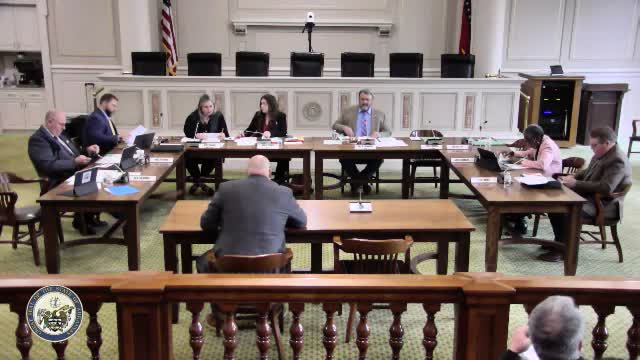
A Senate State Agencies & Governmental Affairs committee on an unspecified date voted to advance legislation that would require officials to place sequential serial numbers on both original and duplicate (remade) ballots so the two can be linked for later review.
Senator Steve Kroll (Senator, District 3) said the measure clarifies existing practice and adds explicit, sequential numbering to damaged ballots and their replacements to improve "ballot transparency." He told the committee the bill "has clear guidelines and sequence numbers for the damaged ballots" to make tracking easier.
Daniel Schultz, director of the State Election Commission, told the committee that current Arkansas law requires officials to write the word "duplicate" on remade ballots but does not require a serial number to link the duplicate to the original. "Right now, the only statutory requirement is that you write duplicate on the duplicate," Schultz said, and the bill would add a serial number to both pieces so officials could "go back and compare to confirm it was done correctly in the context of a recount or any further review." He said in most cases damaged ballots are handled in a central-count setting (for absentee ballots) rather than at precincts.
Clint Lancaster of the Arkansas Voter Integrity Initiative testified in favor, recounting a Crawford County primary where a set of absentee ballots were put into a DS200 tabulator without being marked as duplicates. "They did not mark them as duplicate and they did nothing to make them identifiable," Lancaster said, adding that the event made it impossible to track whether remade ballots were handled correctly.
Senator Kroll closed by asking the committee to recommend the bill "do pass." The motion was made and seconded and the committee advanced the bill by voice vote.
The committee record shows the bill received no recorded public opposition during the hearing; next steps are committee reporting and scheduling for floor consideration as required by chamber rules.
Senator Steve Kroll (Senator, District 3) said the measure clarifies existing practice and adds explicit, sequential numbering to damaged ballots and their replacements to improve "ballot transparency." He told the committee the bill "has clear guidelines and sequence numbers for the damaged ballots" to make tracking easier.
Daniel Schultz, director of the State Election Commission, told the committee that current Arkansas law requires officials to write the word "duplicate" on remade ballots but does not require a serial number to link the duplicate to the original. "Right now, the only statutory requirement is that you write duplicate on the duplicate," Schultz said, and the bill would add a serial number to both pieces so officials could "go back and compare to confirm it was done correctly in the context of a recount or any further review." He said in most cases damaged ballots are handled in a central-count setting (for absentee ballots) rather than at precincts.
Clint Lancaster of the Arkansas Voter Integrity Initiative testified in favor, recounting a Crawford County primary where a set of absentee ballots were put into a DS200 tabulator without being marked as duplicates. "They did not mark them as duplicate and they did nothing to make them identifiable," Lancaster said, adding that the event made it impossible to track whether remade ballots were handled correctly.
Senator Kroll closed by asking the committee to recommend the bill "do pass." The motion was made and seconded and the committee advanced the bill by voice vote.
The committee record shows the bill received no recorded public opposition during the hearing; next steps are committee reporting and scheduling for floor consideration as required by chamber rules.
View the Full Meeting & All Its Details
This article offers just a summary. Unlock complete video, transcripts, and insights as a Founder Member.
✓
Watch full, unedited meeting videos
✓
Search every word spoken in unlimited transcripts
✓
AI summaries & real-time alerts (all government levels)
✓
Permanent access to expanding government content
30-day money-back guarantee
