Families, former inmates tell Senate committee Arkansas prisons lack timely medical and mental-health care; DOC officials cite staffing and contract changes
December 04, 2023 | STATE AGENCIES & GOVT'L AFFAIRS-SENATE, Senate, Committees, Legislative, Arkansas
This article was created by AI summarizing key points discussed. AI makes mistakes, so for full details and context, please refer to the video of the full meeting. Please report any errors so we can fix them. Report an error »
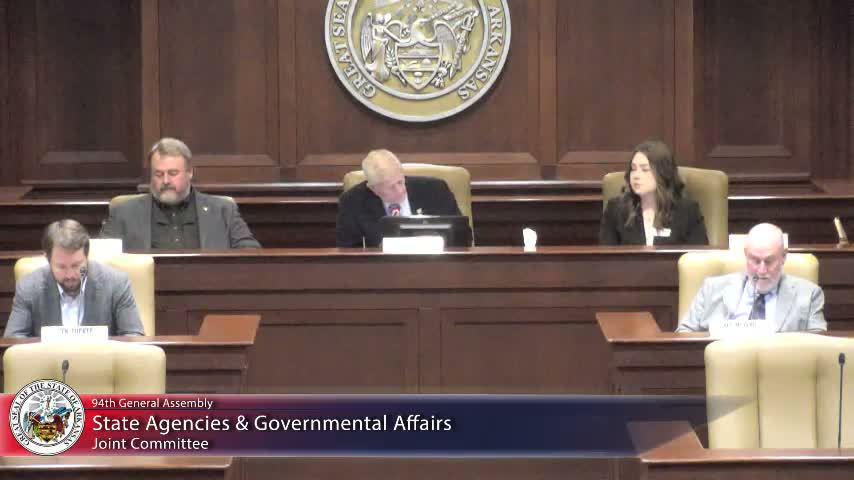
Dozens of family members, formerly incarcerated people and advocates told the Senate State Agencies & Governmental Affairs Committee that Arkansas’s prisons are falling short on medical care, mental-health services, staffing and basic facility maintenance.
"Evidence overwhelmingly indicates that conditions within our prisons are falling short in providing adequate medical and mental health care," said Ladina Biddle, who identified herself as director of the Arkansas Department of Corrections Family Support nonprofit, in opening public testimony describing medication errors, delayed diagnoses and restrictions on mobility devices for some inmates. Families said staff misconduct went unaddressed, that mail or visits were sometimes restricted, and that some inmates were placed into restrictive housing after disciplinary actions that their relatives described as disproportionate.
Several witnesses described long waits to see mental-health clinicians, limited access to treatment beyond medication, and the mental-health harms of extended isolation. Albertus Murray, a former inmate who served decades in the system, described longstanding gaps in mental-health care and recounted practices at supermax facilities he said had severe psychological effects.
Family members reported case-specific allegations: Debbie Baker said her son lost 40 pounds and was placed in restrictive housing after repeated disciplinaries she described as unwarranted; Amber Lance said a client approved for parole remains in restrictive housing after threats and estimated the cost to taxpayers at roughly $13,000 since parole approval. Megan McVay and others said facility problems — including a leaky roof at the McPherson women’s unit and chronic understaffing on some shifts — create safety and sanitation hazards.
Department of Corrections Director Dexter Payne and senior staff acknowledged the concerns, described the agency’s grievance process and said the department investigates allegations. Payne told the committee the agency limits some communications when it believes a person seeking information is connected with a prison gang, a security concern he said can complicate family outreach. Payne confirmed recent storm damage at McPherson had been repaired but said aging facilities continue to require maintenance. DOC officials said security vacancies statewide are high — they estimated vacancy at roughly 40% for security positions — and they described plans to expand recruitment by using mobile training academies and to fold mental-health services into the next iteration of the DOC medical contract to improve hiring and continuity.
Senators and representatives asked for data on staffing, disciplinary trends, the cost of holding parole-eligible inmates, and comparisons between incarceration costs and state-hospital care for people with severe mental illness. The department provided several operational figures in response to questions: a roughly 40% vacancy rate in corrections security positions; approximately 1,900 inmates being held in county jails awaiting DOC transfer (about 2,056 with community corrections included); and roughly $5 million spent on recent roof projects. The DOC said it has referred some specific allegations to internal affairs for investigation.
The hearing closed with committee members urging continued dialogue and with DOC officials acknowledging the need for additional resources and contract changes to address mental-health staffing and services.
"Evidence overwhelmingly indicates that conditions within our prisons are falling short in providing adequate medical and mental health care," said Ladina Biddle, who identified herself as director of the Arkansas Department of Corrections Family Support nonprofit, in opening public testimony describing medication errors, delayed diagnoses and restrictions on mobility devices for some inmates. Families said staff misconduct went unaddressed, that mail or visits were sometimes restricted, and that some inmates were placed into restrictive housing after disciplinary actions that their relatives described as disproportionate.
Several witnesses described long waits to see mental-health clinicians, limited access to treatment beyond medication, and the mental-health harms of extended isolation. Albertus Murray, a former inmate who served decades in the system, described longstanding gaps in mental-health care and recounted practices at supermax facilities he said had severe psychological effects.
Family members reported case-specific allegations: Debbie Baker said her son lost 40 pounds and was placed in restrictive housing after repeated disciplinaries she described as unwarranted; Amber Lance said a client approved for parole remains in restrictive housing after threats and estimated the cost to taxpayers at roughly $13,000 since parole approval. Megan McVay and others said facility problems — including a leaky roof at the McPherson women’s unit and chronic understaffing on some shifts — create safety and sanitation hazards.
Department of Corrections Director Dexter Payne and senior staff acknowledged the concerns, described the agency’s grievance process and said the department investigates allegations. Payne told the committee the agency limits some communications when it believes a person seeking information is connected with a prison gang, a security concern he said can complicate family outreach. Payne confirmed recent storm damage at McPherson had been repaired but said aging facilities continue to require maintenance. DOC officials said security vacancies statewide are high — they estimated vacancy at roughly 40% for security positions — and they described plans to expand recruitment by using mobile training academies and to fold mental-health services into the next iteration of the DOC medical contract to improve hiring and continuity.
Senators and representatives asked for data on staffing, disciplinary trends, the cost of holding parole-eligible inmates, and comparisons between incarceration costs and state-hospital care for people with severe mental illness. The department provided several operational figures in response to questions: a roughly 40% vacancy rate in corrections security positions; approximately 1,900 inmates being held in county jails awaiting DOC transfer (about 2,056 with community corrections included); and roughly $5 million spent on recent roof projects. The DOC said it has referred some specific allegations to internal affairs for investigation.
The hearing closed with committee members urging continued dialogue and with DOC officials acknowledging the need for additional resources and contract changes to address mental-health staffing and services.
Don't Miss a Word: See the Full Meeting!
Go beyond summaries. Unlock every video, transcript, and key insight with a Founder Membership.
✓
Get instant access to full meeting videos
✓
Search and clip any phrase from complete transcripts
✓
Receive AI-powered summaries & custom alerts
✓
Enjoy lifetime, unrestricted access to government data
30-day money-back guarantee
