U of Arkansas Division of Agriculture outlines outreach, funding goals and research returns
October 31, 2022 | AGRICULTURE, FORESTRY & ECONOMIC DEVELOPMENT - SENATE, Senate, Committees, Legislative, Arkansas
This article was created by AI summarizing key points discussed. AI makes mistakes, so for full details and context, please refer to the video of the full meeting. Please report any errors so we can fix them. Report an error »
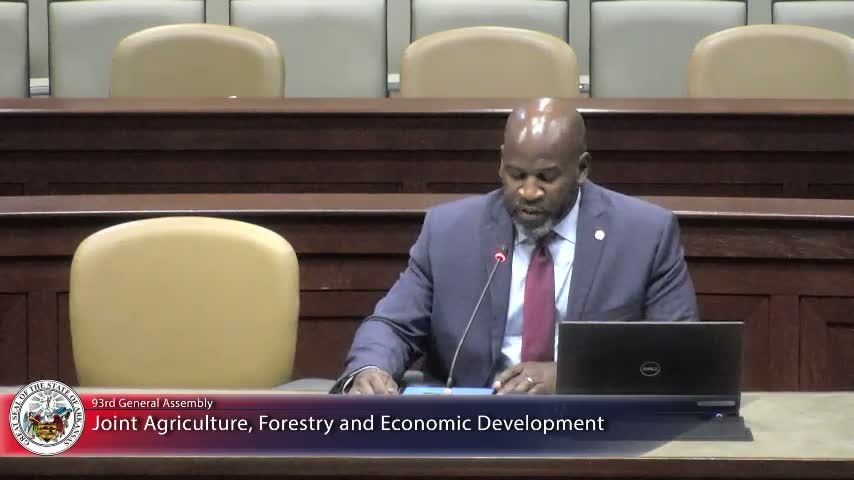
DQ Fields, vice president of the University of Arkansas Division of Agriculture, told a joint Senate‑House session that the division’s primary work is research and extension — turning university research into practical services delivered county‑by‑county through extension offices, 4‑H and community programs.
Fields described his background in land‑grant institutions and said the division plays a major role in the state university’s research output: about 40% of Fayetteville campus research expenditures come from work done by the division, and many faculty hold joint appointments. He said roughly half of the division’s revenue is state funding and that increasing competitive extramural awards is a top priority.
Asked about revenue‑generating programs, Fields highlighted UADA’s blackberry breeding at the Clarksville Research Station, which he said returns about $2 million a year in royalties. He stressed that most research is not run as a profit center but as public investment that yields statewide economic value.
Fields acknowledged budget and morale challenges caused by differing funding mechanisms between the Fayetteville campus and UADA, and thanked the legislature for recent increases intended to address inequities. He also said he “has absolutely no intention” of selling UADA land.
Fields recommended more collaborative, larger‑scale grant efforts — citing a planned multi‑state $50 million application — and said UADA is evaluating duplicate positions after a 2020 consolidation to operate more efficiently. He framed the division’s work as an investment that returns measurable benefits to Arkansas communities.
The chair thanked Fields and opened Q&A; members pressed on revenue examples, grant strategy and the division’s voter‑education publications, which Fields said are widely downloaded and intended as unbiased resources.
Fields described his background in land‑grant institutions and said the division plays a major role in the state university’s research output: about 40% of Fayetteville campus research expenditures come from work done by the division, and many faculty hold joint appointments. He said roughly half of the division’s revenue is state funding and that increasing competitive extramural awards is a top priority.
Asked about revenue‑generating programs, Fields highlighted UADA’s blackberry breeding at the Clarksville Research Station, which he said returns about $2 million a year in royalties. He stressed that most research is not run as a profit center but as public investment that yields statewide economic value.
Fields acknowledged budget and morale challenges caused by differing funding mechanisms between the Fayetteville campus and UADA, and thanked the legislature for recent increases intended to address inequities. He also said he “has absolutely no intention” of selling UADA land.
Fields recommended more collaborative, larger‑scale grant efforts — citing a planned multi‑state $50 million application — and said UADA is evaluating duplicate positions after a 2020 consolidation to operate more efficiently. He framed the division’s work as an investment that returns measurable benefits to Arkansas communities.
The chair thanked Fields and opened Q&A; members pressed on revenue examples, grant strategy and the division’s voter‑education publications, which Fields said are widely downloaded and intended as unbiased resources.
Don't Miss a Word: See the Full Meeting!
Go beyond summaries. Unlock every video, transcript, and key insight with a Founder Membership.
✓
Get instant access to full meeting videos
✓
Search and clip any phrase from complete transcripts
✓
Receive AI-powered summaries & custom alerts
✓
Enjoy lifetime, unrestricted access to government data
30-day money-back guarantee
