University, growers present plans for Northeast Arkansas Rice Research & Extension Center
July 01, 2021 | AGRICULTURE, FORESTRY & ECONOMIC DEVELOPMENT - SENATE, Senate, Committees, Legislative, Arkansas
This article was created by AI summarizing key points discussed. AI makes mistakes, so for full details and context, please refer to the video of the full meeting. Please report any errors so we can fix them. Report an error »
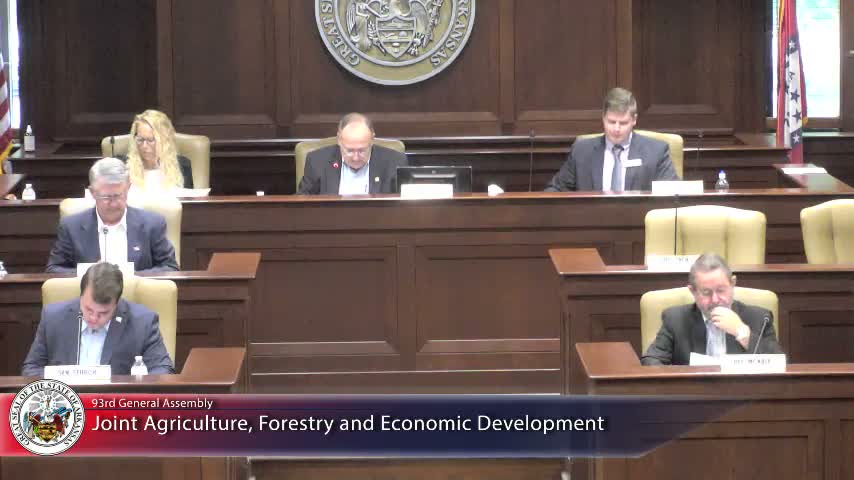
Dr. Timothy Bertram, director of the Northeast Rice Research & Extension Center, told the joint Senate and House agriculture committees that the University of Arkansas is constructing what he described as the division’s first new experiment station since 1961 on a 600‑acre farm near Harrisburg.
"We are constructing the first new experiment station for the division since 1961," Bertram said, and described the site as roughly 14 miles south of Jonesboro with a 32‑acre reservoir (about 10 feet deep), Henry silt loam soils on roughly 94% of the farm, and field layouts intended for large‑scale production trials. The center’s design incorporates research, outreach and a built‑in K‑12/4‑H education mission, including a Rice Discovery Center with bus access and seating for about 250 people.
Bertram said the Arkansas Rice Research and Promotion Board has dedicated about $21,400,000 to the project and cited a separate building commitment of $10,000,000. He explained those funds come from a tariff‑rate quota (TRQ) mechanism that channels checkoff resources to rice research. Private support to date includes a $2,000,000 gift from Greenway (split as $1 million toward the facility and $1 million for equipment) and roughly $171,000 of equipment gifts; Bertram reported cumulative private support of about $2,079,300 so far.
The center will host applied trials — rice performance plots, weed‑science and cover‑crop experiments — and collaborate with Arkansas State University and U of A specialists. Bertram described use cases including drone spraying for small plots (he cited a Rantizo system used on a 4‑acre plot) and a test kitchen to demonstrate rice varieties and cooking techniques for outreach.
Brad Doyle, a fourth‑generation producer, emphasized the center’s value to nearby farms and reinforced the need for local, regionally‑targeted research. He said producers north of I‑40 use different practices than those south of the interstate and that a local research facility will deliver more relevant recommendations for soils, irrigation and disease control.
Bertram framed the investment as an economic strategy for Arkansas, saying the state produced about 49% of U.S. rice in 2020 and pointing to a study he attributed to Dr. Nalley that estimated the RISE checkoff fund returns $28.49 in benefits per dollar (or up to $70 if environmental and ecosystem benefits are included). He offered to provide the report and associated presentation materials to committee staff for distribution.
The committee asked for the slide deck and the video; staff agreed to distribute the files. The University has also requested $6,000,000 from the governor for related initiatives, Bertram said; the transcript records that request was pending at the time of the briefing.
"We are constructing the first new experiment station for the division since 1961," Bertram said, and described the site as roughly 14 miles south of Jonesboro with a 32‑acre reservoir (about 10 feet deep), Henry silt loam soils on roughly 94% of the farm, and field layouts intended for large‑scale production trials. The center’s design incorporates research, outreach and a built‑in K‑12/4‑H education mission, including a Rice Discovery Center with bus access and seating for about 250 people.
Bertram said the Arkansas Rice Research and Promotion Board has dedicated about $21,400,000 to the project and cited a separate building commitment of $10,000,000. He explained those funds come from a tariff‑rate quota (TRQ) mechanism that channels checkoff resources to rice research. Private support to date includes a $2,000,000 gift from Greenway (split as $1 million toward the facility and $1 million for equipment) and roughly $171,000 of equipment gifts; Bertram reported cumulative private support of about $2,079,300 so far.
The center will host applied trials — rice performance plots, weed‑science and cover‑crop experiments — and collaborate with Arkansas State University and U of A specialists. Bertram described use cases including drone spraying for small plots (he cited a Rantizo system used on a 4‑acre plot) and a test kitchen to demonstrate rice varieties and cooking techniques for outreach.
Brad Doyle, a fourth‑generation producer, emphasized the center’s value to nearby farms and reinforced the need for local, regionally‑targeted research. He said producers north of I‑40 use different practices than those south of the interstate and that a local research facility will deliver more relevant recommendations for soils, irrigation and disease control.
Bertram framed the investment as an economic strategy for Arkansas, saying the state produced about 49% of U.S. rice in 2020 and pointing to a study he attributed to Dr. Nalley that estimated the RISE checkoff fund returns $28.49 in benefits per dollar (or up to $70 if environmental and ecosystem benefits are included). He offered to provide the report and associated presentation materials to committee staff for distribution.
The committee asked for the slide deck and the video; staff agreed to distribute the files. The University has also requested $6,000,000 from the governor for related initiatives, Bertram said; the transcript records that request was pending at the time of the briefing.
Don't Miss a Word: See the Full Meeting!
Go beyond summaries. Unlock every video, transcript, and key insight with a Founder Membership.
✓
Get instant access to full meeting videos
✓
Search and clip any phrase from complete transcripts
✓
Receive AI-powered summaries & custom alerts
✓
Enjoy lifetime, unrestricted access to government data
30-day money-back guarantee
