University preliminary estimate: June floods affected ~800,000 acres, $206M baseline damage
July 01, 2021 | AGRICULTURE, FORESTRY & ECONOMIC DEVELOPMENT - SENATE, Senate, Committees, Legislative, Arkansas
This article was created by AI summarizing key points discussed. AI makes mistakes, so for full details and context, please refer to the video of the full meeting. Please report any errors so we can fix them. Report an error »
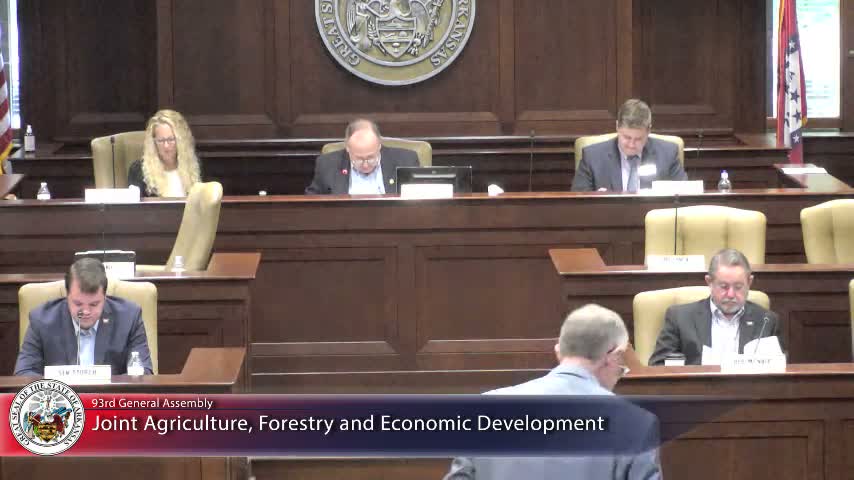
Dr. John Anderson, representing the University of Arkansas agricultural economics team, told the joint committee that preliminary satellite and crop‑overlay analysis shows roughly 800,000 acres were affected by the June heavy‑rain event in parts of Southeast Arkansas, with just over 500,000 acres experiencing six inches or more of standing water for multiple days.
Using conservative baseline assumptions, Anderson said the team’s headline estimate of economic damage — focused on major row crops — is about $206,000,000. He provided a crop breakdown the team used for the baseline: roughly $60 million for corn, about $6 million for cotton, just under $70 million for rice and about $70 million for soybeans, with roughly $1 million for wheat.
Anderson described methodological assumptions behind the figures: a 15% average production loss used for corn across ~360,000 acres (at an assumed market price of $5.95/bushel), a 10% rice yield loss on affected acres, and for soybeans an estimate that 25,000 acres were a total loss while another ~100,000 acres would be replanted late and carry an average 30% yield penalty. He said that this baseline omits some categories that are harder to quantify — infrastructure and equipment losses, levee failures, clogged drainage and increased harvest costs — and that including those unquantified losses could raise the estimate by 10%–25% (Anderson gave a range of about $227,000,000 to $257,000,000 as an upper bound with additional factors).
On insurance, Anderson said most farms have some crop‑insurance participation but many in Southeast Arkansas hold only catastrophic coverage (50% yield, 55% price), which provides limited protection for partial losses. He said the University will refine estimates as USDA and RMA data become available and offered to follow up with additional information for Farm Bureau and committee briefings.
Committee members asked about a federal disaster declaration; Anderson said he was not aware of a federal declaration at that time and said the congressional delegation was pursuing available options. He also warned that pre‑booked crop contracts and cash‑flow disruptions can produce long‑term financial hardship for individual producers even when aggregated headline values capture gross value lost.
Using conservative baseline assumptions, Anderson said the team’s headline estimate of economic damage — focused on major row crops — is about $206,000,000. He provided a crop breakdown the team used for the baseline: roughly $60 million for corn, about $6 million for cotton, just under $70 million for rice and about $70 million for soybeans, with roughly $1 million for wheat.
Anderson described methodological assumptions behind the figures: a 15% average production loss used for corn across ~360,000 acres (at an assumed market price of $5.95/bushel), a 10% rice yield loss on affected acres, and for soybeans an estimate that 25,000 acres were a total loss while another ~100,000 acres would be replanted late and carry an average 30% yield penalty. He said that this baseline omits some categories that are harder to quantify — infrastructure and equipment losses, levee failures, clogged drainage and increased harvest costs — and that including those unquantified losses could raise the estimate by 10%–25% (Anderson gave a range of about $227,000,000 to $257,000,000 as an upper bound with additional factors).
On insurance, Anderson said most farms have some crop‑insurance participation but many in Southeast Arkansas hold only catastrophic coverage (50% yield, 55% price), which provides limited protection for partial losses. He said the University will refine estimates as USDA and RMA data become available and offered to follow up with additional information for Farm Bureau and committee briefings.
Committee members asked about a federal disaster declaration; Anderson said he was not aware of a federal declaration at that time and said the congressional delegation was pursuing available options. He also warned that pre‑booked crop contracts and cash‑flow disruptions can produce long‑term financial hardship for individual producers even when aggregated headline values capture gross value lost.
Don't Miss a Word: See the Full Meeting!
Go beyond summaries. Unlock every video, transcript, and key insight with a Founder Membership.
✓
Get instant access to full meeting videos
✓
Search and clip any phrase from complete transcripts
✓
Receive AI-powered summaries & custom alerts
✓
Enjoy lifetime, unrestricted access to government data
30-day money-back guarantee
