Annual groundwater report warns long‑term decline; tax credits and surface‑water projects highlighted
July 01, 2021 | AGRICULTURE, FORESTRY & ECONOMIC DEVELOPMENT - SENATE, Senate, Committees, Legislative, Arkansas
This article was created by AI summarizing key points discussed. AI makes mistakes, so for full details and context, please refer to the video of the full meeting. Please report any errors so we can fix them. Report an error »
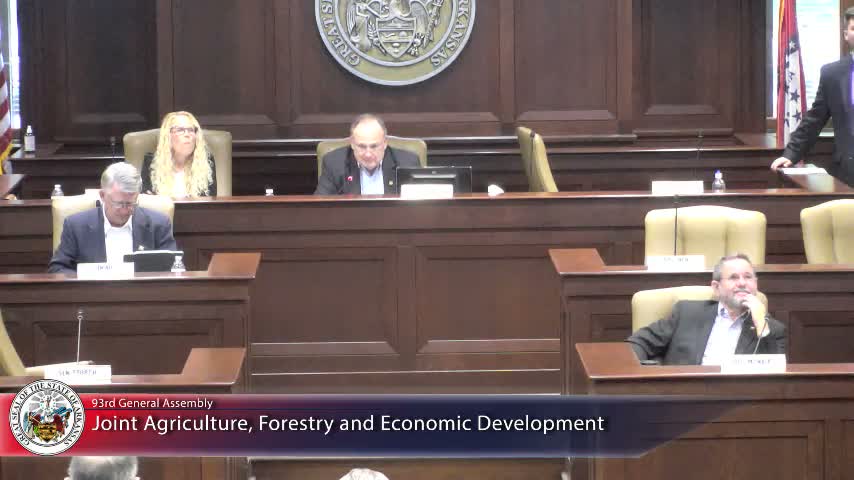
Bruce Holland, executive director of the Arkansas Natural Resources Commission, and Jim Batchell, Groundwater Section Supervisor, presented the commission’s annual Groundwater Protection Management Report to the joint ag committees.
Batchell said the report focuses on the Mississippi River Valley alluvial aquifer and the Sparta‑Memphis sand. The program monitors about 800 alluvial wells and roughly 300 Sparta wells annually and reports an overall long‑term decline in many areas. "We use about 7,000,000,000 gallons a day, from the Mississippi River Valley alluvial," Batchell said, noting 96%–98% of that use is for row‑crop irrigation in high‑use years.
Presenters highlighted geographic cones of depression west of Crowley’s Ridge and described places with only 10%–20% saturated thickness left, which makes groundwater pumping infeasible. Batchell cited USGS model scenarios indicating that, under some projections, maintaining a 50% saturated thickness in certain areas would require turning off up to 80% of irrigation wells.
The presenters described a groundwater conservation tax‑credit program (used for land leveling, reservoir construction, water meters and conversions from groundwater to surface water) and said Act 875 expanded the program’s eligibility footprint. They emphasized that the program is non‑regulatory and provides economic incentives (including EQIP points) to encourage conversions, while surface‑water diversion projects (for example, Union County’s use of Ouachita River water) show measurable aquifer rebound over a decade.
Committee members asked about the durability of incentives and whether tax‑credit projects could be repurposed for non‑irrigation uses; presenters said the law does not currently require long‑term use conditions and that adoption depends on economic incentives. The committee requested continued briefings as monitoring and project development progress.
Batchell said the report focuses on the Mississippi River Valley alluvial aquifer and the Sparta‑Memphis sand. The program monitors about 800 alluvial wells and roughly 300 Sparta wells annually and reports an overall long‑term decline in many areas. "We use about 7,000,000,000 gallons a day, from the Mississippi River Valley alluvial," Batchell said, noting 96%–98% of that use is for row‑crop irrigation in high‑use years.
Presenters highlighted geographic cones of depression west of Crowley’s Ridge and described places with only 10%–20% saturated thickness left, which makes groundwater pumping infeasible. Batchell cited USGS model scenarios indicating that, under some projections, maintaining a 50% saturated thickness in certain areas would require turning off up to 80% of irrigation wells.
The presenters described a groundwater conservation tax‑credit program (used for land leveling, reservoir construction, water meters and conversions from groundwater to surface water) and said Act 875 expanded the program’s eligibility footprint. They emphasized that the program is non‑regulatory and provides economic incentives (including EQIP points) to encourage conversions, while surface‑water diversion projects (for example, Union County’s use of Ouachita River water) show measurable aquifer rebound over a decade.
Committee members asked about the durability of incentives and whether tax‑credit projects could be repurposed for non‑irrigation uses; presenters said the law does not currently require long‑term use conditions and that adoption depends on economic incentives. The committee requested continued briefings as monitoring and project development progress.
Don't Miss a Word: See the Full Meeting!
Go beyond summaries. Unlock every video, transcript, and key insight with a Founder Membership.
✓
Get instant access to full meeting videos
✓
Search and clip any phrase from complete transcripts
✓
Receive AI-powered summaries & custom alerts
✓
Enjoy lifetime, unrestricted access to government data
30-day money-back guarantee
