Arkansas Farm Bureau warns low Mississippi River levels are raising freight costs and squeezing farmers
October 31, 2022 | AGRICULTURE, FORESTRY & ECONOMIC DEVELOPMENT - SENATE, Senate, Committees, Legislative, Arkansas
This article was created by AI summarizing key points discussed. AI makes mistakes, so for full details and context, please refer to the video of the full meeting. Please report any errors so we can fix them. Report an error »
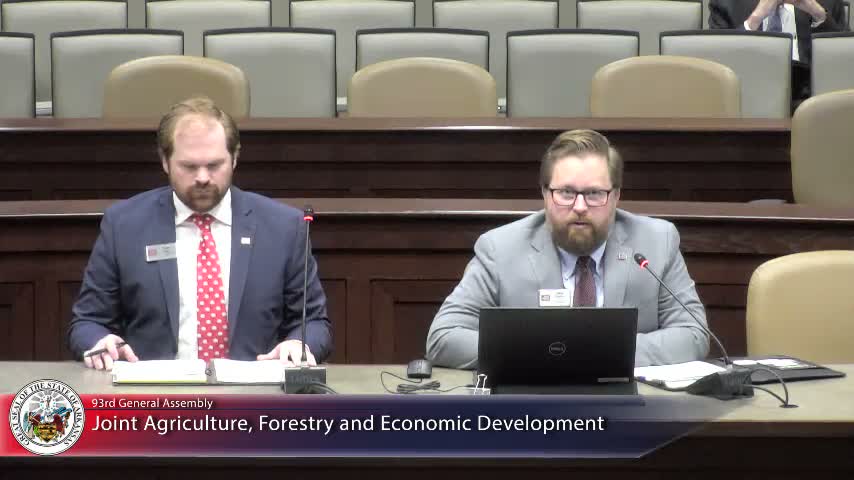
John McMinn and Tyler Ochsner of the Arkansas Farm Bureau Federation briefed the committee on how unusually low Mississippi River stages are disrupting grain movement, increasing freight costs and squeezing producers.
McMinn explained the central role of barge transport for U.S. grain exports and described how lower water levels force barges to move partially loaded or operate single‑lane traffic at choke points. He cited Army Corps figures on freight volumes and argued that constrained river navigation raises costs across the supply chain.
Tyler Ochsner explained the effect on basis — the difference between local elevator prices and futures — and described how storage and loading constraints have led some elevators to widen basis offers to deter deliveries. He said freight from St. Louis has risen from roughly $0.50 a bushel in prior seasons to about $3.50 a bushel in recent weeks for soybeans, which squeezes farmer returns and may force more expensive rail or truck movements.
In questions legislators raised fertilizer supply dependencies and domestic production. Farm Bureau witnesses said fertilizer import disruptions (global supply chain issues) complicate production and recommended resilience measures. The Farm Bureau closed by warning that persistent low levels could reroute export business to other countries and underscored continuing economic risk to Arkansas producers.
McMinn explained the central role of barge transport for U.S. grain exports and described how lower water levels force barges to move partially loaded or operate single‑lane traffic at choke points. He cited Army Corps figures on freight volumes and argued that constrained river navigation raises costs across the supply chain.
Tyler Ochsner explained the effect on basis — the difference between local elevator prices and futures — and described how storage and loading constraints have led some elevators to widen basis offers to deter deliveries. He said freight from St. Louis has risen from roughly $0.50 a bushel in prior seasons to about $3.50 a bushel in recent weeks for soybeans, which squeezes farmer returns and may force more expensive rail or truck movements.
In questions legislators raised fertilizer supply dependencies and domestic production. Farm Bureau witnesses said fertilizer import disruptions (global supply chain issues) complicate production and recommended resilience measures. The Farm Bureau closed by warning that persistent low levels could reroute export business to other countries and underscored continuing economic risk to Arkansas producers.
Don't Miss a Word: See the Full Meeting!
Go beyond summaries. Unlock every video, transcript, and key insight with a Founder Membership.
✓
Get instant access to full meeting videos
✓
Search and clip any phrase from complete transcripts
✓
Receive AI-powered summaries & custom alerts
✓
Enjoy lifetime, unrestricted access to government data
30-day money-back guarantee
