Committee approves bill letting Oil and Gas Commission regulate underground storage of CO2 and hydrogen; eminent domain for pore space clarified
February 09, 2023 | AGRICULTURE, FORESTRY & ECONOMIC DEVELOPMENT - SENATE, Senate, Committees, Legislative, Arkansas
This article was created by AI summarizing key points discussed. AI makes mistakes, so for full details and context, please refer to the video of the full meeting. Please report any errors so we can fix them. Report an error »
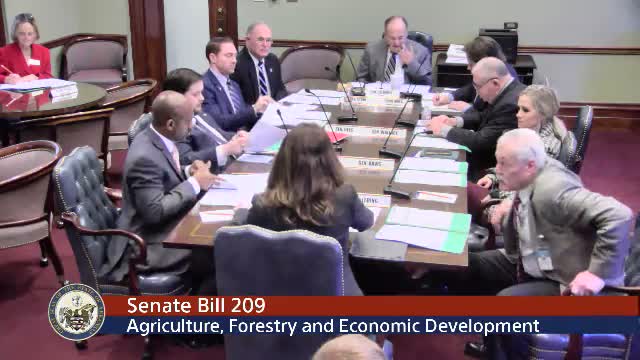
Senate Bill 210, sponsored by Senator Missy Irvin (District 24), received department testimony and passed the Agriculture, Forestry & Economic Development Committee after extended questioning about safety, regulatory steps and the bill's eminent-domain provisions.
"Right now, the natural gas storage laws in Arkansas give the Oil and Gas Commission authority to authorize and regulate the storage of natural gas," Shane Corey, secretary for the Arkansas Department of Energy and Environment, told the committee. He said SB210 would extend the commission's jurisdiction to other gases, specifically CO2 for carbon-capture and sequestration and hydrogen storage tied to regional hydrogen-hub efforts. Corey said that, if enacted, the state would likely pursue delegation (primacy) from the U.S. Environmental Protection Agency for Class VI wells; he estimated that process could take two to three years.
Committee members asked about safety and whether expanding the definition of "gas" to include hydrogen or CO2 changes regulatory requirements. Corey and Lawrence Mangum, chief administrator for energy programs at the Department and director of the Oil and Gas Commission, emphasized that the commission must promulgate rules, the process includes public comment and federal Class VI regulations would be adopted as necessary. "We would probably get a rule for each or amend a rule for new ones as they came in," Corey said.
On eminent domain and pore-space acquisition, Corey and Mangum said the bill does not decide ownership of pore space but provides a legal mechanism to acquire necessary rights when voluntary acquisition fails. "The eminent domain would only be used, however, if a company did not acquire all the rights in the area that they were going to inject into," Mangum said, adding a court would determine appropriate compensation or the project would not continue.
Members also pressed about surface impacts and depth. Mangum said storage is conducted subsurface and federal regulations require preventing gas migration; he cited target reservoirs in South Arkansas at about 8,000 to 17,000 feet and said operators would not be permitted where vertical migration could occur.
Senator Irvin framed the bill as an adaptation to industry realities and an opportunity for economic development tied to new technologies. After closing remarks, the committee moved to a voice vote on SB210; Senator Love seconded the motion and the chair declared the bill passed. The committee adjourned with no further business.
"Right now, the natural gas storage laws in Arkansas give the Oil and Gas Commission authority to authorize and regulate the storage of natural gas," Shane Corey, secretary for the Arkansas Department of Energy and Environment, told the committee. He said SB210 would extend the commission's jurisdiction to other gases, specifically CO2 for carbon-capture and sequestration and hydrogen storage tied to regional hydrogen-hub efforts. Corey said that, if enacted, the state would likely pursue delegation (primacy) from the U.S. Environmental Protection Agency for Class VI wells; he estimated that process could take two to three years.
Committee members asked about safety and whether expanding the definition of "gas" to include hydrogen or CO2 changes regulatory requirements. Corey and Lawrence Mangum, chief administrator for energy programs at the Department and director of the Oil and Gas Commission, emphasized that the commission must promulgate rules, the process includes public comment and federal Class VI regulations would be adopted as necessary. "We would probably get a rule for each or amend a rule for new ones as they came in," Corey said.
On eminent domain and pore-space acquisition, Corey and Mangum said the bill does not decide ownership of pore space but provides a legal mechanism to acquire necessary rights when voluntary acquisition fails. "The eminent domain would only be used, however, if a company did not acquire all the rights in the area that they were going to inject into," Mangum said, adding a court would determine appropriate compensation or the project would not continue.
Members also pressed about surface impacts and depth. Mangum said storage is conducted subsurface and federal regulations require preventing gas migration; he cited target reservoirs in South Arkansas at about 8,000 to 17,000 feet and said operators would not be permitted where vertical migration could occur.
Senator Irvin framed the bill as an adaptation to industry realities and an opportunity for economic development tied to new technologies. After closing remarks, the committee moved to a voice vote on SB210; Senator Love seconded the motion and the chair declared the bill passed. The committee adjourned with no further business.
View the Full Meeting & All Its Details
This article offers just a summary. Unlock complete video, transcripts, and insights as a Founder Member.
✓
Watch full, unedited meeting videos
✓
Search every word spoken in unlimited transcripts
✓
AI summaries & real-time alerts (all government levels)
✓
Permanent access to expanding government content
30-day money-back guarantee
