Committee passes HB 1182 as amended to create veterinary technician specialist role with limits
February 14, 2023 | AGRICULTURE, FORESTRY & ECONOMIC DEVELOPMENT - SENATE, Senate, Committees, Legislative, Arkansas
This article was created by AI summarizing key points discussed. AI makes mistakes, so for full details and context, please refer to the video of the full meeting. Please report any errors so we can fix them. Report an error »
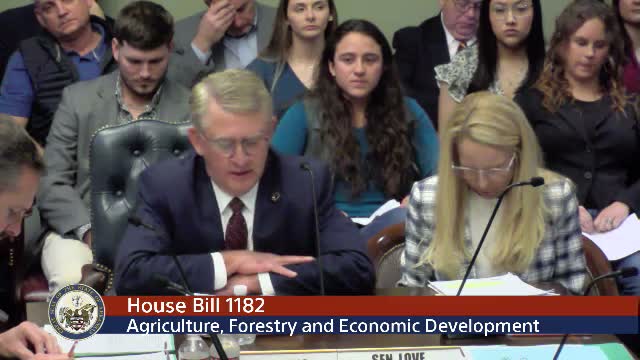
The Senate Agriculture, Forestry & Economic Development committee voted to pass House Bill 1182 as amended, a measure aimed at creating a distinct certification and scope of practice for "veterinary technician specialists" (VTS) to expand access to veterinary care in underserved areas of Arkansas.
Sponsor and amendment: Senator Ricky Hill, who introduced the bill to the committee, framed the measure as a response to a shortage of large-animal veterinarians in rural Arkansas and as a way to better serve livestock producers and pet owners in the Delta and other underserved regions. Representative Vaught presented and summarized a last-minute amendment that removed prescriptive authority from the bill, retracted a compensation provision, narrowed surgical language by removing the word "major," and added several safeguards that put vet tech specialists under the direct responsibility and supervision of a licensed veterinarian.
Scope and safeguards: As amended, HB 1182 authorizes a veterinary technician specialist to perform specialized veterinary technology under a written collaborative-practice agreement with a licensed veterinarian; the collaborating veterinarian remains "individually responsible and liable for the performance of the acts and omissions delegated" to the VTS. The amendment also:
- Prohibits VTSs from prescribing (the amendment removed prescriptive authority), and restricts compensation so VTSs may not take fees directly from clients (they may be paid only by the employing veterinarian).
- Bars a VTS from establishing a separate office independent from the veterinarian's regular office, though the bill permits field or on-route work within the collaborating practice context.
- Caps collaborations: a veterinarian may enter into a collaborative-practice agreement with no more than three VTSs at a time.
- Requires the collaborating veterinarian to personally see a new animal patient within 15 days to complete the veterinarian-client-patient relationship (VCPR).
- Allows VTSs to perform limited minor dental and surgical procedures but excludes abdominal, thoracic, orthopedic surgery and neurosurgery; it permits administration of drugs when done under the collaborating veterinarian's direction and in compliance with state and federal law. The amendment also requires informing clients in writing that the provider is not a veterinarian.
Support: Multiple veterinary technicians and candidates for VTS certification testified in favor. Meg Harrington, a credentialed veterinary technologist, told the committee "This bill would allow a BTS to establish a preliminary BCPR for a new animal patient on behalf of the veterinarian in order to go pull a calf" and said the bill would reduce animal suffering and increase access to emergency care in rural areas. Robin Roberts, a veterinary technician pursuing VTS certification, urged the committee to enact the bill to create career advancement and improve retention of credentialed technicians.
Opposition and concerns: The American Veterinary Medical Association (AVMA), represented by Dr. Kent McClure, said it supports veterinary technicians but opposes the bill as drafted because it creates a new practitioner category that could authorize diagnosis and treatment beyond training and raise food-safety and public-health risks. "We do oppose this bill," McClure said, adding that allowing VTSs to establish VCPRs or to make independent diagnostic decisions for new patients risks missed or delayed diagnoses with animal and economic consequences. Practicing veterinarians who testified (Dr. Chris Ashford/Ashworth and others) warned about federal controls on prescribing and the implications for food-animal drug withdrawal times; Ashford/Ashworth noted that federal agencies (FDA, DEA) constrain prescriptive authority for certain drugs.
Committee action and next step: After adopting the amendment (voice vote recorded as 'Aye'), the committee took immediate consideration and voted 'Aye' to pass HB 1182 as amended. The transcript records the committee voice vote but does not include a roll-call tally. The bill will move forward in the legislative process per Senate procedures.
What remains unclear: Transcript witnesses provided conflicting or differing numerical claims about workforce size and timelines (for example, supporters cited low veterinarian density in some regions; an AVMA witness said the number of actively licensed veterinarians is higher than some testimony suggested). The transcript does not contain a fiscal or regulatory analysis of the amendment's practical effects on malpractice coverage, drug-dispensing practices in the field, or possible changes in insurer underwriting; committee discussion flagged those as real-world implementation questions.
Sponsor and amendment: Senator Ricky Hill, who introduced the bill to the committee, framed the measure as a response to a shortage of large-animal veterinarians in rural Arkansas and as a way to better serve livestock producers and pet owners in the Delta and other underserved regions. Representative Vaught presented and summarized a last-minute amendment that removed prescriptive authority from the bill, retracted a compensation provision, narrowed surgical language by removing the word "major," and added several safeguards that put vet tech specialists under the direct responsibility and supervision of a licensed veterinarian.
Scope and safeguards: As amended, HB 1182 authorizes a veterinary technician specialist to perform specialized veterinary technology under a written collaborative-practice agreement with a licensed veterinarian; the collaborating veterinarian remains "individually responsible and liable for the performance of the acts and omissions delegated" to the VTS. The amendment also:
- Prohibits VTSs from prescribing (the amendment removed prescriptive authority), and restricts compensation so VTSs may not take fees directly from clients (they may be paid only by the employing veterinarian).
- Bars a VTS from establishing a separate office independent from the veterinarian's regular office, though the bill permits field or on-route work within the collaborating practice context.
- Caps collaborations: a veterinarian may enter into a collaborative-practice agreement with no more than three VTSs at a time.
- Requires the collaborating veterinarian to personally see a new animal patient within 15 days to complete the veterinarian-client-patient relationship (VCPR).
- Allows VTSs to perform limited minor dental and surgical procedures but excludes abdominal, thoracic, orthopedic surgery and neurosurgery; it permits administration of drugs when done under the collaborating veterinarian's direction and in compliance with state and federal law. The amendment also requires informing clients in writing that the provider is not a veterinarian.
Support: Multiple veterinary technicians and candidates for VTS certification testified in favor. Meg Harrington, a credentialed veterinary technologist, told the committee "This bill would allow a BTS to establish a preliminary BCPR for a new animal patient on behalf of the veterinarian in order to go pull a calf" and said the bill would reduce animal suffering and increase access to emergency care in rural areas. Robin Roberts, a veterinary technician pursuing VTS certification, urged the committee to enact the bill to create career advancement and improve retention of credentialed technicians.
Opposition and concerns: The American Veterinary Medical Association (AVMA), represented by Dr. Kent McClure, said it supports veterinary technicians but opposes the bill as drafted because it creates a new practitioner category that could authorize diagnosis and treatment beyond training and raise food-safety and public-health risks. "We do oppose this bill," McClure said, adding that allowing VTSs to establish VCPRs or to make independent diagnostic decisions for new patients risks missed or delayed diagnoses with animal and economic consequences. Practicing veterinarians who testified (Dr. Chris Ashford/Ashworth and others) warned about federal controls on prescribing and the implications for food-animal drug withdrawal times; Ashford/Ashworth noted that federal agencies (FDA, DEA) constrain prescriptive authority for certain drugs.
Committee action and next step: After adopting the amendment (voice vote recorded as 'Aye'), the committee took immediate consideration and voted 'Aye' to pass HB 1182 as amended. The transcript records the committee voice vote but does not include a roll-call tally. The bill will move forward in the legislative process per Senate procedures.
What remains unclear: Transcript witnesses provided conflicting or differing numerical claims about workforce size and timelines (for example, supporters cited low veterinarian density in some regions; an AVMA witness said the number of actively licensed veterinarians is higher than some testimony suggested). The transcript does not contain a fiscal or regulatory analysis of the amendment's practical effects on malpractice coverage, drug-dispensing practices in the field, or possible changes in insurer underwriting; committee discussion flagged those as real-world implementation questions.
Don't Miss a Word: See the Full Meeting!
Go beyond summaries. Unlock every video, transcript, and key insight with a Founder Membership.
✓
Get instant access to full meeting videos
✓
Search and clip any phrase from complete transcripts
✓
Receive AI-powered summaries & custom alerts
✓
Enjoy lifetime, unrestricted access to government data
30-day money-back guarantee
