Senate committee rejects bill to allow VCPR by telemedicine after testimony on risks and access
February 28, 2023 | AGRICULTURE, FORESTRY & ECONOMIC DEVELOPMENT - SENATE, Senate, Committees, Legislative, Arkansas
This article was created by AI summarizing key points discussed. AI makes mistakes, so for full details and context, please refer to the video of the full meeting. Please report any errors so we can fix them. Report an error »
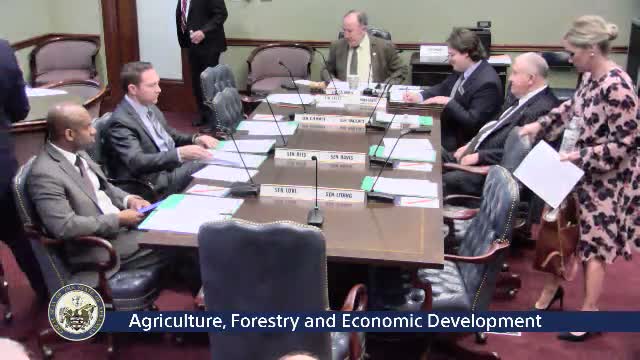
Little Rock — A Senate committee on agriculture debated a bill by Sen. Ricky Hill that would permit a veterinarian to establish a veterinary‑client‑patient relationship (VCPR) via telemedicine, but after extensive testimony the committee voted and the motion to pass the bill as amended failed.
Hill, a Republican from Senate District 11, told the committee the proposal is voluntary for veterinarians and designed to expand access in underserved parts of the state, particularly eastern and southern Arkansas. "We have a shortage of veterinarians out here," Hill said, arguing telemedicine could help economically challenged families who cannot easily reach a clinic.
Opponents included representatives of the Arkansas Veterinary Medical Association and witnesses from the private sector who warned remote establishment of a VCPR could increase misdiagnosis and public‑health risk. Bruce Holland, representing the American Veterinary Medical Association, testified the bill "will ultimately lead to misdiagnosis, unnecessary suffering and death of pets as well as farm animals," and raised concerns about inappropriate prescribing and antibiotic resistance.
Jordan Fireborn, government affairs director for Merck, told the committee his company does not oppose telemedicine when an in‑person relationship already exists but opposes virtual establishment of the VCPR. "We wanna make sure that that first visit is established in person, that that veterinarian has a good understanding of the client and the patient," Fireborn said.
Veterinary witnesses including Rodney Baker (Arkansas Veterinary Medical Association) and Dr. Michael Lyles, a practicing clinician, described legal and clinical limits on teleprescribing. They noted federal rules—enforced by the FDA and other agencies—continue to require in‑person contact for medicated feed, off‑label drug use and certain compounding. Dr. Lyles gave concrete examples where remote assessment missed life‑threatening conditions, and said providers lacked comprehensive outcome data from the COVID era to show remote VCPR establishment was safe.
Hill acknowledged those concerns and said the bill would not supersede federal limits on medicated feed or compounding. He also said rulemaking would define acceptable telemedicine practices, and that veterinarians retain professional judgment to require an in‑person exam. "The veterinarian has a choice. A choice to do this. A choice to not do it," Hill said.
After debate and adoption of an amendment that removed an in‑state residency requirement and clarified licensing, the committee moved to "do pass as amended." A roll call recorded several aye votes but fell short of the required number; the chair announced the bill did not pass.
The hearing included numerous clinical examples and back‑and‑forth questions from senators about the balance between improving access for rural producers and protecting public and animal health. Committee members asked witnesses for data on outcomes from telemedicine usage during the COVID public‑health emergency; witnesses said no comprehensive statewide dataset was available at the hearing.
The committee adjourned with Sen. Hill saying he could bring the issue back and with offers from the Department of Agriculture to follow up on enforcement and workforce questions.
What happened next: The committee voted against advancing Hill's bill as amended, leaving the bill without committee approval; proponents said they may revise or refile language to address oversight and enforcement.
Sources: Committee hearing transcript, testimony from Sen. Ricky Hill; Bruce Holland (AMVA); Jordan Fireborn (Merck); Rodney Baker and Dr. Michael Lyles (Arkansas Veterinary Medical Association); West Ford (Arkansas Department of Agriculture).
Hill, a Republican from Senate District 11, told the committee the proposal is voluntary for veterinarians and designed to expand access in underserved parts of the state, particularly eastern and southern Arkansas. "We have a shortage of veterinarians out here," Hill said, arguing telemedicine could help economically challenged families who cannot easily reach a clinic.
Opponents included representatives of the Arkansas Veterinary Medical Association and witnesses from the private sector who warned remote establishment of a VCPR could increase misdiagnosis and public‑health risk. Bruce Holland, representing the American Veterinary Medical Association, testified the bill "will ultimately lead to misdiagnosis, unnecessary suffering and death of pets as well as farm animals," and raised concerns about inappropriate prescribing and antibiotic resistance.
Jordan Fireborn, government affairs director for Merck, told the committee his company does not oppose telemedicine when an in‑person relationship already exists but opposes virtual establishment of the VCPR. "We wanna make sure that that first visit is established in person, that that veterinarian has a good understanding of the client and the patient," Fireborn said.
Veterinary witnesses including Rodney Baker (Arkansas Veterinary Medical Association) and Dr. Michael Lyles, a practicing clinician, described legal and clinical limits on teleprescribing. They noted federal rules—enforced by the FDA and other agencies—continue to require in‑person contact for medicated feed, off‑label drug use and certain compounding. Dr. Lyles gave concrete examples where remote assessment missed life‑threatening conditions, and said providers lacked comprehensive outcome data from the COVID era to show remote VCPR establishment was safe.
Hill acknowledged those concerns and said the bill would not supersede federal limits on medicated feed or compounding. He also said rulemaking would define acceptable telemedicine practices, and that veterinarians retain professional judgment to require an in‑person exam. "The veterinarian has a choice. A choice to do this. A choice to not do it," Hill said.
After debate and adoption of an amendment that removed an in‑state residency requirement and clarified licensing, the committee moved to "do pass as amended." A roll call recorded several aye votes but fell short of the required number; the chair announced the bill did not pass.
The hearing included numerous clinical examples and back‑and‑forth questions from senators about the balance between improving access for rural producers and protecting public and animal health. Committee members asked witnesses for data on outcomes from telemedicine usage during the COVID public‑health emergency; witnesses said no comprehensive statewide dataset was available at the hearing.
The committee adjourned with Sen. Hill saying he could bring the issue back and with offers from the Department of Agriculture to follow up on enforcement and workforce questions.
What happened next: The committee voted against advancing Hill's bill as amended, leaving the bill without committee approval; proponents said they may revise or refile language to address oversight and enforcement.
Sources: Committee hearing transcript, testimony from Sen. Ricky Hill; Bruce Holland (AMVA); Jordan Fireborn (Merck); Rodney Baker and Dr. Michael Lyles (Arkansas Veterinary Medical Association); West Ford (Arkansas Department of Agriculture).
Don't Miss a Word: See the Full Meeting!
Go beyond summaries. Unlock every video, transcript, and key insight with a Founder Membership.
✓
Get instant access to full meeting videos
✓
Search and clip any phrase from complete transcripts
✓
Receive AI-powered summaries & custom alerts
✓
Enjoy lifetime, unrestricted access to government data
30-day money-back guarantee
