Committee advances sweeping Department of Agriculture reorganization after contested forester testimony
March 28, 2023 | AGRICULTURE, FORESTRY & ECONOMIC DEVELOPMENT - SENATE, Senate, Committees, Legislative, Arkansas
This article was created by AI summarizing key points discussed. AI makes mistakes, so for full details and context, please refer to the video of the full meeting. Please report any errors so we can fix them. Report an error »
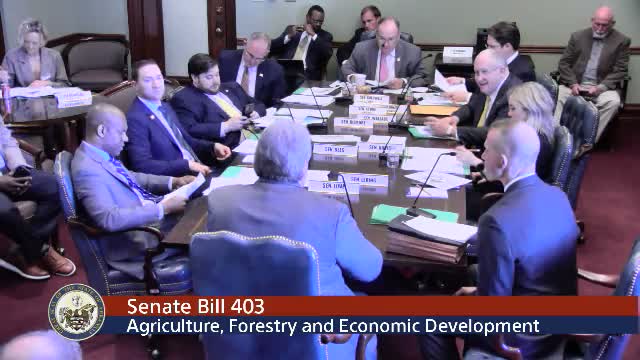
The Senate Agriculture Committee advanced a broad reorganization of the Department of Agriculture (SB403 as amended) after extended debate and multiple expert witnesses raised concerns about professional licensing for foresters.
Sen. Blake Johnson said the bill narrows 16 boards and commissions into four main categories (Arkansas Forestry Commission, Livestock and Poultry Commission, Natural Resources Commission and State Plant Board) and creates several subcommittees, including a Veterinary Licensing Subcommittee and a Registered Forester Subcommittee. An amendment adopted in committee clarified fund transfers, preserved the Red River navigation feasibility study with a July 2026 sunset, adjusted boll weevil board membership and required certain appointments be confirmed by the Senate.
Sponsors and agency staff said the changes correct constitutional problems in the current statutory structure and that subcommittees would operate akin to historical plant‑board subcommittees: they may draft rules but the overall commission retains authority to approve rules and licensing decisions.
Several foresters—Greg Hay (consulting forester), Mary Clapp (former board chair) and Dr. Matthew Pelkey (University of Arkansas at Monticello)—urged rejection or revision. They argued that abolishing the formal Board of Registration for Foresters and placing licensing responsibilities under a politically appointed Forestry Commission risks lowering technical standards, undermining reciprocity with other states, creating ethical conflicts when the commission oversees foresters it employs, and harming industry confidence and certification programs.
Greg Hay recommended either preserving the independent registration board or specifying that the subcommittee be composed of experienced registered foresters (he recommended a majority with at least 12 years of experience). Dr. Pelkey emphasized academic and professional autonomy concerns, saying universities should not have licensing exams written or effectively controlled by an administrative commission.
Sen. Johnson rejected the claim that the bill would automatically weaken standards, noted the amendment added protections and said sponsors would revisit language if problems arise. The committee moved and approved the bill as amended by voice vote.
What happens next: SB403 proceeds with committee approval. Sponsors and agency staff said implementation will require rulemaking and that they intend to monitor for unintended consequences; forester groups asked for continued stakeholder engagement before floor action.
Sen. Blake Johnson said the bill narrows 16 boards and commissions into four main categories (Arkansas Forestry Commission, Livestock and Poultry Commission, Natural Resources Commission and State Plant Board) and creates several subcommittees, including a Veterinary Licensing Subcommittee and a Registered Forester Subcommittee. An amendment adopted in committee clarified fund transfers, preserved the Red River navigation feasibility study with a July 2026 sunset, adjusted boll weevil board membership and required certain appointments be confirmed by the Senate.
Sponsors and agency staff said the changes correct constitutional problems in the current statutory structure and that subcommittees would operate akin to historical plant‑board subcommittees: they may draft rules but the overall commission retains authority to approve rules and licensing decisions.
Several foresters—Greg Hay (consulting forester), Mary Clapp (former board chair) and Dr. Matthew Pelkey (University of Arkansas at Monticello)—urged rejection or revision. They argued that abolishing the formal Board of Registration for Foresters and placing licensing responsibilities under a politically appointed Forestry Commission risks lowering technical standards, undermining reciprocity with other states, creating ethical conflicts when the commission oversees foresters it employs, and harming industry confidence and certification programs.
Greg Hay recommended either preserving the independent registration board or specifying that the subcommittee be composed of experienced registered foresters (he recommended a majority with at least 12 years of experience). Dr. Pelkey emphasized academic and professional autonomy concerns, saying universities should not have licensing exams written or effectively controlled by an administrative commission.
Sen. Johnson rejected the claim that the bill would automatically weaken standards, noted the amendment added protections and said sponsors would revisit language if problems arise. The committee moved and approved the bill as amended by voice vote.
What happens next: SB403 proceeds with committee approval. Sponsors and agency staff said implementation will require rulemaking and that they intend to monitor for unintended consequences; forester groups asked for continued stakeholder engagement before floor action.
Don't Miss a Word: See the Full Meeting!
Go beyond summaries. Unlock every video, transcript, and key insight with a Founder Membership.
✓
Get instant access to full meeting videos
✓
Search and clip any phrase from complete transcripts
✓
Receive AI-powered summaries & custom alerts
✓
Enjoy lifetime, unrestricted access to government data
30-day money-back guarantee
