Growers tell senators state stepped in to depopulate birds after Cooks Venture’s collapse; committee presses agency on cleanup, authority and accountability
February 09, 2024 | AGRICULTURE, FORESTRY & ECONOMIC DEVELOPMENT - SENATE, Senate, Committees, Legislative, Arkansas
This article was created by AI summarizing key points discussed. AI makes mistakes, so for full details and context, please refer to the video of the full meeting. Please report any errors so we can fix them. Report an error »
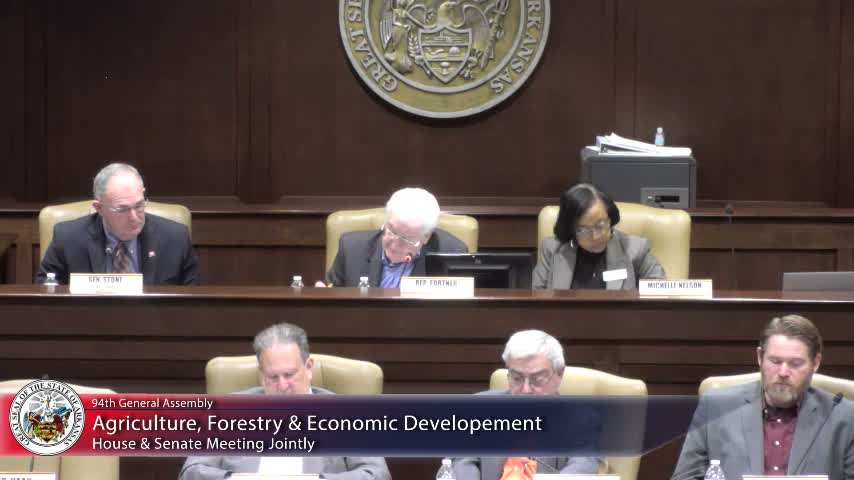
Former contract growers who appeared before the Senate Agriculture Committee described confusion, missed communications and economic losses after Cooks Venture faltered and the state intervened to depopulate and dispose of birds.
"My birds were only 13 old. I was not aware that the state was coming until 12 hours before they got there to depopulate my chickens," said Leslie Harp, a former grower for Cooks Venture, describing poultry that she said had passed routine USDA biosecurity checks and for which she had feed and utilities available. Harp said farmers asked to keep birds until they could be processed for food and were denied, and she estimated that, had her flock reached processing weight, the loss would have been hundreds of thousands of pounds of meat.
Lance Logan, another former grower, described repeated failures to provide hauling equipment for euthanized birds and said he locked his gate until reliable transport was confirmed. "I wouldn't let them foam my chickens until they had a way to haul the chickens off," Logan said; he and others said growers were left to manage decomposing birds in houses before removal arrangements were made.
Dustin Mabey, also a former Cooks grower, said his market‑weight birds were tested repeatedly and "My birds never had AI," and that some growers who had birds euthanized were not compensated and continue to await payment. He asked the state to consider assistance for growers harmed by the company’s failure.
Patrick Fisk, director of Livestock and Poultry at the Arkansas Department of Agriculture, explained the agency’s role: Arkansas recorded its first high‑path avian influenza case on Oct. 30, and the department received a call the day before Thanksgiving that Cooks Venture had stopped operating and growers were without resources. Fisk said some growers had birds too young to process and that the company asked for state assistance; the department moved to depopulate flocks when processing or safe redistribution was infeasible and supervised sanitary disposal measures such as in‑house composting and permitted off‑site burial.
"We acted on the best interest of the state as a whole because of welfare considerations," Fisk said, adding that the department both supervised and assisted when resources permitted and that disposal methods were selected to eliminate virus risk through heat generated by composting where possible.
Senators and representatives pressed the department on its statutory authority and on why the state depopulated birds but did not complete removal and cleanup in every case. Members repeatedly cited Ark. Code 2‑33‑107 and asked whether the department’s statutory role was limited to supervision of sanitary work and whether the state had an obligation to also fund or carry out complete cleanup. Secretary West Ward and Fisk said the law gives the department authority to act and that resource constraints limited what the department could do directly; they said the Livestock and Poultry Commission has penalty authority and that the department will investigate complaints and pursue compliance actions.
Committee members asked what civil recourse growers have against Cooks Venture; the department described civil avenues and said the agency will present compliance findings to the Livestock and Poultry Commission, which has enforcement tools. Fisk said the cost to the state for the response so far is roughly $77,000.
Lawmakers from both parties expressed sympathy for affected growers and urged prompt review of statutes and rulemaking or legislation to ensure the state is not left with an incomplete depopulation cleanup and uncompensated growers in future incidents. Representative Beatty and others urged the committee to study whether state law should be revised so that, if the state exercises eradication authority for animal welfare or disease control, the cleanup phase and associated costs are clear and funded.
"My birds were only 13 old. I was not aware that the state was coming until 12 hours before they got there to depopulate my chickens," said Leslie Harp, a former grower for Cooks Venture, describing poultry that she said had passed routine USDA biosecurity checks and for which she had feed and utilities available. Harp said farmers asked to keep birds until they could be processed for food and were denied, and she estimated that, had her flock reached processing weight, the loss would have been hundreds of thousands of pounds of meat.
Lance Logan, another former grower, described repeated failures to provide hauling equipment for euthanized birds and said he locked his gate until reliable transport was confirmed. "I wouldn't let them foam my chickens until they had a way to haul the chickens off," Logan said; he and others said growers were left to manage decomposing birds in houses before removal arrangements were made.
Dustin Mabey, also a former Cooks grower, said his market‑weight birds were tested repeatedly and "My birds never had AI," and that some growers who had birds euthanized were not compensated and continue to await payment. He asked the state to consider assistance for growers harmed by the company’s failure.
Patrick Fisk, director of Livestock and Poultry at the Arkansas Department of Agriculture, explained the agency’s role: Arkansas recorded its first high‑path avian influenza case on Oct. 30, and the department received a call the day before Thanksgiving that Cooks Venture had stopped operating and growers were without resources. Fisk said some growers had birds too young to process and that the company asked for state assistance; the department moved to depopulate flocks when processing or safe redistribution was infeasible and supervised sanitary disposal measures such as in‑house composting and permitted off‑site burial.
"We acted on the best interest of the state as a whole because of welfare considerations," Fisk said, adding that the department both supervised and assisted when resources permitted and that disposal methods were selected to eliminate virus risk through heat generated by composting where possible.
Senators and representatives pressed the department on its statutory authority and on why the state depopulated birds but did not complete removal and cleanup in every case. Members repeatedly cited Ark. Code 2‑33‑107 and asked whether the department’s statutory role was limited to supervision of sanitary work and whether the state had an obligation to also fund or carry out complete cleanup. Secretary West Ward and Fisk said the law gives the department authority to act and that resource constraints limited what the department could do directly; they said the Livestock and Poultry Commission has penalty authority and that the department will investigate complaints and pursue compliance actions.
Committee members asked what civil recourse growers have against Cooks Venture; the department described civil avenues and said the agency will present compliance findings to the Livestock and Poultry Commission, which has enforcement tools. Fisk said the cost to the state for the response so far is roughly $77,000.
Lawmakers from both parties expressed sympathy for affected growers and urged prompt review of statutes and rulemaking or legislation to ensure the state is not left with an incomplete depopulation cleanup and uncompensated growers in future incidents. Representative Beatty and others urged the committee to study whether state law should be revised so that, if the state exercises eradication authority for animal welfare or disease control, the cleanup phase and associated costs are clear and funded.
View the Full Meeting & All Its Details
This article offers just a summary. Unlock complete video, transcripts, and insights as a Founder Member.
✓
Watch full, unedited meeting videos
✓
Search every word spoken in unlimited transcripts
✓
AI summaries & real-time alerts (all government levels)
✓
Permanent access to expanding government content
30-day money-back guarantee
