Senate Education Committee advances bill letting districts meet instructional hours instead of days, sets no-earlier-than Labor Day limit
April 05, 2021 | EDUCATION COMMITTEE - SENATE, Senate, Committees, Legislative, Arkansas
This article was created by AI summarizing key points discussed. AI makes mistakes, so for full details and context, please refer to the video of the full meeting. Please report any errors so we can fix them. Report an error »
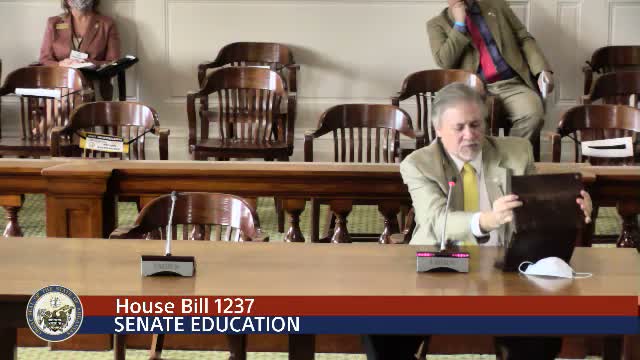
The Senate Education Committee on voice vote advanced House Bill 12-37 on a bipartisan motion after more than an hour of testimony and questions about calendar, funding and impacts for rural schools.
Representative Mark Lowry, sponsor of the bill, said the measure would allow districts to meet the state's minimum instructional requirement by counting hours rather than days and would prohibit public schools from beginning earlier than the Monday two weeks before Labor Day. "The flexibility is there," Lowry said, adding that districts could lengthen the school day, add the lost week to the end of the year or adopt other schedules to meet required hours.
Johnny Key of the Arkansas Department of Education told the committee that the department's eSchool and eFinance systems can adapt to an hours-based approach and that the bill contains conversion language to protect funding calculations such as average daily membership and employment-contract requirements.
Stacy Hurst, secretary of the Arkansas Department of Parks, Heritage and Tourism, urged support for the measure on economic grounds, citing a department study that estimated earlier starts were associated with lower travel expenditures and job losses in tourism. "Tourism is the second largest sector of the Arkansas economy," Hurst said, urging flexibility that could help recovery after COVID-19.
Opponents, including Rep. David Tollett (also superintendent of Barton School District), warned the bill would remove an avenue—Act 1240 early-start waivers—that some rural districts rely on to provide extra days before higher-education schedules begin. Tollett said his district uses the earlier start to enroll low-income students in concurrent-credit classes, pay tuition and transportation costs, and provide athletic and safety coordination. "Those two lines [prohibiting the waiver] would be detrimental to us," he said.
Committee members pressed for detail on the calculations behind the hours conversion and on impacts for noncertified staff paid on hourly or daily schedules. Department officials acknowledged some transportation funding formulas (enhanced transportation) could be affected and said bureau-level determinations would follow.
Lawmakers discussed alternative routes for affected districts: the School of Innovation designation and conversion charters, which Department staff said can provide waiver-like relief but require a planning process. The Department indicated it would consider a one-year Act 1240 waiver for affected districts while they pursue a longer-term solution.
The committee recorded the bill as advancing by voice vote; no roll-call tally was recorded in the hearing transcript. HB12-37 is scheduled to move to the next legislative step in the senate.
The committee also noted the bill's effective date is the 2022-23 school year and that the measure carries no emergency clause, giving districts and institutions time to adapt.
Representative Mark Lowry, sponsor of the bill, said the measure would allow districts to meet the state's minimum instructional requirement by counting hours rather than days and would prohibit public schools from beginning earlier than the Monday two weeks before Labor Day. "The flexibility is there," Lowry said, adding that districts could lengthen the school day, add the lost week to the end of the year or adopt other schedules to meet required hours.
Johnny Key of the Arkansas Department of Education told the committee that the department's eSchool and eFinance systems can adapt to an hours-based approach and that the bill contains conversion language to protect funding calculations such as average daily membership and employment-contract requirements.
Stacy Hurst, secretary of the Arkansas Department of Parks, Heritage and Tourism, urged support for the measure on economic grounds, citing a department study that estimated earlier starts were associated with lower travel expenditures and job losses in tourism. "Tourism is the second largest sector of the Arkansas economy," Hurst said, urging flexibility that could help recovery after COVID-19.
Opponents, including Rep. David Tollett (also superintendent of Barton School District), warned the bill would remove an avenue—Act 1240 early-start waivers—that some rural districts rely on to provide extra days before higher-education schedules begin. Tollett said his district uses the earlier start to enroll low-income students in concurrent-credit classes, pay tuition and transportation costs, and provide athletic and safety coordination. "Those two lines [prohibiting the waiver] would be detrimental to us," he said.
Committee members pressed for detail on the calculations behind the hours conversion and on impacts for noncertified staff paid on hourly or daily schedules. Department officials acknowledged some transportation funding formulas (enhanced transportation) could be affected and said bureau-level determinations would follow.
Lawmakers discussed alternative routes for affected districts: the School of Innovation designation and conversion charters, which Department staff said can provide waiver-like relief but require a planning process. The Department indicated it would consider a one-year Act 1240 waiver for affected districts while they pursue a longer-term solution.
The committee recorded the bill as advancing by voice vote; no roll-call tally was recorded in the hearing transcript. HB12-37 is scheduled to move to the next legislative step in the senate.
The committee also noted the bill's effective date is the 2022-23 school year and that the measure carries no emergency clause, giving districts and institutions time to adapt.
View the Full Meeting & All Its Details
This article offers just a summary. Unlock complete video, transcripts, and insights as a Founder Member.
✓
Watch full, unedited meeting videos
✓
Search every word spoken in unlimited transcripts
✓
AI summaries & real-time alerts (all government levels)
✓
Permanent access to expanding government content
30-day money-back guarantee
