Restoring 2.5 GPA route for lottery scholarships stalls amid equity debate and large fiscal estimate
April 19, 2021 | EDUCATION COMMITTEE - SENATE, Senate, Committees, Legislative, Arkansas
This article was created by AI summarizing key points discussed. AI makes mistakes, so for full details and context, please refer to the video of the full meeting. Please report any errors so we can fix them. Report an error »
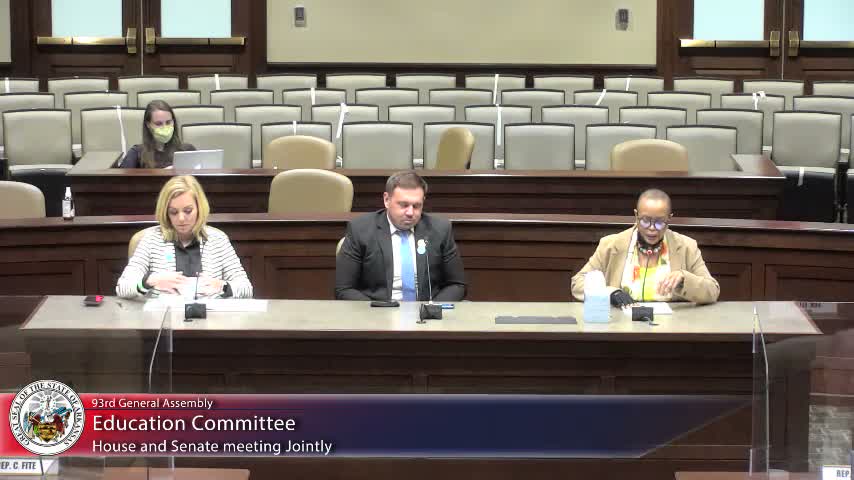
Senate Bill 4 62, a proposal to restore a 2.5 GPA eligibility route alongside the ACT‑score threshold for Arkansas Academic Challenge scholarships, failed to win the committee's approval after extended debate about equity, predictive measures and fiscal cost.
Senator Joyce Elliott, sponsor of SB 4 62, framed the measure as corrective: she said removing the GPA route disproportionately excluded students of color and that the ACT‑only threshold treats scholarships as a "chance"‑based outcome. "We made a promise to them, and we broke it," Elliott said, urging restoration of the GPA criterion to reduce racial and socioeconomic disparities in award distribution.
Committee members and witnesses discussed research on standardized testing bias, classroom mitigation strategies, and which metric best predicts college persistence. Maria Markham and Division of Higher Education analytics noted an ACT score of 19 roughly corresponds to a high‑school GPA of about 2.74; staff said ACT 19 is in part a policy and affordability choice rather than a purely predictive one.
Fiscal staff explained the $38.5 million fiscal impact: using public‑school data, they estimated about 2,750 additional students per year would be eligible under a restored 2.5 GPA path (a conservative 'maximum' estimate used to compute a multi‑year cumulative cost). Members questioned whether the estimate assumed full take‑up (every eligible student enrolling and applying); staff said the figure was intentionally conservative to present a maximum possible cost.
After sponsor closings, the roll call recorded ayes from Senators Chesterfield, Lehi, Beckham and Elliott; with other members not voting, the chair announced the result as 4 ayes and 4 non‑voting and said the bill did not pass.
Senator Joyce Elliott, sponsor of SB 4 62, framed the measure as corrective: she said removing the GPA route disproportionately excluded students of color and that the ACT‑only threshold treats scholarships as a "chance"‑based outcome. "We made a promise to them, and we broke it," Elliott said, urging restoration of the GPA criterion to reduce racial and socioeconomic disparities in award distribution.
Committee members and witnesses discussed research on standardized testing bias, classroom mitigation strategies, and which metric best predicts college persistence. Maria Markham and Division of Higher Education analytics noted an ACT score of 19 roughly corresponds to a high‑school GPA of about 2.74; staff said ACT 19 is in part a policy and affordability choice rather than a purely predictive one.
Fiscal staff explained the $38.5 million fiscal impact: using public‑school data, they estimated about 2,750 additional students per year would be eligible under a restored 2.5 GPA path (a conservative 'maximum' estimate used to compute a multi‑year cumulative cost). Members questioned whether the estimate assumed full take‑up (every eligible student enrolling and applying); staff said the figure was intentionally conservative to present a maximum possible cost.
After sponsor closings, the roll call recorded ayes from Senators Chesterfield, Lehi, Beckham and Elliott; with other members not voting, the chair announced the result as 4 ayes and 4 non‑voting and said the bill did not pass.
Don't Miss a Word: See the Full Meeting!
Go beyond summaries. Unlock every video, transcript, and key insight with a Founder Membership.
✓
Get instant access to full meeting videos
✓
Search and clip any phrase from complete transcripts
✓
Receive AI-powered summaries & custom alerts
✓
Enjoy lifetime, unrestricted access to government data
30-day money-back guarantee
