Senate Education Committee reviews K–12 adequacy funding matrix and gaps
February 07, 2022 | EDUCATION COMMITTEE - SENATE, Senate, Committees, Legislative, Arkansas
This article was created by AI summarizing key points discussed. AI makes mistakes, so for full details and context, please refer to the video of the full meeting. Please report any errors so we can fix them. Report an error »
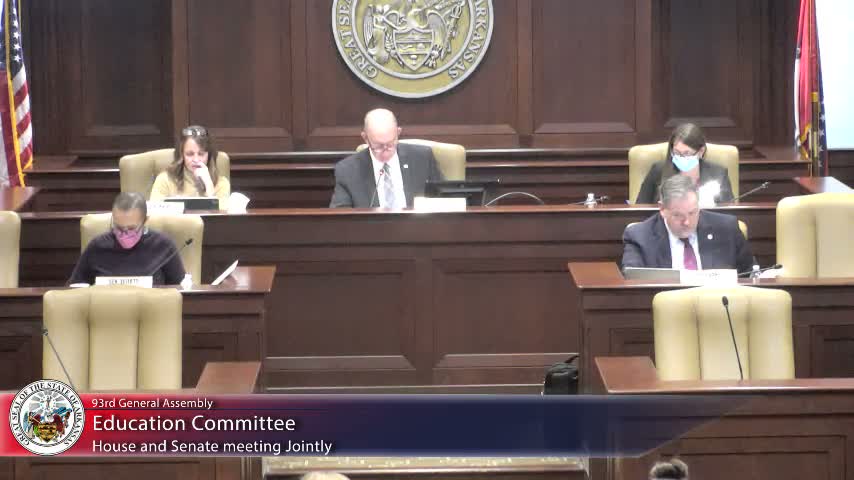
The Senate Education Committee on Wednesday heard a detailed briefing from bureau analysts about how Arkansas funds public schools and where the state’s adequacy funding falls short.
Julie Holt of the Bureau opened the presentation by framing the adequacy study and the matrix used to calculate per‑pupil foundation funding, saying staff wanted to “tell the story of adequacy from beginning to end.” The bureau said foundation funding accounted for about 62% of state‑level support in 2021, with categorical programs roughly 5% and supplemental grants about 2%, while ‘‘other’’ local, state and federal funds made up the remainder.
Why it matters: the matrix is built on a prototypical 500‑student school. Bureau analysts said the model works statistically for some calculations but can undercount needs in Arkansas, where 70% of schools had fewer than 500 students in 2021. That mismatch affects how many teachers, specialists and other staff are funded for smaller schools and districts.
Key findings from the briefing included that the matrix funds fewer classroom teachers at elementary and high‑school levels than evidence‑based models recommend and that the matrix does not consistently capture resources districts receive from local or federal sources. Katie Walden of the Bureau’s Fiscal Division walked members through the Public School Fund, the Educational Excellence Trust Fund, the Educational Adequacy Fund (created after the Lakeview decisions) and other state accounts that feed foundation and categorical aid.
Lawmakers pressed staff on two recurring themes: whether the bureau’s resource recommendations reflect the most recent research, and how pandemic‑era changes (notably increased federal aid and expanded virtual enrollment for some charters) should affect long‑term adequacy assumptions. Staff said much of the underlying research draws on recent evidence‑based models (including a 2020 synthesis cited in the report) but acknowledged some data predate COVID and that pandemic effects require careful follow‑up.
The committee requested further analysis disaggregating superintendent survey responses and funding by school and district size, and a spending‑pattern briefing scheduled for the next day to compare statutory intent with actual district expenditures. The meeting concluded with a series of follow‑ups on special education, Solution Tree professional development participation, and transportation formulas.
Next steps: bureau staff agreed to provide lists of Solution Tree participant schools, further analyses by district size, and an updated special education report.
Julie Holt of the Bureau opened the presentation by framing the adequacy study and the matrix used to calculate per‑pupil foundation funding, saying staff wanted to “tell the story of adequacy from beginning to end.” The bureau said foundation funding accounted for about 62% of state‑level support in 2021, with categorical programs roughly 5% and supplemental grants about 2%, while ‘‘other’’ local, state and federal funds made up the remainder.
Why it matters: the matrix is built on a prototypical 500‑student school. Bureau analysts said the model works statistically for some calculations but can undercount needs in Arkansas, where 70% of schools had fewer than 500 students in 2021. That mismatch affects how many teachers, specialists and other staff are funded for smaller schools and districts.
Key findings from the briefing included that the matrix funds fewer classroom teachers at elementary and high‑school levels than evidence‑based models recommend and that the matrix does not consistently capture resources districts receive from local or federal sources. Katie Walden of the Bureau’s Fiscal Division walked members through the Public School Fund, the Educational Excellence Trust Fund, the Educational Adequacy Fund (created after the Lakeview decisions) and other state accounts that feed foundation and categorical aid.
Lawmakers pressed staff on two recurring themes: whether the bureau’s resource recommendations reflect the most recent research, and how pandemic‑era changes (notably increased federal aid and expanded virtual enrollment for some charters) should affect long‑term adequacy assumptions. Staff said much of the underlying research draws on recent evidence‑based models (including a 2020 synthesis cited in the report) but acknowledged some data predate COVID and that pandemic effects require careful follow‑up.
The committee requested further analysis disaggregating superintendent survey responses and funding by school and district size, and a spending‑pattern briefing scheduled for the next day to compare statutory intent with actual district expenditures. The meeting concluded with a series of follow‑ups on special education, Solution Tree professional development participation, and transportation formulas.
Next steps: bureau staff agreed to provide lists of Solution Tree participant schools, further analyses by district size, and an updated special education report.
Don't Miss a Word: See the Full Meeting!
Go beyond summaries. Unlock every video, transcript, and key insight with a Founder Membership.
✓
Get instant access to full meeting videos
✓
Search and clip any phrase from complete transcripts
✓
Receive AI-powered summaries & custom alerts
✓
Enjoy lifetime, unrestricted access to government data
30-day money-back guarantee
