Committee flags special‑education staffing shortfalls and growing student mental‑health needs
February 07, 2022 | EDUCATION COMMITTEE - SENATE, Senate, Committees, Legislative, Arkansas
This article was created by AI summarizing key points discussed. AI makes mistakes, so for full details and context, please refer to the video of the full meeting. Please report any errors so we can fix them. Report an error »
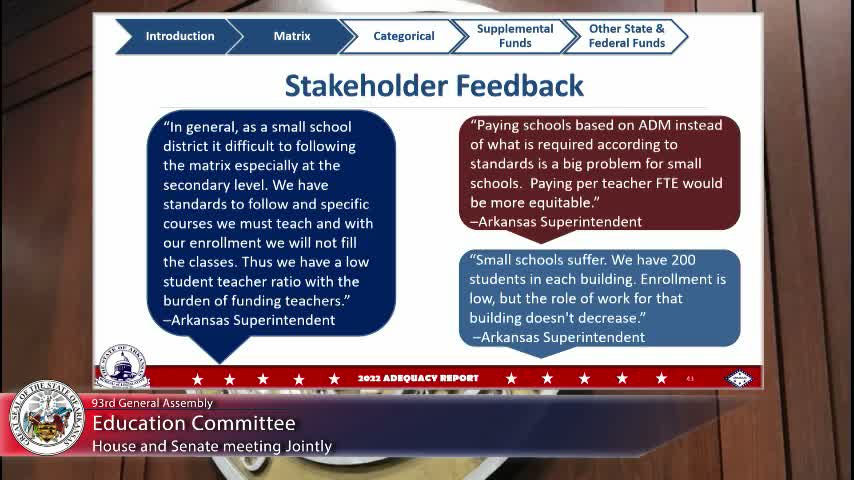
Lawmakers pressed bureau analysts about special education and student mental health during a multi‑hour adequacy briefing, and staff said both areas warrant immediate attention and further analysis.
The bureau noted the matrix funds 2.9 special‑education teachers per 500 students while the evidence‑based model used by past consultants (Auden & Pikus) recommends roughly 4.05 per 500. Bureau staff said districts are supplementing the shortfall with other funds and that charters often fall short of even the matrix‑funded ratio.
On mental health, staff said the superintendent survey and national studies point to unmet needs: "in Arkansas, the suicide rate among that same age group has increased by 45 percent," a presenter told the committee, adding that rural areas are especially affected and many students with mental‑health disorders do not receive treatment. Staff recommended identifying specialized positions (social workers, psychologists, behavioral specialists) rather than relying solely on guidance counselors, whose role and capacity vary by school.
Members asked whether school districts can use partnerships—nursing practicums, community mental‑health providers, or contracts with third parties—to fill gaps. Bureau staff confirmed such partnerships exist and said the bureau will examine survey responses to quantify outside service use and spending.
The committee asked the bureau to deliver a dedicated Special Education Report with updated growth trends and a breakdown of high‑cost special‑education reimbursements; staff agreed to provide that follow‑up.
The bureau noted the matrix funds 2.9 special‑education teachers per 500 students while the evidence‑based model used by past consultants (Auden & Pikus) recommends roughly 4.05 per 500. Bureau staff said districts are supplementing the shortfall with other funds and that charters often fall short of even the matrix‑funded ratio.
On mental health, staff said the superintendent survey and national studies point to unmet needs: "in Arkansas, the suicide rate among that same age group has increased by 45 percent," a presenter told the committee, adding that rural areas are especially affected and many students with mental‑health disorders do not receive treatment. Staff recommended identifying specialized positions (social workers, psychologists, behavioral specialists) rather than relying solely on guidance counselors, whose role and capacity vary by school.
Members asked whether school districts can use partnerships—nursing practicums, community mental‑health providers, or contracts with third parties—to fill gaps. Bureau staff confirmed such partnerships exist and said the bureau will examine survey responses to quantify outside service use and spending.
The committee asked the bureau to deliver a dedicated Special Education Report with updated growth trends and a breakdown of high‑cost special‑education reimbursements; staff agreed to provide that follow‑up.
Don't Miss a Word: See the Full Meeting!
Go beyond summaries. Unlock every video, transcript, and key insight with a Founder Membership.
✓
Get instant access to full meeting videos
✓
Search and clip any phrase from complete transcripts
✓
Receive AI-powered summaries & custom alerts
✓
Enjoy lifetime, unrestricted access to government data
30-day money-back guarantee
