Adequacy presenters detail non‑matrix spending, instructional aides, categorical funds and requests for follow‑up data
April 04, 2022 | EDUCATION COMMITTEE - SENATE, Senate, Committees, Legislative, Arkansas
This article was created by AI summarizing key points discussed. AI makes mistakes, so for full details and context, please refer to the video of the full meeting. Please report any errors so we can fix them. Report an error »
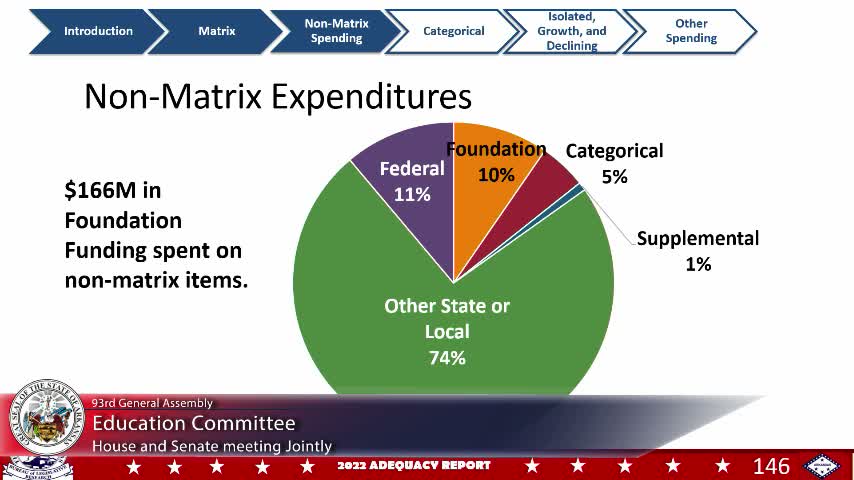
Presenters to the joint House and Senate Education Committee outlined how schools used foundation and categorical funds during the 2021 reporting year and identified items outside the adequacy matrix that consume foundation dollars.
Jasmine (presenter) told the committee "a total of a hundred and $66,000,000 in foundation funding were spent on nonmatrix items," about 5% of total foundation funding, and said instructional aids comprised roughly 44% of those non‑matrix expenditures. Staff showed that when all funding sources are included schools spent approximately $198,000,000 on instructional aids in 2021.
The presenters cited the consulting work of Auden & Pikus and APA in earlier adequacy cycles. They summarized Auden & Pikus’s finding that instructional aides generally "do not add value" to student achievement except when those aides are trained for specific reading programs and used as tutors; local anecdotes were offered where trained aides reinforced phonics instruction and supported reading gains.
On categorical funds, staff reported the state provided $352 per English language learner student in 2021 but districts spent roughly $570 per ELL when other funding sources were combined. For Alternative Learning Environments (ALE), the state categorical amount was $4,700 per ALE student, while total ALE spending across funding sources was reported at $9,177 per ALE student. Enhanced Student Achievement (ESA) funding and a $5.3 million matching‑grant pool were described; staff said ESA funds are often transferred among categoricals and that they will provide a list of approved "other activities" on request.
Committee members pressed presenters for more detail. Representative Love, Representative Beck and others asked whether the department had correlated instructional‑aid spending with academic outcomes and whether salary expenditures categorized under professional development were direct PD salaries or payments to trainers and administrators. Presenters said district coding and interviews informed the analysis but that they would supply requested breakdowns (lists of matching‑grant recipients, ESA "other activities," PD salary composition, and counts/training status of instructional aides) in follow‑up materials and in upcoming reports.
Members also probed equity implications — whether transfers from larger categorical pots (ESA) reduce funding for other priorities — and asked for comparisons of spending patterns among the highest‑ and lowest‑performing schools. Presenters said additional analysis will be included in forthcoming sessions and reports (ALE and CTE deep dives were scheduled for May). The session produced several follow‑up requests rather than committee directives.
Jasmine (presenter) told the committee "a total of a hundred and $66,000,000 in foundation funding were spent on nonmatrix items," about 5% of total foundation funding, and said instructional aids comprised roughly 44% of those non‑matrix expenditures. Staff showed that when all funding sources are included schools spent approximately $198,000,000 on instructional aids in 2021.
The presenters cited the consulting work of Auden & Pikus and APA in earlier adequacy cycles. They summarized Auden & Pikus’s finding that instructional aides generally "do not add value" to student achievement except when those aides are trained for specific reading programs and used as tutors; local anecdotes were offered where trained aides reinforced phonics instruction and supported reading gains.
On categorical funds, staff reported the state provided $352 per English language learner student in 2021 but districts spent roughly $570 per ELL when other funding sources were combined. For Alternative Learning Environments (ALE), the state categorical amount was $4,700 per ALE student, while total ALE spending across funding sources was reported at $9,177 per ALE student. Enhanced Student Achievement (ESA) funding and a $5.3 million matching‑grant pool were described; staff said ESA funds are often transferred among categoricals and that they will provide a list of approved "other activities" on request.
Committee members pressed presenters for more detail. Representative Love, Representative Beck and others asked whether the department had correlated instructional‑aid spending with academic outcomes and whether salary expenditures categorized under professional development were direct PD salaries or payments to trainers and administrators. Presenters said district coding and interviews informed the analysis but that they would supply requested breakdowns (lists of matching‑grant recipients, ESA "other activities," PD salary composition, and counts/training status of instructional aides) in follow‑up materials and in upcoming reports.
Members also probed equity implications — whether transfers from larger categorical pots (ESA) reduce funding for other priorities — and asked for comparisons of spending patterns among the highest‑ and lowest‑performing schools. Presenters said additional analysis will be included in forthcoming sessions and reports (ALE and CTE deep dives were scheduled for May). The session produced several follow‑up requests rather than committee directives.
Don't Miss a Word: See the Full Meeting!
Go beyond summaries. Unlock every video, transcript, and key insight with a Founder Membership.
✓
Get instant access to full meeting videos
✓
Search and clip any phrase from complete transcripts
✓
Receive AI-powered summaries & custom alerts
✓
Enjoy lifetime, unrestricted access to government data
30-day money-back guarantee
