Briefing: 8% of Arkansas students were English learners in 2021; exit rates and test results vary
May 03, 2022 | EDUCATION COMMITTEE - SENATE, Senate, Committees, Legislative, Arkansas
This article was created by AI summarizing key points discussed. AI makes mistakes, so for full details and context, please refer to the video of the full meeting. Please report any errors so we can fix them. Report an error »
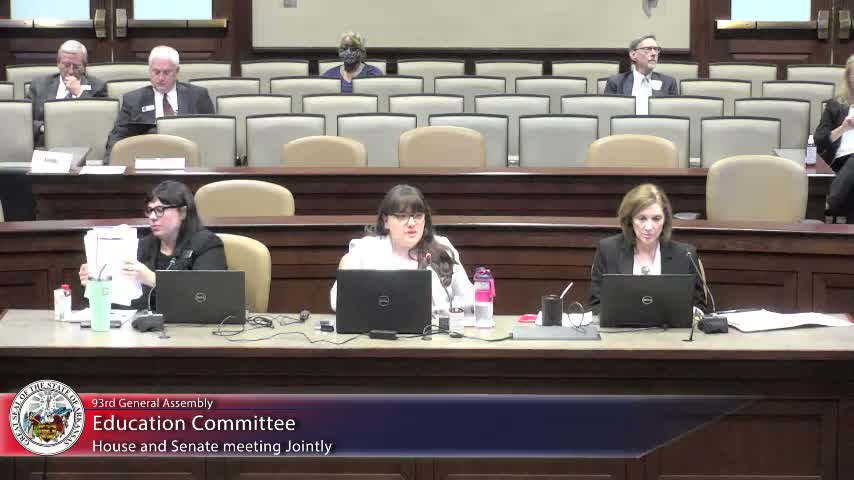
Adrian Beck of the Bureau of Legislative Research summarized how Arkansas identifies, serves and measures English language learners (ELLs), highlighting federal legal obligations, program models and student outcomes.
Beck said federal law (Title VI and the Supreme Court case cited in the presentation) requires districts to provide an equal educational opportunity and to take steps beyond offering the same materials to ensure ELL students can participate meaningfully. In Arkansas in 2021 about 8% of students were ELLs, and roughly 18% of those were also in special education; Springdale School District accounted for about 19% of the state's ELL population.
Screening begins with a home language survey and an ELPA21 screener. Placement decisions are made by a district language proficiency and assessment committee using multiple measures, and exit requires ELPA21 proficiency plus two pieces of evidence of academic content proficiency (examples cited: ACT Aspire component scores or a 19 on the ACT as one possible measure). The monitoring period for students who exit was extended to four years under federal Every Student Succeeds Act rules.
On achievement, Beck said ELL students performed worse than non‑ELL peers on the ACT Aspire and NAEP in most comparisons: for example, in 2021 roughly 13% of ELL students scored ready or exceeding in math versus 38% for non‑ELL students; ELA readiness showed a comparable gap. He also noted that statewide ELL growth measures (ELPA21 growth score) averaged about 83.38, which the bureau interpreted as higher than expected growth against prior performance.
Beck said the bureau will follow up with members on certain data requests, including raw counts and NAEP language administration.
Beck said federal law (Title VI and the Supreme Court case cited in the presentation) requires districts to provide an equal educational opportunity and to take steps beyond offering the same materials to ensure ELL students can participate meaningfully. In Arkansas in 2021 about 8% of students were ELLs, and roughly 18% of those were also in special education; Springdale School District accounted for about 19% of the state's ELL population.
Screening begins with a home language survey and an ELPA21 screener. Placement decisions are made by a district language proficiency and assessment committee using multiple measures, and exit requires ELPA21 proficiency plus two pieces of evidence of academic content proficiency (examples cited: ACT Aspire component scores or a 19 on the ACT as one possible measure). The monitoring period for students who exit was extended to four years under federal Every Student Succeeds Act rules.
On achievement, Beck said ELL students performed worse than non‑ELL peers on the ACT Aspire and NAEP in most comparisons: for example, in 2021 roughly 13% of ELL students scored ready or exceeding in math versus 38% for non‑ELL students; ELA readiness showed a comparable gap. He also noted that statewide ELL growth measures (ELPA21 growth score) averaged about 83.38, which the bureau interpreted as higher than expected growth against prior performance.
Beck said the bureau will follow up with members on certain data requests, including raw counts and NAEP language administration.
Don't Miss a Word: See the Full Meeting!
Go beyond summaries. Unlock every video, transcript, and key insight with a Founder Membership.
✓
Get instant access to full meeting videos
✓
Search and clip any phrase from complete transcripts
✓
Receive AI-powered summaries & custom alerts
✓
Enjoy lifetime, unrestricted access to government data
30-day money-back guarantee
