Criminal Justice Institute urges statewide push on youth mental health, threat teams and SRO professionalization
June 06, 2022 | EDUCATION COMMITTEE - SENATE, Senate, Committees, Legislative, Arkansas
This article was created by AI summarizing key points discussed. AI makes mistakes, so for full details and context, please refer to the video of the full meeting. Please report any errors so we can fix them. Report an error »
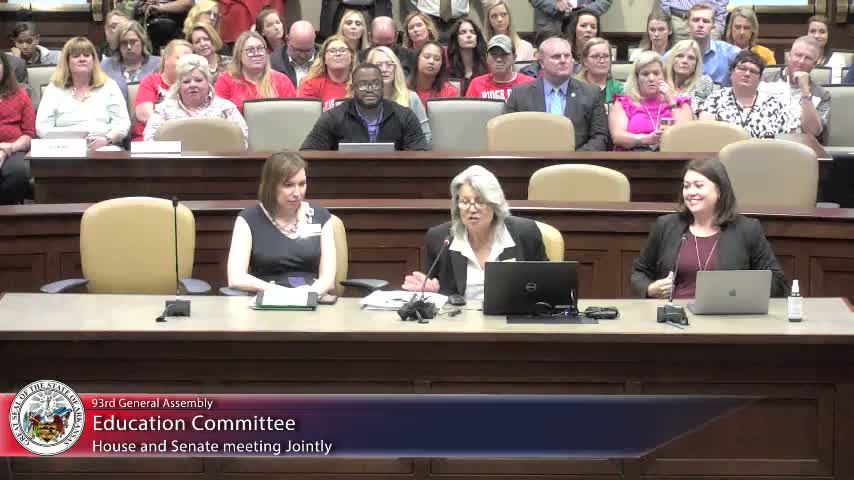
Cheryl May, director of the Criminal Justice Institute and the Arkansas Center for School Safety, told the Senate Education Committee that the state’s school‑safety work traces to a 2018 commission that produced 30 recommendations and to legislation enacted in 2019 and 2021.
May described a set of interlocking steps the center and the Department of Elementary and Secondary Education (DESE) are promoting: broader Youth Mental Health First Aid training for staff, formal behavioral threat‑assessment teams, trauma‑response supports for schools and tighter role definitions and training for school resource officers (SROs). “When we met as a commission, in 2018, we worked for 9 months. There were 19 of us, and we came up with 30 recommendations,” May said.
On mental‑health training, May noted statutory requirements tied to 2021 actions and said the center and partners offer state‑wide programs for counselors and SROs. The center has provided Youth Mental Health First Aid trainings around the state and partnered with DESE’s Project AWARE, she said; local districts such as Greenbrier described multi‑year rollouts that trained staff across job categories.
May also outlined a trauma‑notification pilot modeled on the “Handle with Care” approach—in Arkansas rebranded the Paycheck program (Protecting Arkansas Youth)—in which law enforcement, child‑welfare or corrections can notify a school that a child experienced a potentially traumatic event so staff can “handle them with care.” May said the Paycheck program has been implemented in seven counties and the center plans statewide implementation next school year.
On threat assessment, May urged every district to establish a behavioral threat‑assessment team that includes administrators, investigators, counselors, school psychologists and law enforcement; the center said it has delivered basic behavioral threat‑assessment training to dozens of districts and has online toolkits available. “These are teams…used in the event that there is a threat, to be able to evaluate how credible the threat is,” May said.
May emphasized professionalizing SRO programs: the center reported roughly 460 SROs serving 223 districts (about 79% coverage) and described required memoranda of understanding and training standards—including a 40‑hour basic SRO class, five‑year refreshers and annual continuing education—now monitored by the Arkansas Center for School Safety. “When school resource officers are not used appropriately, it causes a world of damage,” May said, and she stressed that SROs should not be used as school disciplinary officers.
Lawmakers asked how to fund broader SRO coverage and who holds responsibility for district‑level implementation. Committee members also pressed for lists of districts that have institutional police departments (CLEST approvals), and for clarity about statewide anonymous reporting systems and fusion‑center coordination to share timely threat information with schools.
The committee approved routine meeting minutes, then moved to DESE presentations on assessments and the PLC initiative. The center and DESE officials said next steps include curriculum rollouts for safety coordinators and expanded training schedules for summer and fall.
May described a set of interlocking steps the center and the Department of Elementary and Secondary Education (DESE) are promoting: broader Youth Mental Health First Aid training for staff, formal behavioral threat‑assessment teams, trauma‑response supports for schools and tighter role definitions and training for school resource officers (SROs). “When we met as a commission, in 2018, we worked for 9 months. There were 19 of us, and we came up with 30 recommendations,” May said.
On mental‑health training, May noted statutory requirements tied to 2021 actions and said the center and partners offer state‑wide programs for counselors and SROs. The center has provided Youth Mental Health First Aid trainings around the state and partnered with DESE’s Project AWARE, she said; local districts such as Greenbrier described multi‑year rollouts that trained staff across job categories.
May also outlined a trauma‑notification pilot modeled on the “Handle with Care” approach—in Arkansas rebranded the Paycheck program (Protecting Arkansas Youth)—in which law enforcement, child‑welfare or corrections can notify a school that a child experienced a potentially traumatic event so staff can “handle them with care.” May said the Paycheck program has been implemented in seven counties and the center plans statewide implementation next school year.
On threat assessment, May urged every district to establish a behavioral threat‑assessment team that includes administrators, investigators, counselors, school psychologists and law enforcement; the center said it has delivered basic behavioral threat‑assessment training to dozens of districts and has online toolkits available. “These are teams…used in the event that there is a threat, to be able to evaluate how credible the threat is,” May said.
May emphasized professionalizing SRO programs: the center reported roughly 460 SROs serving 223 districts (about 79% coverage) and described required memoranda of understanding and training standards—including a 40‑hour basic SRO class, five‑year refreshers and annual continuing education—now monitored by the Arkansas Center for School Safety. “When school resource officers are not used appropriately, it causes a world of damage,” May said, and she stressed that SROs should not be used as school disciplinary officers.
Lawmakers asked how to fund broader SRO coverage and who holds responsibility for district‑level implementation. Committee members also pressed for lists of districts that have institutional police departments (CLEST approvals), and for clarity about statewide anonymous reporting systems and fusion‑center coordination to share timely threat information with schools.
The committee approved routine meeting minutes, then moved to DESE presentations on assessments and the PLC initiative. The center and DESE officials said next steps include curriculum rollouts for safety coordinators and expanded training schedules for summer and fall.
Don't Miss a Word: See the Full Meeting!
Go beyond summaries. Unlock every video, transcript, and key insight with a Founder Membership.
✓
Get instant access to full meeting videos
✓
Search and clip any phrase from complete transcripts
✓
Receive AI-powered summaries & custom alerts
✓
Enjoy lifetime, unrestricted access to government data
30-day money-back guarantee
