Arkansas committee hears adequacy report showing low proficiency despite high graduation rates
June 07, 2022 | EDUCATION COMMITTEE - SENATE, Senate, Committees, Legislative, Arkansas
This article was created by AI summarizing key points discussed. AI makes mistakes, so for full details and context, please refer to the video of the full meeting. Please report any errors so we can fix them. Report an error »
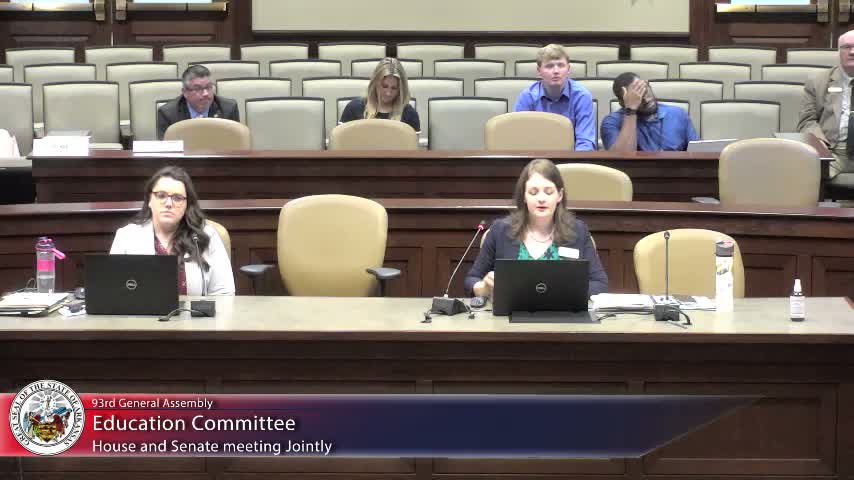
A state adequacy report presented to the Senate Education Committee on June 7 summarized Arkansas student achievement across multiple measures and drew urgent questions from lawmakers about policy choices and equity.
The Bureau of Legislative Research and audit staff opened with national and state comparisons. Adrienne Beck said Arkansas was below the national average on 2019 NAEP reading and math for fourth and eighth grades — examples cited included roughly 27% of eighth graders at or above proficient in math and about 33% at-or-above proficiency in fourth-grade math — and noted NAEP is a sampled national measure, not directly interchangeable with state assessments. The bureau also reported that 45% of AP exams scored 3 or higher in Arkansas in 2020 versus 64% nationally and that the class of 2021’s ACT composite averaged about 19 in Arkansas compared with about 20.3 nationally. "Our overall graduation rate in Arkansas for 2021 was 88.5 percent for all students," staff added.
Why those numbers diverge drove most of the committee discussion. Representative Jake Meeks pressed staff on "the disconnect" between the roughly one-third of students judged proficient on some measures and the nearly 90% graduation rate, asking "are we graduating students who aren't ready?" Bureau presenters and DESE counsel said the two sets of measures are defined differently: graduation is credit-based at the local level while proficiency is a performance benchmark on specific assessments; NAEP’s sampled methodology and changes in ELA cut scores on state tests complicate direct comparisons.
Members asked for more disaggregated analysis. Senator George Elliott and Representative Godfrey urged further study of early-childhood programs, universal pre-K, and the relationship between school integration and outcomes; Godfrey specifically requested state comparisons for jurisdictions with universal pre-K and a racial-integration analysis tied to outcomes. Senator Elliott said the legislature has a responsibility to act, noting past interstate reviews and urging focus on implementation rather than searching for "silver bullets." "Don't be mad at the Department of Education. Be mad at us," Elliott said, calling for legislative leadership on expectations and resource allocation.
Johnny Key of the Department of Education told the committee DESE would provide staff with College Board data on AP participation and said the department is seeing increased AP participation and performance among Hispanic students, in part aided by virtual AP offerings through Virtual Arkansas. Key also cited teacher recruitment and retention as a constraint on access to rigorous courses.
Staff highlighted equity gaps. NAEP and state data showed persistent disparities by race, ethnicity and economic status: for several assessments the gap between white and Black students was especially pronounced, and students from high concentrations of free or reduced-price lunch eligibility performed lower on average. Committee members asked bureau staff to return with targeted analyses, including: (1) state comparison of literacy outcomes tied to pre-K availability, (2) disaggregation of Black-student outcomes by school racial composition, and (3) an examination of the apparent inverse relationship observed between four‑year graduation rates and percent meeting all ACT college‑readiness benchmarks.
What’s next: staff and DESE agreed to provide follow-up materials requested by the committee (College Board/AP data, district-level detail where privacy and statute allow, and updates on supports for districts in levels of required assistance). The committee directed staff to circulate additional district-level fiscal- and classroom-level data as requested by members.
Sources: presentation by the Bureau of Legislative Research and questions and answers with Department of Education staff at the June 7 Senate Education Committee meeting. Quotes in this article are taken from recorded committee remarks and attributions are to the speakers listed in committee materials.
The Bureau of Legislative Research and audit staff opened with national and state comparisons. Adrienne Beck said Arkansas was below the national average on 2019 NAEP reading and math for fourth and eighth grades — examples cited included roughly 27% of eighth graders at or above proficient in math and about 33% at-or-above proficiency in fourth-grade math — and noted NAEP is a sampled national measure, not directly interchangeable with state assessments. The bureau also reported that 45% of AP exams scored 3 or higher in Arkansas in 2020 versus 64% nationally and that the class of 2021’s ACT composite averaged about 19 in Arkansas compared with about 20.3 nationally. "Our overall graduation rate in Arkansas for 2021 was 88.5 percent for all students," staff added.
Why those numbers diverge drove most of the committee discussion. Representative Jake Meeks pressed staff on "the disconnect" between the roughly one-third of students judged proficient on some measures and the nearly 90% graduation rate, asking "are we graduating students who aren't ready?" Bureau presenters and DESE counsel said the two sets of measures are defined differently: graduation is credit-based at the local level while proficiency is a performance benchmark on specific assessments; NAEP’s sampled methodology and changes in ELA cut scores on state tests complicate direct comparisons.
Members asked for more disaggregated analysis. Senator George Elliott and Representative Godfrey urged further study of early-childhood programs, universal pre-K, and the relationship between school integration and outcomes; Godfrey specifically requested state comparisons for jurisdictions with universal pre-K and a racial-integration analysis tied to outcomes. Senator Elliott said the legislature has a responsibility to act, noting past interstate reviews and urging focus on implementation rather than searching for "silver bullets." "Don't be mad at the Department of Education. Be mad at us," Elliott said, calling for legislative leadership on expectations and resource allocation.
Johnny Key of the Department of Education told the committee DESE would provide staff with College Board data on AP participation and said the department is seeing increased AP participation and performance among Hispanic students, in part aided by virtual AP offerings through Virtual Arkansas. Key also cited teacher recruitment and retention as a constraint on access to rigorous courses.
Staff highlighted equity gaps. NAEP and state data showed persistent disparities by race, ethnicity and economic status: for several assessments the gap between white and Black students was especially pronounced, and students from high concentrations of free or reduced-price lunch eligibility performed lower on average. Committee members asked bureau staff to return with targeted analyses, including: (1) state comparison of literacy outcomes tied to pre-K availability, (2) disaggregation of Black-student outcomes by school racial composition, and (3) an examination of the apparent inverse relationship observed between four‑year graduation rates and percent meeting all ACT college‑readiness benchmarks.
What’s next: staff and DESE agreed to provide follow-up materials requested by the committee (College Board/AP data, district-level detail where privacy and statute allow, and updates on supports for districts in levels of required assistance). The committee directed staff to circulate additional district-level fiscal- and classroom-level data as requested by members.
Sources: presentation by the Bureau of Legislative Research and questions and answers with Department of Education staff at the June 7 Senate Education Committee meeting. Quotes in this article are taken from recorded committee remarks and attributions are to the speakers listed in committee materials.
View the Full Meeting & All Its Details
This article offers just a summary. Unlock complete video, transcripts, and insights as a Founder Member.
✓
Watch full, unedited meeting videos
✓
Search every word spoken in unlimited transcripts
✓
AI summaries & real-time alerts (all government levels)
✓
Permanent access to expanding government content
30-day money-back guarantee
