SUCCEED scholarship report: 493–503 participating students; private-school test results limited and not comparable
June 07, 2022 | EDUCATION COMMITTEE - SENATE, Senate, Committees, Legislative, Arkansas
This article was created by AI summarizing key points discussed. AI makes mistakes, so for full details and context, please refer to the video of the full meeting. Please report any errors so we can fix them. Report an error »
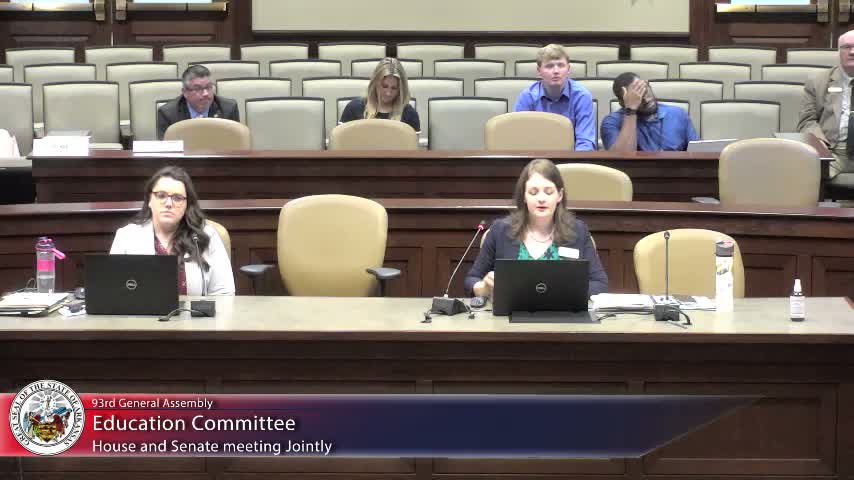
The committee reviewed the SUCCEED private-school scholarship report required by statute. Bureau staff told the committee the program is limited to eligible students (students with disabilities, foster-care students, and, after 2021, dependents of uniformed-services members) and noted the scholarship amount equals the state foundation funding amount (reported as $7,018 for 2021). According to quarterly statements provided to the bureau, 493 students used payments in the 2021 school year; DESE’s approval spreadsheet lists 503 approved participants, a discrepancy the bureau attributed to approvals versus actual monthly enrollments.
Private schools were required to submit demographic and performance information for participating students. Staff said reporting practices and privacy rules limited analysis: the report redacted groups with fewer than 10 students to avoid personally identifiable information, private schools used different nationally recognized assessments (Stanford-10, KTEA-3, NWEA, WJ-IV and others) and reported mixed score types (scale scores, percentiles, achievement-level labels), making cross-school comparisons infeasible.
Where data were analyzable, staff reported mixed results: many small-sample assessments were below national readiness benchmarks (for example, KTEA‑3 and WJ‑IV groupings showed a majority in very low/low ranges for the students reported). Staff also noted 183 students were listed as exempt from standardized testing in the questionnaires, and of those, about 74% still took a standardized test. Private-school accreditation status was reported: among 33 respondent private schools, 28 reported full accreditation and 5 reported associate or in‑process status. Administrative costs reported by 13 schools ranged from about $21 to $1,730.
Committee members expressed concern that the statute’s reporting limitations — data only for participating students and privacy redactions — prevent reliable comparisons of private-school performance to student populations that remain in public schools. Representative Brown asked whether the bureau could compare participating students’ performance to other students at the same private schools; staff said the statutory scope covers only participating students but offered to pursue additional information where feasible.
What’s next: staff will follow up on whether participating students have IEPs/ISPs versus medical diagnoses where that distinction was allowed under the 2021 eligibility expansion, and will provide any additional comparative data the bureau can legally and practically assemble.
Private schools were required to submit demographic and performance information for participating students. Staff said reporting practices and privacy rules limited analysis: the report redacted groups with fewer than 10 students to avoid personally identifiable information, private schools used different nationally recognized assessments (Stanford-10, KTEA-3, NWEA, WJ-IV and others) and reported mixed score types (scale scores, percentiles, achievement-level labels), making cross-school comparisons infeasible.
Where data were analyzable, staff reported mixed results: many small-sample assessments were below national readiness benchmarks (for example, KTEA‑3 and WJ‑IV groupings showed a majority in very low/low ranges for the students reported). Staff also noted 183 students were listed as exempt from standardized testing in the questionnaires, and of those, about 74% still took a standardized test. Private-school accreditation status was reported: among 33 respondent private schools, 28 reported full accreditation and 5 reported associate or in‑process status. Administrative costs reported by 13 schools ranged from about $21 to $1,730.
Committee members expressed concern that the statute’s reporting limitations — data only for participating students and privacy redactions — prevent reliable comparisons of private-school performance to student populations that remain in public schools. Representative Brown asked whether the bureau could compare participating students’ performance to other students at the same private schools; staff said the statutory scope covers only participating students but offered to pursue additional information where feasible.
What’s next: staff will follow up on whether participating students have IEPs/ISPs versus medical diagnoses where that distinction was allowed under the 2021 eligibility expansion, and will provide any additional comparative data the bureau can legally and practically assemble.
View the Full Meeting & All Its Details
This article offers just a summary. Unlock complete video, transcripts, and insights as a Founder Member.
✓
Watch full, unedited meeting videos
✓
Search every word spoken in unlimited transcripts
✓
AI summaries & real-time alerts (all government levels)
✓
Permanent access to expanding government content
30-day money-back guarantee
