House adequacy proposal advances after committee debate over teacher pay and funding sources
October 04, 2022 | EDUCATION COMMITTEE - SENATE, Senate, Committees, Legislative, Arkansas
This article was created by AI summarizing key points discussed. AI makes mistakes, so for full details and context, please refer to the video of the full meeting. Please report any errors so we can fix them. Report an error »
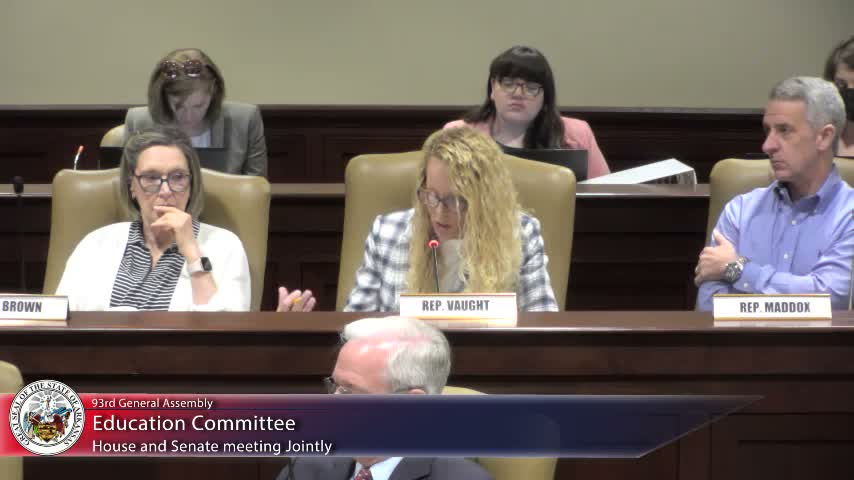
A joint meeting of the Education Committee continued consideration of the 2022 adequacy report, focusing on a House-proposed funding matrix that includes a sustained teacher-salary increase and other line-item changes.
Representative Vaught (House) moved that the committee accept the House adequacy proposal. Members delayed immediate approval to allow technical questions and discussion of the handout distributed at the prior meeting. Committee members asked the Department of Education and budget staff to explain the mechanics: whether the $4.50 per-pupil 'salary enhancement' is a one-time bonus and how the proposal would be funded across fiscal years.
Representative Evans, who presented the House proposal, said the salary increase is not a bonus but a sustained raise that would be implemented by legislation and entered onto the salary schedule. He said the package could be carried as a single bill or broken into parts. Secretary Johnny Key of the Department of Education confirmed the proposal is intended to be sustainable, pointing to special-revenue growth in the adequacy and public-school funds driven by sales-tax receipts and lower-than-expected student counts after COVID.
Members pressed specifics. Representative Starcher asked how much the $44-per-classified-staff line would cost; the House estimate was about $20.8 million a year. Representative Godfrey and others raised concerns about special-education staffing: the matrix keeps special-education teacher FTEs flat (2.9) despite committee evidence that students with disabilities have increased — Godfrey cited an 11% rise in students with disabilities noted in the adequacy report.
Budget office officials cautioned about sustainability. Robert Breck, speaking for the state budget office, said there is not a single $400 million pot earmarked for long-term increases and warned that multi-year increases at the scale discussed would be difficult to sustain under current forecasts. He identified the catastrophic reserve and the general reserve as possible sources for one-time or limited uses but said ongoing commitments should be within projected revenue growth.
After procedural votes to end debate and move to immediate consideration, the committee recorded separate chamber votes. The House members present voted to accept the House adequacy proposal. The transcript states the House "passed the resolution" while noting the Senate "opposes the matrix." The record shows the House carried its vote; senators on the joint committee continued to express fiscal and policy concerns.
What happens next: Committee members and staff said the committee's recommendations and submitted written testimony will be compiled in the final adequacy report and filed for public comment around Oct. 15; any statutory changes to enact pay increases or categorical adjustments must be run as legislation in the next session.
Ending note: Department and fiscal officials agreed to provide further budget-detail breakdowns (DFNA/budget buckets and adequacy-fund balances) to answer members' requests about the specific funding sources and multi-year projections.
Representative Vaught (House) moved that the committee accept the House adequacy proposal. Members delayed immediate approval to allow technical questions and discussion of the handout distributed at the prior meeting. Committee members asked the Department of Education and budget staff to explain the mechanics: whether the $4.50 per-pupil 'salary enhancement' is a one-time bonus and how the proposal would be funded across fiscal years.
Representative Evans, who presented the House proposal, said the salary increase is not a bonus but a sustained raise that would be implemented by legislation and entered onto the salary schedule. He said the package could be carried as a single bill or broken into parts. Secretary Johnny Key of the Department of Education confirmed the proposal is intended to be sustainable, pointing to special-revenue growth in the adequacy and public-school funds driven by sales-tax receipts and lower-than-expected student counts after COVID.
Members pressed specifics. Representative Starcher asked how much the $44-per-classified-staff line would cost; the House estimate was about $20.8 million a year. Representative Godfrey and others raised concerns about special-education staffing: the matrix keeps special-education teacher FTEs flat (2.9) despite committee evidence that students with disabilities have increased — Godfrey cited an 11% rise in students with disabilities noted in the adequacy report.
Budget office officials cautioned about sustainability. Robert Breck, speaking for the state budget office, said there is not a single $400 million pot earmarked for long-term increases and warned that multi-year increases at the scale discussed would be difficult to sustain under current forecasts. He identified the catastrophic reserve and the general reserve as possible sources for one-time or limited uses but said ongoing commitments should be within projected revenue growth.
After procedural votes to end debate and move to immediate consideration, the committee recorded separate chamber votes. The House members present voted to accept the House adequacy proposal. The transcript states the House "passed the resolution" while noting the Senate "opposes the matrix." The record shows the House carried its vote; senators on the joint committee continued to express fiscal and policy concerns.
What happens next: Committee members and staff said the committee's recommendations and submitted written testimony will be compiled in the final adequacy report and filed for public comment around Oct. 15; any statutory changes to enact pay increases or categorical adjustments must be run as legislation in the next session.
Ending note: Department and fiscal officials agreed to provide further budget-detail breakdowns (DFNA/budget buckets and adequacy-fund balances) to answer members' requests about the specific funding sources and multi-year projections.
Don't Miss a Word: See the Full Meeting!
Go beyond summaries. Unlock every video, transcript, and key insight with a Founder Membership.
✓
Get instant access to full meeting videos
✓
Search and clip any phrase from complete transcripts
✓
Receive AI-powered summaries & custom alerts
✓
Enjoy lifetime, unrestricted access to government data
30-day money-back guarantee
