BLR presents preliminary adequacy report; committee seeks clearer teacher definitions and sets Sept. 20 submission deadline
September 06, 2022 | EDUCATION COMMITTEE - SENATE, Senate, Committees, Legislative, Arkansas
This article was created by AI summarizing key points discussed. AI makes mistakes, so for full details and context, please refer to the video of the full meeting. Please report any errors so we can fix them. Report an error »
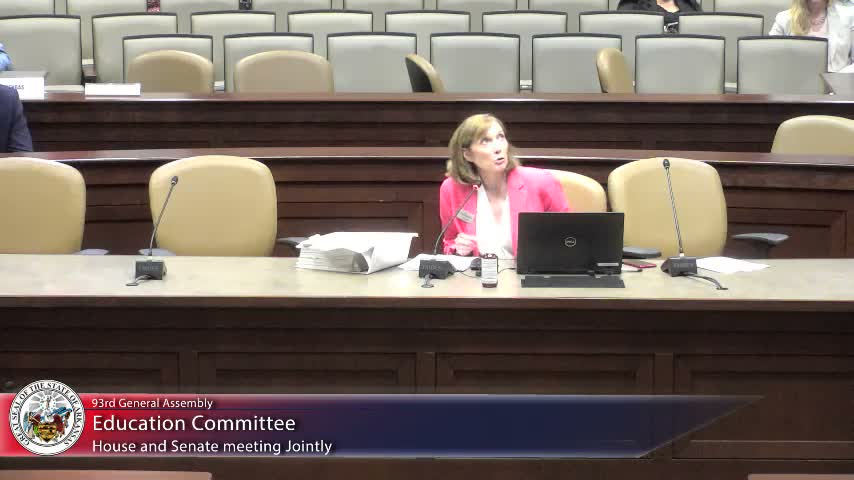
Julie Holt of the Bureau of Legislative Research presented the committee with the preliminary draft of the 2022 adequacy study on Sept. 6 and explained the report structure, statutory basis and upcoming timetable for the final submission.
Holt told members the study follows a statutory evidence-based approach that traces to a 2003 Supreme Court decision and Act 57, and that the final submission (Volume 1 and Volume 2) is due Nov. 1. She reviewed the report's components—state-level funding, district spending patterns, staffing matrices, and student-achievement outcomes—and pointed members to handouts labeled F1 (preliminary report), F2 (PowerPoint) and F3 (worksheet).
Members pressed Holt for clarity about who is included in the teacher line items in the matrix. Holt said the teacher-related line includes classroom teachers and a set of school-level instructional staff (for example, kindergarten and grade-level classroom teachers, PAM teachers, special-education teachers, librarians, counselors and media specialists) and that principals and secretaries are separate line items. She agreed to provide a clear, itemized list that can be circulated to committee members.
Representative Beck and others raised the "teacher of record" issue and asked which positions were included in the survey sample and in the average-salary calculations. Holt said the survey sample is built from teachers assigned to teach classes and excluded paraprofessionals and purely administrative staff; response rates and the exact sample definitions will be provided to members.
Representative McKenzie asked about a Department of Education contract with Forward Arkansas (approximately $250,000); the chair clarified Forward Arkansas was commissioned to follow up on a 2014–15 study and to assess COVID's impact on Arkansas education and that Forward Arkansas' written recommendation is in committee materials or will be provided.
The committee set a procedural deadline and data-collection step: members were asked to submit organized recommendations using handout number 3 by September 20. Staff said they would produce a one-page electronic form (fillable Word/Google Doc) to collect and systematize member inputs for the October meeting, when the committee plans to begin voting on final adequacy recommendations.
Members discussed longer-term policy goals: several members reiterated a goal of raising the minimum salary schedule for teachers and the matrix base salary, but Holt and the chair reminded the body that any salary-change legislation must be enacted in session and that the committee's work feeds recommendations for the next legislative session.
Quote-at-large: "We respectfully submit the preliminary report for the 2022 adequacy study," Julie Holt said when presenting the materials.
What comes next: Holt will circulate the detailed staffing lists and the fillable worksheet; members will return recommended matrix adjustments by Sept. 20 so the committee can consider and vote on recommendations during its October meeting.
Holt told members the study follows a statutory evidence-based approach that traces to a 2003 Supreme Court decision and Act 57, and that the final submission (Volume 1 and Volume 2) is due Nov. 1. She reviewed the report's components—state-level funding, district spending patterns, staffing matrices, and student-achievement outcomes—and pointed members to handouts labeled F1 (preliminary report), F2 (PowerPoint) and F3 (worksheet).
Members pressed Holt for clarity about who is included in the teacher line items in the matrix. Holt said the teacher-related line includes classroom teachers and a set of school-level instructional staff (for example, kindergarten and grade-level classroom teachers, PAM teachers, special-education teachers, librarians, counselors and media specialists) and that principals and secretaries are separate line items. She agreed to provide a clear, itemized list that can be circulated to committee members.
Representative Beck and others raised the "teacher of record" issue and asked which positions were included in the survey sample and in the average-salary calculations. Holt said the survey sample is built from teachers assigned to teach classes and excluded paraprofessionals and purely administrative staff; response rates and the exact sample definitions will be provided to members.
Representative McKenzie asked about a Department of Education contract with Forward Arkansas (approximately $250,000); the chair clarified Forward Arkansas was commissioned to follow up on a 2014–15 study and to assess COVID's impact on Arkansas education and that Forward Arkansas' written recommendation is in committee materials or will be provided.
The committee set a procedural deadline and data-collection step: members were asked to submit organized recommendations using handout number 3 by September 20. Staff said they would produce a one-page electronic form (fillable Word/Google Doc) to collect and systematize member inputs for the October meeting, when the committee plans to begin voting on final adequacy recommendations.
Members discussed longer-term policy goals: several members reiterated a goal of raising the minimum salary schedule for teachers and the matrix base salary, but Holt and the chair reminded the body that any salary-change legislation must be enacted in session and that the committee's work feeds recommendations for the next legislative session.
Quote-at-large: "We respectfully submit the preliminary report for the 2022 adequacy study," Julie Holt said when presenting the materials.
What comes next: Holt will circulate the detailed staffing lists and the fillable worksheet; members will return recommended matrix adjustments by Sept. 20 so the committee can consider and vote on recommendations during its October meeting.
View the Full Meeting & All Its Details
This article offers just a summary. Unlock complete video, transcripts, and insights as a Founder Member.
✓
Watch full, unedited meeting videos
✓
Search every word spoken in unlimited transcripts
✓
AI summaries & real-time alerts (all government levels)
✓
Permanent access to expanding government content
30-day money-back guarantee
