Joint education committee debates $4,000 teacher raise, special‑education gap and differentiated pay; no final vote
October 03, 2022 | EDUCATION COMMITTEE - SENATE, Senate, Committees, Legislative, Arkansas
This article was created by AI summarizing key points discussed. AI makes mistakes, so for full details and context, please refer to the video of the full meeting. Please report any errors so we can fix them. Report an error »
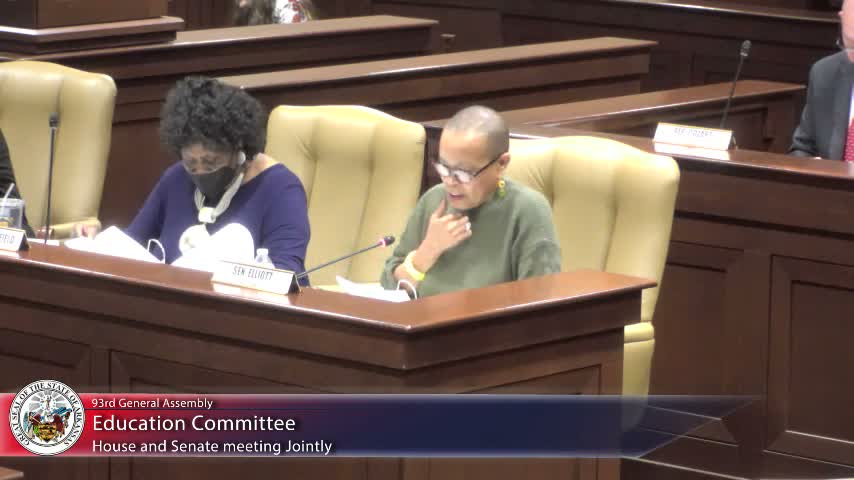
Madam Chair opened a working meeting of the joint Education Committee and invited legislators to present draft recommendations on the state adequacy report, focusing largely on teacher compensation and special‑education funding.
Representative Godfrey urged the committee to deliver a $4,000 raise to classroom teachers, saying an increase "is an absolutely urgent need" and proposing options including a $4.25 per‑pupil boost or a $42,000 minimum salary. She also cited a gap between district special‑education spending and designated foundation funding, stating that districts spend about "$508,000,000" while the designated foundation funding is only "$189,000,000," and urged either more funded SPED FTEs or a new per‑pupil categorical for special education.
Senator Chesterfield proposed a $46,000 starting salary for teachers and a $20‑per‑hour minimum for education support professionals, and pressed the committee to ask the state's congressional delegation to address a federal rule that, as she described it during the meeting, prevents some nine‑month school employees from drawing unemployment in summer months.
Representative Evans presented a House compilation of recommendations intended as a comprehensive funding package. He said an average daily membership (ADM) factor of 4.50 (rather than 4.25) would be needed so the net result to teachers is the $4,000 raise after benefits and taxes. Evans also proposed a $2‑per‑hour boost for classified employees (funded using what he described as a 44 ADM allocation for that category), raising teacher insurance funding to about $3,600 per covered employee, increasing the SPED catastrophic fund to $17,000,000, and expanding school‑safety grants. Evans estimated that the core ADM salary projection in his presentation would amount to roughly $234,000,000 in increased annual funding for the matrix, and said an emergency clause could allow legislation and retroactive pay to be implemented in the spring.
Dr. Ivy Pfeiffer of the Department of Education described differentiated (district‑level) pay models used elsewhere, saying the approach "is about giving districts options to not just pay from a salary schedule based on years of experience or a degree, but put in some other factors," and she pointed to Tennessee as an example that requires districts to include an additional component in salary schedules. Several committee members asked for guardrails and statutory language before embracing merit‑style pay, and others warned merit pay can deepen inequities if not carefully designed.
Committee members repeatedly returned to two tensions: how to make sure additional funding actually gets to classroom teachers, and how to raise pay high enough to compete with neighboring states while keeping rural districts financially sustainable. Members asked staff and BLR for written worksheets and requested the house and senate proposals be provided in document form for review. Taylor Lloyd of the Bureau of Legislative Research told the committee the adequacy report must be filed by Nov. 1 and that the committee may amend its report if needed.
No substantive legislative policy was adopted during the meeting. The only formal action recorded was the voice approval of the committee's Sept. 6 meeting minutes. The committee scheduled further work and follow‑up documentation and said it may reconvene to finalize recommendations prior to the statutory filing deadline.
Representative Godfrey urged the committee to deliver a $4,000 raise to classroom teachers, saying an increase "is an absolutely urgent need" and proposing options including a $4.25 per‑pupil boost or a $42,000 minimum salary. She also cited a gap between district special‑education spending and designated foundation funding, stating that districts spend about "$508,000,000" while the designated foundation funding is only "$189,000,000," and urged either more funded SPED FTEs or a new per‑pupil categorical for special education.
Senator Chesterfield proposed a $46,000 starting salary for teachers and a $20‑per‑hour minimum for education support professionals, and pressed the committee to ask the state's congressional delegation to address a federal rule that, as she described it during the meeting, prevents some nine‑month school employees from drawing unemployment in summer months.
Representative Evans presented a House compilation of recommendations intended as a comprehensive funding package. He said an average daily membership (ADM) factor of 4.50 (rather than 4.25) would be needed so the net result to teachers is the $4,000 raise after benefits and taxes. Evans also proposed a $2‑per‑hour boost for classified employees (funded using what he described as a 44 ADM allocation for that category), raising teacher insurance funding to about $3,600 per covered employee, increasing the SPED catastrophic fund to $17,000,000, and expanding school‑safety grants. Evans estimated that the core ADM salary projection in his presentation would amount to roughly $234,000,000 in increased annual funding for the matrix, and said an emergency clause could allow legislation and retroactive pay to be implemented in the spring.
Dr. Ivy Pfeiffer of the Department of Education described differentiated (district‑level) pay models used elsewhere, saying the approach "is about giving districts options to not just pay from a salary schedule based on years of experience or a degree, but put in some other factors," and she pointed to Tennessee as an example that requires districts to include an additional component in salary schedules. Several committee members asked for guardrails and statutory language before embracing merit‑style pay, and others warned merit pay can deepen inequities if not carefully designed.
Committee members repeatedly returned to two tensions: how to make sure additional funding actually gets to classroom teachers, and how to raise pay high enough to compete with neighboring states while keeping rural districts financially sustainable. Members asked staff and BLR for written worksheets and requested the house and senate proposals be provided in document form for review. Taylor Lloyd of the Bureau of Legislative Research told the committee the adequacy report must be filed by Nov. 1 and that the committee may amend its report if needed.
No substantive legislative policy was adopted during the meeting. The only formal action recorded was the voice approval of the committee's Sept. 6 meeting minutes. The committee scheduled further work and follow‑up documentation and said it may reconvene to finalize recommendations prior to the statutory filing deadline.
View the Full Meeting & All Its Details
This article offers just a summary. Unlock complete video, transcripts, and insights as a Founder Member.
✓
Watch full, unedited meeting videos
✓
Search every word spoken in unlimited transcripts
✓
AI summaries & real-time alerts (all government levels)
✓
Permanent access to expanding government content
30-day money-back guarantee
