Joint education committee advances several lottery‑fund scholarship bills, amends HB1333 to drop ninth grade
March 15, 2023 | EDUCATION COMMITTEE - SENATE, Senate, Committees, Legislative, Arkansas
This article was created by AI summarizing key points discussed. AI makes mistakes, so for full details and context, please refer to the video of the full meeting. Please report any errors so we can fix them. Report an error »
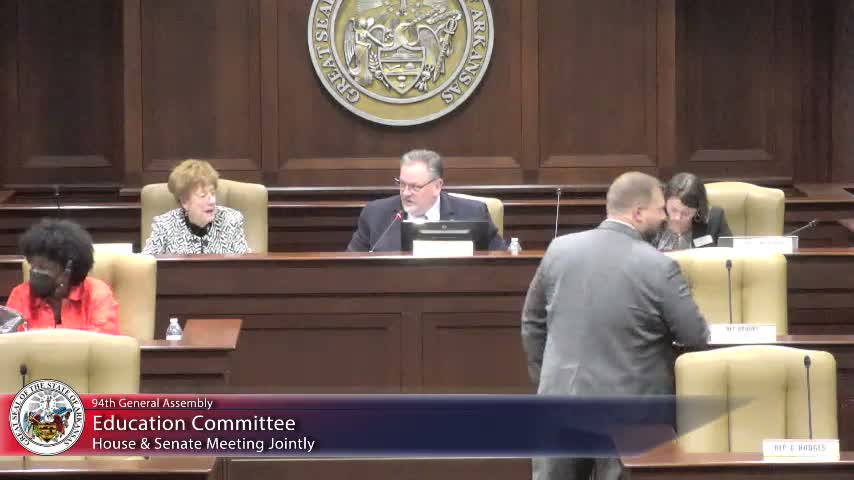
A joint House‑Senate education committee on Feb. 1 advanced a package of bills that would shift how Arkansas’ lottery scholarship proceeds are used, amending one proposal to reduce cost and sending others forward with conditions for further adjustment.
Representative Lundstrom’s House Bill 13‑33, originally written to extend scholarships to ninth‑ and tenth‑grade students taking concurrent college courses, was amended on the floor to remove ninth grade and the committee voted to advance the bill as amended. Lundstrom said the change responds to concerns about younger students’ readiness and the program’s price tag; she told the committee, “We can walk before we run if the will of the body is to do the tenth grade only.”
Maria Markham, director of the Division of Higher Education, told legislators that the scholarship program already requires placement measures and a 2.5 college GPA to maintain eligibility and cautioned that accruing a college GPA as a ninth grader can jeopardize later aid: “We’ve had some instances where kids who have gotten a concurrent challenge their college GPA drops below a 2.5 while they’re still in high school,” she said.
Committee finance staff and the Division of Higher Education provided first‑year fiscal estimates for the bills. Staff cited an allocation formula used to produce a $14.5 million joint‑committee spending ceiling for new scholarship proposals this year. The initial estimate for HB13‑33 was about $2.0 million but, after the amendment removing ninth grade, staff said the cost would be roughly $1.1 million for tenth through twelfth graders.
Senator Jane English presented Senate Bill 2‑48, the “Academic Challenge Plus” proposal to add a sliding, need‑based scale to increase awards for lower‑income students up to the existing senior cap. Markham described a plan that would use FAFSA/Estimated Family Contribution data to tier awards, and cautioned that the bill as drafted sets tiers in $1,000 increments that can be adjusted based on available funds. Committee staff estimated a large first‑year fiscal impact for SB2‑48 under the required formula but explained the award tiers could be scaled downward to fit available proceeds.
Senate Bill 2‑49, which would fund in‑state tuition eligibility for veterans and their dependents from lottery proceeds, carried a roughly $1.6 million fiscal impact in the department’s estimate and was advanced by the committee. Markham said that the current program is already overspending its general‑revenue pool and that moving the overage to lottery proceeds would allow existing eligible students to continue receiving benefits.
Lawmakers also considered three bills aimed at opening lottery funds to vocational, technical and trade programs (bills filed as HB14‑13, HB14‑15 — a proposed constitutional amendment — and HB14‑17). Representative Lundstrom argued for expanding scholarships to help fill workforce shortages in nursing, welding and truck driving. Members pressed for guardrails before directing lottery dollars to private, for‑profit career schools: Markham said many such providers operate on a clock‑hour basis and that the department lacks an off‑the‑shelf payment and oversight model for those programs; Marty Garrity of the Bureau of Legislative Research advised the committee that constitutional and statutory questions could ultimately be decided by the courts. Given the uncertainties, the committee agreed to hold HB14‑13 and HB14‑17 and to pursue a cap and additional rulemaking language for HB14‑15, with the sponsor saying she would bring an amendment for a $2,000,000 cap to be reviewed by the legislature.
The committee voted the listed bills out of committee in order: HB13‑33 (as amended) advanced; HB14‑12 (which would allow scholarship awards to be used in summer sessions and by part‑time students) was advanced with no additional lottery cost estimated; SB2‑48 (Challenge Plus) was advanced with direction to scale awards to fit the joint committee ceiling; and SB2‑49 (veterans tuition) was advanced. The committee agreed to reconvene after spring break to finalize technical amendments, rulemaking authority and oversight provisions for any program that would extend lottery proceeds to private vocational providers.
Votes at a glance
- House Bill 13‑33 (Lundstrom), amended to remove 9th grade: advanced by committee (outcome: approved as amended). Fiscal impact: amended estimate ≈ $1.1 million first year.
- House Bill 14‑12 (Mayberry), permit summer/part‑time distribution of existing awards: advanced (outcome: approved). Fiscal impact: $0 additional lottery dollars (redistribution of terms).
- Senate Bill 2‑48 (English), Academic Challenge Plus (sliding need scale): advanced (outcome: advanced). Fiscal impact: large under statutory formula; staff instructed to scale tiers to fit available funds (joint committee ceiling ≈ $14.5M).
- Senate Bill 2‑49 (English), in‑state tuition for veterans/military dependents funded from lottery proceeds: advanced (outcome: approved). Fiscal impact: ≈ $1.6 million first year.
- HB14‑13 / HB14‑17 (VOTEC/trade school funding) and HB14‑15 (constitutional amendment): committee held HB14‑13 and HB14‑17 for further work; HB14‑15 will be considered with an amendment to add a $2,000,000 cap and with additional rulemaking/oversight language to be drafted.
What’s next
Committee staff and agency finance will revise fiscal impacts to reflect adopted amendments and scaling instructions. Sponsors and the Division of Higher Education will draft statutory and rules‑and‑regulations language to establish administrative, eligibility and oversight mechanisms for any program that uses lottery proceeds to pay private vocational/career providers. The committee agreed to reconvene after spring break to complete that work.
Representative Lundstrom’s House Bill 13‑33, originally written to extend scholarships to ninth‑ and tenth‑grade students taking concurrent college courses, was amended on the floor to remove ninth grade and the committee voted to advance the bill as amended. Lundstrom said the change responds to concerns about younger students’ readiness and the program’s price tag; she told the committee, “We can walk before we run if the will of the body is to do the tenth grade only.”
Maria Markham, director of the Division of Higher Education, told legislators that the scholarship program already requires placement measures and a 2.5 college GPA to maintain eligibility and cautioned that accruing a college GPA as a ninth grader can jeopardize later aid: “We’ve had some instances where kids who have gotten a concurrent challenge their college GPA drops below a 2.5 while they’re still in high school,” she said.
Committee finance staff and the Division of Higher Education provided first‑year fiscal estimates for the bills. Staff cited an allocation formula used to produce a $14.5 million joint‑committee spending ceiling for new scholarship proposals this year. The initial estimate for HB13‑33 was about $2.0 million but, after the amendment removing ninth grade, staff said the cost would be roughly $1.1 million for tenth through twelfth graders.
Senator Jane English presented Senate Bill 2‑48, the “Academic Challenge Plus” proposal to add a sliding, need‑based scale to increase awards for lower‑income students up to the existing senior cap. Markham described a plan that would use FAFSA/Estimated Family Contribution data to tier awards, and cautioned that the bill as drafted sets tiers in $1,000 increments that can be adjusted based on available funds. Committee staff estimated a large first‑year fiscal impact for SB2‑48 under the required formula but explained the award tiers could be scaled downward to fit available proceeds.
Senate Bill 2‑49, which would fund in‑state tuition eligibility for veterans and their dependents from lottery proceeds, carried a roughly $1.6 million fiscal impact in the department’s estimate and was advanced by the committee. Markham said that the current program is already overspending its general‑revenue pool and that moving the overage to lottery proceeds would allow existing eligible students to continue receiving benefits.
Lawmakers also considered three bills aimed at opening lottery funds to vocational, technical and trade programs (bills filed as HB14‑13, HB14‑15 — a proposed constitutional amendment — and HB14‑17). Representative Lundstrom argued for expanding scholarships to help fill workforce shortages in nursing, welding and truck driving. Members pressed for guardrails before directing lottery dollars to private, for‑profit career schools: Markham said many such providers operate on a clock‑hour basis and that the department lacks an off‑the‑shelf payment and oversight model for those programs; Marty Garrity of the Bureau of Legislative Research advised the committee that constitutional and statutory questions could ultimately be decided by the courts. Given the uncertainties, the committee agreed to hold HB14‑13 and HB14‑17 and to pursue a cap and additional rulemaking language for HB14‑15, with the sponsor saying she would bring an amendment for a $2,000,000 cap to be reviewed by the legislature.
The committee voted the listed bills out of committee in order: HB13‑33 (as amended) advanced; HB14‑12 (which would allow scholarship awards to be used in summer sessions and by part‑time students) was advanced with no additional lottery cost estimated; SB2‑48 (Challenge Plus) was advanced with direction to scale awards to fit the joint committee ceiling; and SB2‑49 (veterans tuition) was advanced. The committee agreed to reconvene after spring break to finalize technical amendments, rulemaking authority and oversight provisions for any program that would extend lottery proceeds to private vocational providers.
Votes at a glance
- House Bill 13‑33 (Lundstrom), amended to remove 9th grade: advanced by committee (outcome: approved as amended). Fiscal impact: amended estimate ≈ $1.1 million first year.
- House Bill 14‑12 (Mayberry), permit summer/part‑time distribution of existing awards: advanced (outcome: approved). Fiscal impact: $0 additional lottery dollars (redistribution of terms).
- Senate Bill 2‑48 (English), Academic Challenge Plus (sliding need scale): advanced (outcome: advanced). Fiscal impact: large under statutory formula; staff instructed to scale tiers to fit available funds (joint committee ceiling ≈ $14.5M).
- Senate Bill 2‑49 (English), in‑state tuition for veterans/military dependents funded from lottery proceeds: advanced (outcome: approved). Fiscal impact: ≈ $1.6 million first year.
- HB14‑13 / HB14‑17 (VOTEC/trade school funding) and HB14‑15 (constitutional amendment): committee held HB14‑13 and HB14‑17 for further work; HB14‑15 will be considered with an amendment to add a $2,000,000 cap and with additional rulemaking/oversight language to be drafted.
What’s next
Committee staff and agency finance will revise fiscal impacts to reflect adopted amendments and scaling instructions. Sponsors and the Division of Higher Education will draft statutory and rules‑and‑regulations language to establish administrative, eligibility and oversight mechanisms for any program that uses lottery proceeds to pay private vocational/career providers. The committee agreed to reconvene after spring break to complete that work.
Don't Miss a Word: See the Full Meeting!
Go beyond summaries. Unlock every video, transcript, and key insight with a Founder Membership.
✓
Get instant access to full meeting videos
✓
Search and clip any phrase from complete transcripts
✓
Receive AI-powered summaries & custom alerts
✓
Enjoy lifetime, unrestricted access to government data
30-day money-back guarantee
