Education committee lays out Jan'July adequacy study schedule, citing Lakeview court mandate
May 15, 2023 | EDUCATION COMMITTEE - SENATE, Senate, Committees, Legislative, Arkansas
This article was created by AI summarizing key points discussed. AI makes mistakes, so for full details and context, please refer to the video of the full meeting. Please report any errors so we can fix them. Report an error »
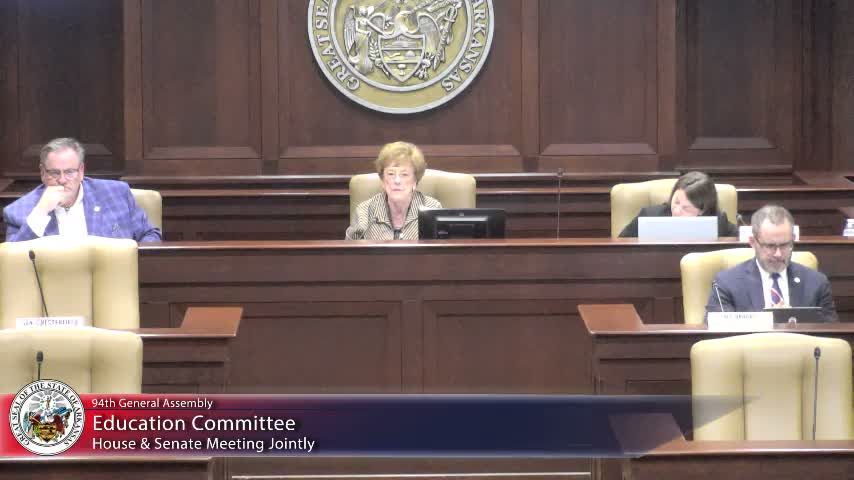
Julie Johnson Holt, administrator of the Policy Analysis & Research Section, told the joint Senate and House Education Committee on the committee's opening day that the biennial adequacy study will run from January through July and will follow an evidence-based approach.
Holt said the bureau will present a series of reports and data products across the months: an initial legal and historical framework, achievement data and testing reports, facilities funding, a line-by-line review of the foundation funding matrix, categorical and supplemental funding reports, teacher compensation and retention analyses, and inflation and health-insurance inputs from consultants in July. "It's really more of a marathon than a race," Holt said, describing the cycle of presentations, analysis, and committee decision points.
The presentation tied the study to the Lakeview school-district lawsuit and subsequent court rulings that established the legislature's duty to define and monitor an adequate education. Holt summarized the history: the Lakeview litigation in the 1990s and the Supreme Court's 2002 ruling led to a 2003 special-session response (Act 57) and later clarifying language in 2007 that together outline eight required study areas and reporting obligations.
Holt described the bureau's evidence strategy: use Arkansas administrative data, comparable data from other states, research literature, and educator surveys. She warned of a timing limitation: the study is constrained to the most recent school-year data, which is often unavailable until September or October, so the bureau may not be able to measure very recent policy effects (for example, the LEARNS Act) until later in the cycle.
On the funding side, Holt previewed the foundation-funding matrix (Exhibit F2) that sets per-line funding amounts for items such as teachers, nurses, counselors, instructional materials, and transportation, and the separate categorical/supplemental streams intended to address equity needs (special education, professional development, etc.). The committee will receive comparisons with other states, research on recommended funding levels, spending-pattern analysis across small and large districts, and educator-survey feedback.
Members asked for specific analyses. Senator Chesterfield requested a three-year comparison of teacher and support-staff retention rates and asked for data on students placed in alternative learning environments (ALE) and whether they returned to regular classrooms; Holt said Adrienne Beck will prepare the retention report and noted COVID-era effects may begin to appear in the newer data. Representative Springer asked whether staffing ratios (kindergarten 20:1; grades 1' 23:1; grades 4
12 25:1) have changed; Holt said those ratios have been consistent since about 2003.
Holt introduced bureau staff who will assist the committee, naming Paul Atkins (data), Adrienne Beck, Lori Bowen, Elizabeth Bynum, Leah, Jasmine, and Chrissy Hyder (administrative support), and noted legal and fiscal staff (Taylor Lloyd; Carlos Silva and Katie Walden) will also assist. She said the committee will hold joint meetings in September, October, and November ahead of the January start and that an October session will examine alternate funding models, including a presentation from the Education Commission of the States and comparisons with other states.
The bureau will provide supporting exhibits and worksheets (Exhibits C, F2, and others) and said November 1 is the deadline for committee reports to the Speaker of the House and the President of the Senate. Holt closed by inviting members to contact bureau staff with requests and by reminding members that, while the bureau supplies evidence and context, policy decisions remain the committee's responsibility.
The committee will convene again per the posted schedule to hear those presentations and to develop recommendations for funding and statutory changes.
Holt said the bureau will present a series of reports and data products across the months: an initial legal and historical framework, achievement data and testing reports, facilities funding, a line-by-line review of the foundation funding matrix, categorical and supplemental funding reports, teacher compensation and retention analyses, and inflation and health-insurance inputs from consultants in July. "It's really more of a marathon than a race," Holt said, describing the cycle of presentations, analysis, and committee decision points.
The presentation tied the study to the Lakeview school-district lawsuit and subsequent court rulings that established the legislature's duty to define and monitor an adequate education. Holt summarized the history: the Lakeview litigation in the 1990s and the Supreme Court's 2002 ruling led to a 2003 special-session response (Act 57) and later clarifying language in 2007 that together outline eight required study areas and reporting obligations.
Holt described the bureau's evidence strategy: use Arkansas administrative data, comparable data from other states, research literature, and educator surveys. She warned of a timing limitation: the study is constrained to the most recent school-year data, which is often unavailable until September or October, so the bureau may not be able to measure very recent policy effects (for example, the LEARNS Act) until later in the cycle.
On the funding side, Holt previewed the foundation-funding matrix (Exhibit F2) that sets per-line funding amounts for items such as teachers, nurses, counselors, instructional materials, and transportation, and the separate categorical/supplemental streams intended to address equity needs (special education, professional development, etc.). The committee will receive comparisons with other states, research on recommended funding levels, spending-pattern analysis across small and large districts, and educator-survey feedback.
Members asked for specific analyses. Senator Chesterfield requested a three-year comparison of teacher and support-staff retention rates and asked for data on students placed in alternative learning environments (ALE) and whether they returned to regular classrooms; Holt said Adrienne Beck will prepare the retention report and noted COVID-era effects may begin to appear in the newer data. Representative Springer asked whether staffing ratios (kindergarten 20:1; grades 1' 23:1; grades 4
12 25:1) have changed; Holt said those ratios have been consistent since about 2003.
Holt introduced bureau staff who will assist the committee, naming Paul Atkins (data), Adrienne Beck, Lori Bowen, Elizabeth Bynum, Leah, Jasmine, and Chrissy Hyder (administrative support), and noted legal and fiscal staff (Taylor Lloyd; Carlos Silva and Katie Walden) will also assist. She said the committee will hold joint meetings in September, October, and November ahead of the January start and that an October session will examine alternate funding models, including a presentation from the Education Commission of the States and comparisons with other states.
The bureau will provide supporting exhibits and worksheets (Exhibits C, F2, and others) and said November 1 is the deadline for committee reports to the Speaker of the House and the President of the Senate. Holt closed by inviting members to contact bureau staff with requests and by reminding members that, while the bureau supplies evidence and context, policy decisions remain the committee's responsibility.
The committee will convene again per the posted schedule to hear those presentations and to develop recommendations for funding and statutory changes.
View the Full Meeting & All Its Details
This article offers just a summary. Unlock complete video, transcripts, and insights as a Founder Member.
✓
Watch full, unedited meeting videos
✓
Search every word spoken in unlimited transcripts
✓
AI summaries & real-time alerts (all government levels)
✓
Permanent access to expanding government content
30-day money-back guarantee
