Joint Education Committee recommends emergency rules to implement LEARNS Act Education Freedom Accounts
July 17, 2023 | EDUCATION COMMITTEE - SENATE, Senate, Committees, Legislative, Arkansas
This article was created by AI summarizing key points discussed. AI makes mistakes, so for full details and context, please refer to the video of the full meeting. Please report any errors so we can fix them. Report an error »
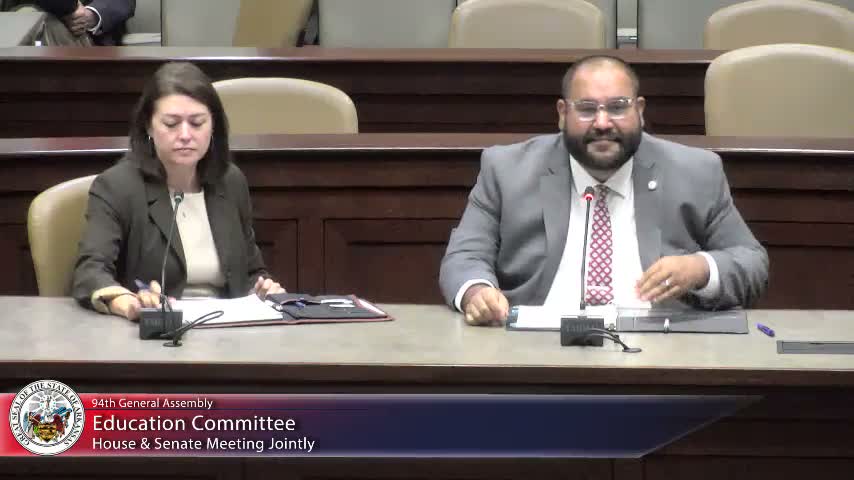
Courtney Solis Ford, chief of staff for the Department of Education, and Andreas Rhodes, the department's chief legal counsel, presented emergency rules the department said are needed to begin the Education Freedom Account (EFA) program under the LEARNS Act.
"Education Freedom accounts or EFAs will allow participating students and families to cover private school tuition, fees, uniforms, and other required expenses with state funding," Rhodes said, summarizing the program and the department's proposed rules. He said EFAs can allocate up to 90% of the state's prior-year per-student foundation funding and that the 2023'24 per-student amount is about $6,600.
The department told the committee it has received roughly 3,400 applications and approved about 2,000 so far for year one. Staff estimated that if all approved students fully use their accounts, the fiscal impact would be just over $30 million; the program cap for year one was stated as $46 million. Applications began June 20, and department staff said outreach so far has been carried out largely by private schools and third parties rather than by state-paid marketing.
Why it matters: the emergency rules will allow the state to operate EFAs beginning Aug. 1, a date that several members connected to pending litigation and to implementation logistics. Committee members pressed the department on several practical safeguards and on how the program will be monitored and measured.
Committee concerns and clarifications
- Accountability for private schools: Several members, including Senator Hammer, asked what steps the department would take if private providers show high turnover, expel students or commit fraud. Rhodes said participating private schools must provide enrollment data to the department; unexplained patterns would prompt conversations about eligibility and could trigger investigations and referrals to the attorney general's office. He said statutory accountability differs from the public-school regime, but that the department can remove providers from the program for fraud or lack of accreditation.
- Student reenrollment and fund flow: Senator Chesterfield asked whether a student expelled from a private school can return to public school and what happens to unused EFA funds. The department said parents may reenroll children in public school and that any unused funds in an individual EFA roll back into the program fund; public-school funding continues to be paid based on prior-year enrollment rules.
- Teacher qualifications: Multiple members sought clarity about the phrase "equivalent documented experience" in the rules. The department said licensure pathways (including emergency permits and Act 1240 waivers) allow some teachers to work without a bachelor's degree while pursuing full licensure, but that decisions are made case by case. Senator Chesterfield requested a clearer "floor" for teacher qualifications; he asked the department to supply examples of the alternative pathways it referenced.
- Testing and program evaluation: The proposed rules require program evaluations and nationally norm-referenced assessments for participating students unless exempted by disability accommodations. The department said testing is intended to provide objective data but that permanent rules will consider additional evaluation measures. Committee members pressed whether only voucher students or entire private-school campuses would be subject to testing; the department said testing requirements apply only to students who receive EFA funds.
- Auditing and enforcement: Committee members were told audits will begin this year, but contract work to run audits was delayed until after Aug. 1 because of prior litigation and a temporary restraining order; referrals for misuse could lead to civil or criminal actions depending on the nature and amount of misspent funds.
Committee action and next steps
Representative Wing moved that the House recommend review and approval of the proposed emergency rules; the house voice vote responded "aye" and the motion carried. In the senate, Senator Dawson moved the same recommendation, Senator Chesterfield seconded, and the senate voice vote carried. Committee leadership said the recommendation will go to the ALC executive subcommittee at noon Thursday for further consideration.
The committee adjourned after the votes.
Reported authorities and procedural notes
The department framed the rules as implementing the LEARNS Act (Act 237 of 2023) and cited section 42 as the authorizing provision. The Individuals with Disabilities Education Act (IDEA) was cited when the department described eligibility and testing accommodations. The department and state board staff told the committee the emergency rules are temporary (120 days after subcommittee approval) and that a permanent rules process with public comment is underway.
What the committee asked for next: members requested dashboards and demographic breakdowns of applicants and approved EFA recipients, written examples and citations for alternative licensure pathways, clarification about the auditing timeline and scope, and a posted list of approved private schools. These follow-ups were to be provided to committee staff.
"Education Freedom accounts or EFAs will allow participating students and families to cover private school tuition, fees, uniforms, and other required expenses with state funding," Rhodes said, summarizing the program and the department's proposed rules. He said EFAs can allocate up to 90% of the state's prior-year per-student foundation funding and that the 2023'24 per-student amount is about $6,600.
The department told the committee it has received roughly 3,400 applications and approved about 2,000 so far for year one. Staff estimated that if all approved students fully use their accounts, the fiscal impact would be just over $30 million; the program cap for year one was stated as $46 million. Applications began June 20, and department staff said outreach so far has been carried out largely by private schools and third parties rather than by state-paid marketing.
Why it matters: the emergency rules will allow the state to operate EFAs beginning Aug. 1, a date that several members connected to pending litigation and to implementation logistics. Committee members pressed the department on several practical safeguards and on how the program will be monitored and measured.
Committee concerns and clarifications
- Accountability for private schools: Several members, including Senator Hammer, asked what steps the department would take if private providers show high turnover, expel students or commit fraud. Rhodes said participating private schools must provide enrollment data to the department; unexplained patterns would prompt conversations about eligibility and could trigger investigations and referrals to the attorney general's office. He said statutory accountability differs from the public-school regime, but that the department can remove providers from the program for fraud or lack of accreditation.
- Student reenrollment and fund flow: Senator Chesterfield asked whether a student expelled from a private school can return to public school and what happens to unused EFA funds. The department said parents may reenroll children in public school and that any unused funds in an individual EFA roll back into the program fund; public-school funding continues to be paid based on prior-year enrollment rules.
- Teacher qualifications: Multiple members sought clarity about the phrase "equivalent documented experience" in the rules. The department said licensure pathways (including emergency permits and Act 1240 waivers) allow some teachers to work without a bachelor's degree while pursuing full licensure, but that decisions are made case by case. Senator Chesterfield requested a clearer "floor" for teacher qualifications; he asked the department to supply examples of the alternative pathways it referenced.
- Testing and program evaluation: The proposed rules require program evaluations and nationally norm-referenced assessments for participating students unless exempted by disability accommodations. The department said testing is intended to provide objective data but that permanent rules will consider additional evaluation measures. Committee members pressed whether only voucher students or entire private-school campuses would be subject to testing; the department said testing requirements apply only to students who receive EFA funds.
- Auditing and enforcement: Committee members were told audits will begin this year, but contract work to run audits was delayed until after Aug. 1 because of prior litigation and a temporary restraining order; referrals for misuse could lead to civil or criminal actions depending on the nature and amount of misspent funds.
Committee action and next steps
Representative Wing moved that the House recommend review and approval of the proposed emergency rules; the house voice vote responded "aye" and the motion carried. In the senate, Senator Dawson moved the same recommendation, Senator Chesterfield seconded, and the senate voice vote carried. Committee leadership said the recommendation will go to the ALC executive subcommittee at noon Thursday for further consideration.
The committee adjourned after the votes.
Reported authorities and procedural notes
The department framed the rules as implementing the LEARNS Act (Act 237 of 2023) and cited section 42 as the authorizing provision. The Individuals with Disabilities Education Act (IDEA) was cited when the department described eligibility and testing accommodations. The department and state board staff told the committee the emergency rules are temporary (120 days after subcommittee approval) and that a permanent rules process with public comment is underway.
What the committee asked for next: members requested dashboards and demographic breakdowns of applicants and approved EFA recipients, written examples and citations for alternative licensure pathways, clarification about the auditing timeline and scope, and a posted list of approved private schools. These follow-ups were to be provided to committee staff.
View the Full Meeting & All Its Details
This article offers just a summary. Unlock complete video, transcripts, and insights as a Founder Member.
✓
Watch full, unedited meeting videos
✓
Search every word spoken in unlimited transcripts
✓
AI summaries & real-time alerts (all government levels)
✓
Permanent access to expanding government content
30-day money-back guarantee
