Representative Kozart previews bill modeled on Tennessee's TISA to redesign Arkansas school funding
October 02, 2023 | EDUCATION COMMITTEE - SENATE, Senate, Committees, Legislative, Arkansas
This article was created by AI summarizing key points discussed. AI makes mistakes, so for full details and context, please refer to the video of the full meeting. Please report any errors so we can fix them. Report an error »
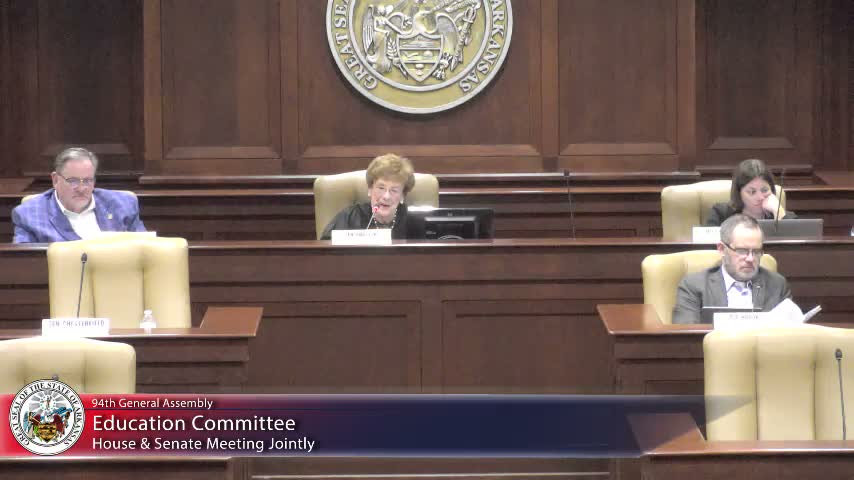
Representative Kozart presented a legislative framework to the committee to redesign Arkansas's school funding, describing it as modeled on the Tennessee Investment in Student Achievement (TISA) approach and noting his earlier effort (the transcript records last session's bill as "HB 16 89"). He said the bill would: establish a foundation base amount for every student, apply multiple weights for students with concentrated poverty, limited English proficiency and special needs, provide direct funding for early-grade literacy and other state priorities, and award outcome funds for meeting performance targets such as third-grade reading proficiency and high-school readiness.
Kozart summarized implementation mechanics in the bill text: foundation funding would be determined on current-year enrollment rather than prior-year enrollment; many categorical and supplemental funds would be combined into one per-student distribution; districts would submit an annual accountability plan describing goals, spending and performance measures; and the department would set up up to 10 "unique learning needs" weights. He outlined a phased hold-harmless to ease transition: the bill as presented included a phase of 90% state coverage in year one, then 75%, 50% and 25% over subsequent years (Kozart said these figures are open to revision during rewrite and staff work).
Kozart supplied enrollment counts for special populations from the 2022 data he referenced in the bill: 39,736 English language learners across 232 districts; 68,020 special education students across 257 districts and charters; 281,595 economically disadvantaged students across 254 districts; and enumerated small/sparse district student counts with thresholds used in the bill's matrix. He said funds would be unrestricted at the district level but would require public annual reporting and accountability plans.
Committee members asked whether the proposal would displace or align with the LEARNS Act and about public engagement; Kozart said he intends to coordinate with the governor's office, the chairs and education stakeholders and to hold public review during the summer adequacy process before reintroducing the bill for the next session. No committee vote or formal amendment occurred at this hearing.
Kozart summarized implementation mechanics in the bill text: foundation funding would be determined on current-year enrollment rather than prior-year enrollment; many categorical and supplemental funds would be combined into one per-student distribution; districts would submit an annual accountability plan describing goals, spending and performance measures; and the department would set up up to 10 "unique learning needs" weights. He outlined a phased hold-harmless to ease transition: the bill as presented included a phase of 90% state coverage in year one, then 75%, 50% and 25% over subsequent years (Kozart said these figures are open to revision during rewrite and staff work).
Kozart supplied enrollment counts for special populations from the 2022 data he referenced in the bill: 39,736 English language learners across 232 districts; 68,020 special education students across 257 districts and charters; 281,595 economically disadvantaged students across 254 districts; and enumerated small/sparse district student counts with thresholds used in the bill's matrix. He said funds would be unrestricted at the district level but would require public annual reporting and accountability plans.
Committee members asked whether the proposal would displace or align with the LEARNS Act and about public engagement; Kozart said he intends to coordinate with the governor's office, the chairs and education stakeholders and to hold public review during the summer adequacy process before reintroducing the bill for the next session. No committee vote or formal amendment occurred at this hearing.
View the Full Meeting & All Its Details
This article offers just a summary. Unlock complete video, transcripts, and insights as a Founder Member.
✓
Watch full, unedited meeting videos
✓
Search every word spoken in unlimited transcripts
✓
AI summaries & real-time alerts (all government levels)
✓
Permanent access to expanding government content
30-day money-back guarantee
