Officials detail CTE audit findings and plans for credentials, alignment and startup grants
November 06, 2023 | EDUCATION COMMITTEE - SENATE, Senate, Committees, Legislative, Arkansas
This article was created by AI summarizing key points discussed. AI makes mistakes, so for full details and context, please refer to the video of the full meeting. Please report any errors so we can fix them. Report an error »
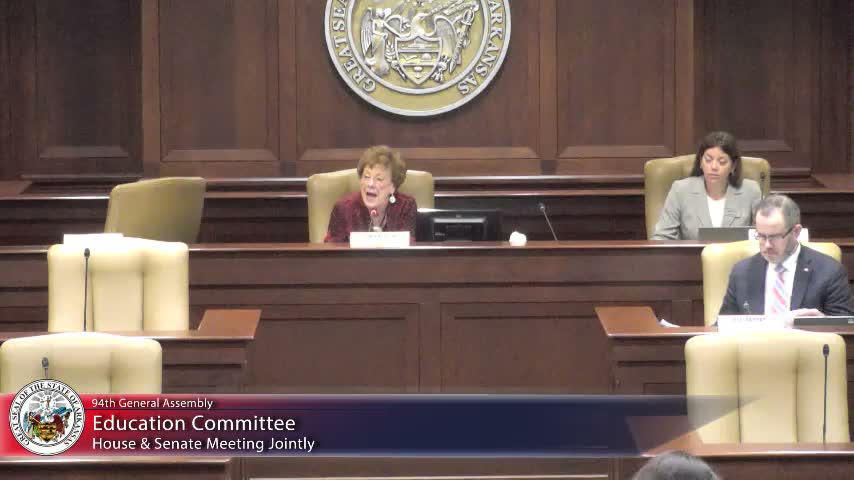
State officials told the Senate Education Committee that Arkansas has strong pockets of career and technical education (CTE) but needs greater statewide alignment so CTE pathways reliably lead to postsecondary credit and workforce-ready credentials.
Ross White, director of the Division of Career and Technical Education, said the governor-ordered audit identified two priority areas: (1) low rates of students earning postsecondary credit while in K–12 and (2) an overrepresentation of legacy programs that may not align to the state's high-skill, high-wage, high-demand (H3) priorities. "Roughly 6 in 10 jobs in our state require advanced credentials," White said, framing the audit's urgency.
White outlined program structure (63 unique pathways, 256 courses), a three-level course sequence (foundation to advanced), and the department’s plan to push for stronger K–12/postsecondary articulation, including a statewide credentials-of-value list the state hopes to define within the academic year. He said the career diploma — a designation that complements the state’s 22 required credits with pathway-focused 'plus' options — will be described publicly in December.
On grants, White described a state startup grant program that opens each August and closes Nov. 1 with roughly $2,000,000 in appropriation. The application rubric now emphasizes regional labor-market alignment, student interest, letters of business and industry support, and postsecondary partnerships; the state typically funds 25–40 of about 97 annual applications. White said the grant covers 85% of startup equipment costs, with districts required to provide 15% matching funds.
Committee members pressed on rubric changes and small-district impacts; White and higher-education representatives said the rubric now intentionally aligns scoring to local labor-market data to improve long-term student outcomes and reduce mismatch between program offerings and employer demand. Officials pointed to Act 242 work requiring course-equivalency recommendations due Dec. 15 and a departmental review with a final list to be published by Jan. 15 to help standardize credit transfer and concurrent-credit pathways.
The presentation outlined concrete implementation steps but produced no legislative action at the hearing. Committee members requested the CTE startup-rubric and award-by-district-size data to evaluate small-school access to grants and to monitor rollout of credentials and the career diploma.
Ross White, director of the Division of Career and Technical Education, said the governor-ordered audit identified two priority areas: (1) low rates of students earning postsecondary credit while in K–12 and (2) an overrepresentation of legacy programs that may not align to the state's high-skill, high-wage, high-demand (H3) priorities. "Roughly 6 in 10 jobs in our state require advanced credentials," White said, framing the audit's urgency.
White outlined program structure (63 unique pathways, 256 courses), a three-level course sequence (foundation to advanced), and the department’s plan to push for stronger K–12/postsecondary articulation, including a statewide credentials-of-value list the state hopes to define within the academic year. He said the career diploma — a designation that complements the state’s 22 required credits with pathway-focused 'plus' options — will be described publicly in December.
On grants, White described a state startup grant program that opens each August and closes Nov. 1 with roughly $2,000,000 in appropriation. The application rubric now emphasizes regional labor-market alignment, student interest, letters of business and industry support, and postsecondary partnerships; the state typically funds 25–40 of about 97 annual applications. White said the grant covers 85% of startup equipment costs, with districts required to provide 15% matching funds.
Committee members pressed on rubric changes and small-district impacts; White and higher-education representatives said the rubric now intentionally aligns scoring to local labor-market data to improve long-term student outcomes and reduce mismatch between program offerings and employer demand. Officials pointed to Act 242 work requiring course-equivalency recommendations due Dec. 15 and a departmental review with a final list to be published by Jan. 15 to help standardize credit transfer and concurrent-credit pathways.
The presentation outlined concrete implementation steps but produced no legislative action at the hearing. Committee members requested the CTE startup-rubric and award-by-district-size data to evaluate small-school access to grants and to monitor rollout of credentials and the career diploma.
Don't Miss a Word: See the Full Meeting!
Go beyond summaries. Unlock every video, transcript, and key insight with a Founder Membership.
✓
Get instant access to full meeting videos
✓
Search and clip any phrase from complete transcripts
✓
Receive AI-powered summaries & custom alerts
✓
Enjoy lifetime, unrestricted access to government data
30-day money-back guarantee
