Senate Education subcommittee approves emergency rule creating $500 family literacy grants and in-school high-impact tutoring program
January 08, 2024 | EDUCATION COMMITTEE - SENATE, Senate, Committees, Legislative, Arkansas
This article was created by AI summarizing key points discussed. AI makes mistakes, so for full details and context, please refer to the video of the full meeting. Please report any errors so we can fix them. Report an error »
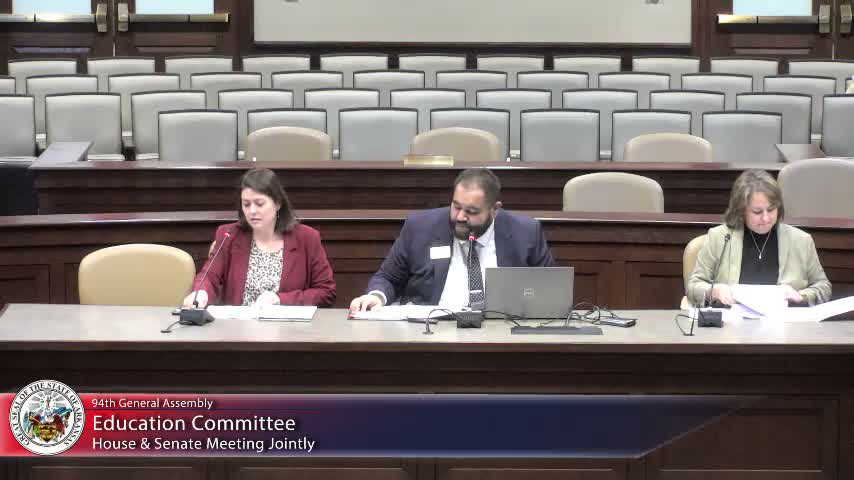
The Senate Education rule-review subcommittee approved an emergency rule that sets up two state-supported tutoring programs aimed at struggling readers and other students across grade levels.
Andres Rhodes, chief legal counsel to the Department of Education, said the rule "provides the framework for 2 separate tutoring programs." One program allows families of K–3 students who are reading below grade level to invoice the department for up to $500 per eligible child for out-of-school tutoring. The second creates a High Impact Tutoring Program under which the department will pay approved providers to deliver tutoring in school districts during the school day.
The department described priority rules and provider criteria. Priority will be given to students retained from the prior year and then to students in the lowest-performing groups (the lowest 15% of the K–3 reporting category, then successive grade-level groupings). For district-run High Impact Tutoring, approved providers must demonstrate experience and outcomes, receive training in the science of reading, and meet other departmental criteria. Rhodes said high-impact services must occur at least three times per week for 30 minutes per session and are intended to supplement — not replace — regular classroom instruction.
Questions from lawmakers focused on funding limits and equity. Senator Bryant asked whether districts could cap payments to third-party contractors; Courtney Salas Ford of the Department of Education said districts apply for a set amount of funds and propose how much they would pay vendors in their applications, so the department has not set a single statewide vendor cap. Representative Botte pressed whether $500 would meaningfully help low-income families; Stacy Smith, deputy commissioner, said "the $500 was set in legislation" and that vendor pricing varies by provider (department materials list bids that may range roughly from 10 to 25 sessions depending on vendor). Smith added vendors must submit progress-monitoring reports and the department can remove providers that do not show student growth.
The committee moved to approve the emergency rule and recorded the motion as approved; a second was recorded as Senator Hammer. The committee took a voice vote and the chair stated the rule had been reviewed and approved. The department noted the permanent rule is open for public comment and that the public comment period closes on 01/22/2024.
What happens next: The department will operate the emergency rule while the permanent rule proceeds through public comment and rulemaking. Parents identified by assessment scores will be notified by letter about eligibility for the $500 literacy tutoring grant, and districts will receive application guidance for the High Impact Tutoring Program.
Andres Rhodes, chief legal counsel to the Department of Education, said the rule "provides the framework for 2 separate tutoring programs." One program allows families of K–3 students who are reading below grade level to invoice the department for up to $500 per eligible child for out-of-school tutoring. The second creates a High Impact Tutoring Program under which the department will pay approved providers to deliver tutoring in school districts during the school day.
The department described priority rules and provider criteria. Priority will be given to students retained from the prior year and then to students in the lowest-performing groups (the lowest 15% of the K–3 reporting category, then successive grade-level groupings). For district-run High Impact Tutoring, approved providers must demonstrate experience and outcomes, receive training in the science of reading, and meet other departmental criteria. Rhodes said high-impact services must occur at least three times per week for 30 minutes per session and are intended to supplement — not replace — regular classroom instruction.
Questions from lawmakers focused on funding limits and equity. Senator Bryant asked whether districts could cap payments to third-party contractors; Courtney Salas Ford of the Department of Education said districts apply for a set amount of funds and propose how much they would pay vendors in their applications, so the department has not set a single statewide vendor cap. Representative Botte pressed whether $500 would meaningfully help low-income families; Stacy Smith, deputy commissioner, said "the $500 was set in legislation" and that vendor pricing varies by provider (department materials list bids that may range roughly from 10 to 25 sessions depending on vendor). Smith added vendors must submit progress-monitoring reports and the department can remove providers that do not show student growth.
The committee moved to approve the emergency rule and recorded the motion as approved; a second was recorded as Senator Hammer. The committee took a voice vote and the chair stated the rule had been reviewed and approved. The department noted the permanent rule is open for public comment and that the public comment period closes on 01/22/2024.
What happens next: The department will operate the emergency rule while the permanent rule proceeds through public comment and rulemaking. Parents identified by assessment scores will be notified by letter about eligibility for the $500 literacy tutoring grant, and districts will receive application guidance for the High Impact Tutoring Program.
View the Full Meeting & All Its Details
This article offers just a summary. Unlock complete video, transcripts, and insights as a Founder Member.
✓
Watch full, unedited meeting videos
✓
Search every word spoken in unlimited transcripts
✓
AI summaries & real-time alerts (all government levels)
✓
Permanent access to expanding government content
30-day money-back guarantee
