State bureau updates Lakeview-era measures and current student achievement; committee seeks follow-up data
January 09, 2024 | EDUCATION COMMITTEE - SENATE, Senate, Committees, Legislative, Arkansas
This article was created by AI summarizing key points discussed. AI makes mistakes, so for full details and context, please refer to the video of the full meeting. Please report any errors so we can fix them. Report an error »
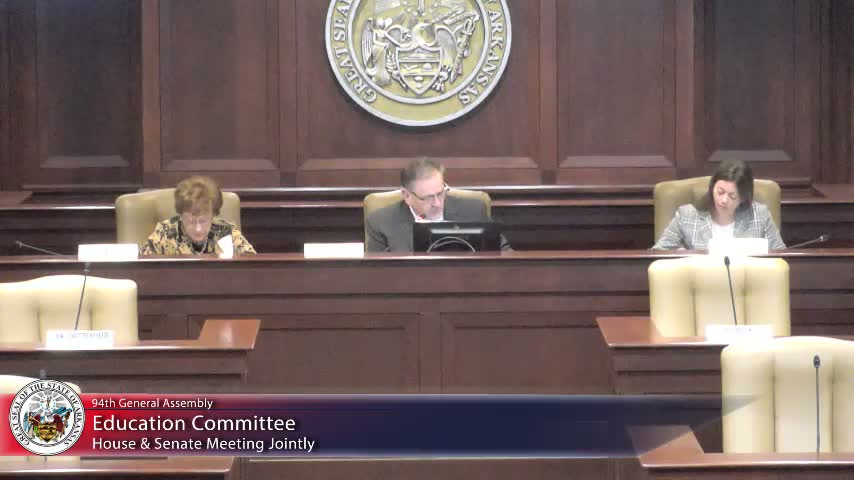
Julie Holt and Adrienne Beck of the bureau presented updated evidence tied to the Lakeview (Kilgore) court findings and a set of current academic measures to the Education Committee on an adequacy study panel. Holt opened by recounting the Pulaski Chancery Court decision (Judge Kilgore, Feb. 2001) that was later affirmed as the Lakeview decision and said the court’s indicators included state test performance, educational‑attainment measures and financial data. Holt and Beck cautioned that changes in tests and accountability systems over the past three decades limit direct score comparisons across eras.
Holt traced Arkansas testing history from the ACTAP benchmark era through PARCC and a later move to ACT Aspire, and said participation changes—especially the expansion to universal ACT testing—affect state averages. She summarized long‑run, census‑based indicators: Arkansas remains below national averages in bachelor’s and graduate degree shares (bachelor’s ~25.3% vs. national ~35%; graduate/professional ~9.4%), while median household income and teacher salary rankings have improved modestly but remain below national medians.
Beck then presented 2022 NAEP results and recent statewide test measures. Key figures cited included 2022 NAEP proficiency for Arkansas fourth‑grade math (28% at or above proficient vs. 35% nationally) and fourth‑grade reading (30% vs. 32% nationally). On the ACT (class of 2023 eleventh graders), the statewide composite was reported near 18.2 (subject ranges roughly 17.6–18.6) with about 12% meeting all four college‑readiness benchmarks; bureau staff noted participation rates matter when comparing across states. Beck explained that ACT Aspire (grades 3–10) measures will be superseded by ATLAS and described two principal measures used for adequacy reporting: percent of students scoring “ready or exceeding” and a value‑added growth score where 80 is on target.
Bureau staff highlighted subgroup findings: ELL, NSL (National School Lunch), ALE, and students with disabilities show lower readiness percentages—examples included ALE students at roughly 5% ready in math and 9% in ELA, ELL students about 7% ready in ELA and 14% in math in 2023, and students with disabilities roughly 6% (ELA) and 10% (math) ready in 2023—while growth scores for many groups hovered near the 80 on‑target benchmark. The 4‑year graduation rate was cited at 89% in 2023 (compared with a national average cited from NCES of 87% in the latest available national data).
Committee members asked for additional context and follow‑up data. Questions included: the cost‑of‑living index used for interstate income comparisons (Holt said her team uses the Missouri‑produced index and would provide specifics), whether NAEP and state trend patterns represent longitudinal cohorts or snapshots (staff said many displays are snapshots but the department can provide more detailed cohort analyses), how ALE programs are monitored and compared across states, and whether ACT/college‑readiness figures correlate with actual remediation rates in higher education (staff said longitudinal tracking from K–12 to higher education is not available in their datasets but could be pursued through other agencies). Staff committed to email exhibits and follow up on specific indices and cross‑state program comparisons.
Holt traced Arkansas testing history from the ACTAP benchmark era through PARCC and a later move to ACT Aspire, and said participation changes—especially the expansion to universal ACT testing—affect state averages. She summarized long‑run, census‑based indicators: Arkansas remains below national averages in bachelor’s and graduate degree shares (bachelor’s ~25.3% vs. national ~35%; graduate/professional ~9.4%), while median household income and teacher salary rankings have improved modestly but remain below national medians.
Beck then presented 2022 NAEP results and recent statewide test measures. Key figures cited included 2022 NAEP proficiency for Arkansas fourth‑grade math (28% at or above proficient vs. 35% nationally) and fourth‑grade reading (30% vs. 32% nationally). On the ACT (class of 2023 eleventh graders), the statewide composite was reported near 18.2 (subject ranges roughly 17.6–18.6) with about 12% meeting all four college‑readiness benchmarks; bureau staff noted participation rates matter when comparing across states. Beck explained that ACT Aspire (grades 3–10) measures will be superseded by ATLAS and described two principal measures used for adequacy reporting: percent of students scoring “ready or exceeding” and a value‑added growth score where 80 is on target.
Bureau staff highlighted subgroup findings: ELL, NSL (National School Lunch), ALE, and students with disabilities show lower readiness percentages—examples included ALE students at roughly 5% ready in math and 9% in ELA, ELL students about 7% ready in ELA and 14% in math in 2023, and students with disabilities roughly 6% (ELA) and 10% (math) ready in 2023—while growth scores for many groups hovered near the 80 on‑target benchmark. The 4‑year graduation rate was cited at 89% in 2023 (compared with a national average cited from NCES of 87% in the latest available national data).
Committee members asked for additional context and follow‑up data. Questions included: the cost‑of‑living index used for interstate income comparisons (Holt said her team uses the Missouri‑produced index and would provide specifics), whether NAEP and state trend patterns represent longitudinal cohorts or snapshots (staff said many displays are snapshots but the department can provide more detailed cohort analyses), how ALE programs are monitored and compared across states, and whether ACT/college‑readiness figures correlate with actual remediation rates in higher education (staff said longitudinal tracking from K–12 to higher education is not available in their datasets but could be pursued through other agencies). Staff committed to email exhibits and follow up on specific indices and cross‑state program comparisons.
View the Full Meeting & All Its Details
This article offers just a summary. Unlock complete video, transcripts, and insights as a Founder Member.
✓
Watch full, unedited meeting videos
✓
Search every word spoken in unlimited transcripts
✓
AI summaries & real-time alerts (all government levels)
✓
Permanent access to expanding government content
30-day money-back guarantee
