Education committee hears staffing report; bureau staff say matrix is a funding, not a spending, model
March 11, 2024 | EDUCATION COMMITTEE - SENATE, Senate, Committees, Legislative, Arkansas
This article was created by AI summarizing key points discussed. AI makes mistakes, so for full details and context, please refer to the video of the full meeting. Please report any errors so we can fix them. Report an error »
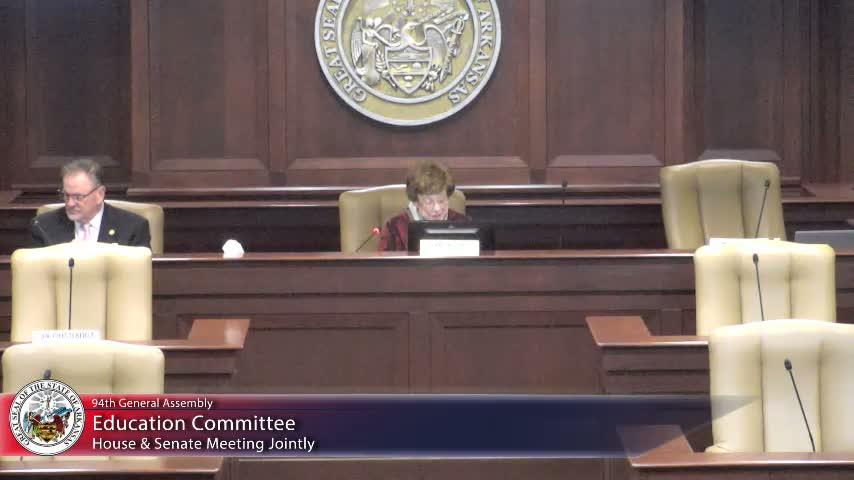
At a joint meeting of the Senate Education Committee, Bureau of Legislative Research staff reviewed the matrix staffing report and described a recurring pattern: foundation funding provides for staff positions across districts, but district expenditures do not always match those line items.
“It's a funding model. It's not a spending model,” Jasmine Ray, a BLR presenter, said while explaining why foundation allocations and district expenditures can diverge. Committee members pressed the presenters for specifics on apparent shortfalls; one member noted that, when comparing foundation funding to reported expenditures across staffing lines, districts were spending about $223,000,000 less of the foundation funding on staffing than the state provided.
The report examined multiple staffing lines in the FY2023 data. Highlights included kindergarten staffing (the matrix assumes two core kindergarten teachers per prototypical 500‑student school and class‑size rules that may require additional teachers), graded classroom teacher funding that accounted for roughly 27.2% of foundation dollars, and special education staffing (matrix funds 2.9 special‑education teachers per 500 students; FY2023 districts spent roughly $270 million on special‑education teachers, roughly $70 million more than they received in foundation funding for that line).
Presenters compared the matrix assumptions to evidence‑based models used by consultants the committee has previously engaged (Auden & Pikus; APA). Those studies generally recommend smaller student–teacher ratios in early grades; BLR staff showed state and regional per‑pupil spending patterns and noted Arkansas spends about $800 less per pupil than the national average on regular‑program instructional salaries (NCES 2020 data).
The staffing report also reviewed student‑support positions. BLR staff reported that roughly 60–70% of responding superintendents indicated a moderate or extreme need for additional funding for classroom teachers, special‑education teachers, instructional facilitators and nurses. Teacher survey response rates were low: BLR said teacher respondents represented a small share of the teacher workforce, while the superintendent survey had 100% participation.
During Q&A, committee members sought granular explanations for where foundation dollars were actually spent when not used on the matrix lines. BLR staff said some foundation dollars are being used for non‑matrix needs (for example, dyslexia services or other state requirements) and for district priorities (operations, maintenance, or categorical items). Staff committed to providing more detail in the forthcoming categorical funding and district‑level resource reports and to adding targeted survey questions if the committee wants more granular accounting.
No formal committee action was taken on funding policy at the meeting. Presenters said the next resource‑allocation reports will include non‑matrix spending, categorical funding breakdowns and additional district‑level detail that should help legislators track where foundation funds are actually expended.
“It's a funding model. It's not a spending model,” Jasmine Ray, a BLR presenter, said while explaining why foundation allocations and district expenditures can diverge. Committee members pressed the presenters for specifics on apparent shortfalls; one member noted that, when comparing foundation funding to reported expenditures across staffing lines, districts were spending about $223,000,000 less of the foundation funding on staffing than the state provided.
The report examined multiple staffing lines in the FY2023 data. Highlights included kindergarten staffing (the matrix assumes two core kindergarten teachers per prototypical 500‑student school and class‑size rules that may require additional teachers), graded classroom teacher funding that accounted for roughly 27.2% of foundation dollars, and special education staffing (matrix funds 2.9 special‑education teachers per 500 students; FY2023 districts spent roughly $270 million on special‑education teachers, roughly $70 million more than they received in foundation funding for that line).
Presenters compared the matrix assumptions to evidence‑based models used by consultants the committee has previously engaged (Auden & Pikus; APA). Those studies generally recommend smaller student–teacher ratios in early grades; BLR staff showed state and regional per‑pupil spending patterns and noted Arkansas spends about $800 less per pupil than the national average on regular‑program instructional salaries (NCES 2020 data).
The staffing report also reviewed student‑support positions. BLR staff reported that roughly 60–70% of responding superintendents indicated a moderate or extreme need for additional funding for classroom teachers, special‑education teachers, instructional facilitators and nurses. Teacher survey response rates were low: BLR said teacher respondents represented a small share of the teacher workforce, while the superintendent survey had 100% participation.
During Q&A, committee members sought granular explanations for where foundation dollars were actually spent when not used on the matrix lines. BLR staff said some foundation dollars are being used for non‑matrix needs (for example, dyslexia services or other state requirements) and for district priorities (operations, maintenance, or categorical items). Staff committed to providing more detail in the forthcoming categorical funding and district‑level resource reports and to adding targeted survey questions if the committee wants more granular accounting.
No formal committee action was taken on funding policy at the meeting. Presenters said the next resource‑allocation reports will include non‑matrix spending, categorical funding breakdowns and additional district‑level detail that should help legislators track where foundation funds are actually expended.
View the Full Meeting & All Its Details
This article offers just a summary. Unlock complete video, transcripts, and insights as a Founder Member.
✓
Watch full, unedited meeting videos
✓
Search every word spoken in unlimited transcripts
✓
AI summaries & real-time alerts (all government levels)
✓
Permanent access to expanding government content
30-day money-back guarantee
