Arkansas education officials describe Alternative Learning Environments as intervention-focused; committee requests more data on outcomes and monitoring
February 05, 2024 | EDUCATION COMMITTEE - SENATE, Senate, Committees, Legislative, Arkansas
This article was created by AI summarizing key points discussed. AI makes mistakes, so for full details and context, please refer to the video of the full meeting. Please report any errors so we can fix them. Report an error »
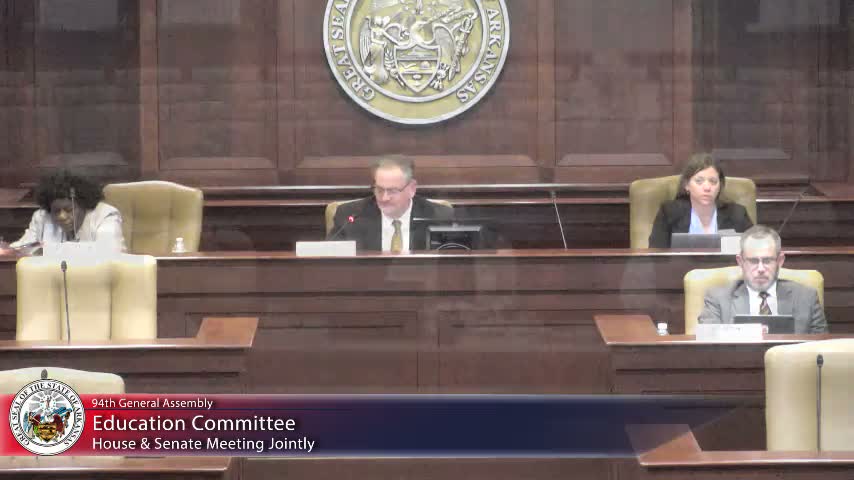
Stacy Smith, Deputy Commissioner at the Arkansas Department of Education, and Jared Hogue, ALE program manager, presented an overview of Alternative Learning Environments to the Senate Education Committee, emphasizing that ALEs are intended as interventions rather than punitive placements.
"A lot of people have in their mind that ALE is this punitive place that you send kids that are bad," Smith said. "...that's not what alternative learning environments are supposed to be."
Smith and Hogue described placement criteria (students must meet at least two indicators such as academic struggles, trauma, frequent relocation, homelessness, high absenteeism or disruptive behavior) and explained that placement decisions are made by an Alternative Education Placement Committee that includes the school counselor, administrators, classroom teachers familiar with the student, the parent, the ALE administrator and the ALE educator.
On funding and scale, ADE staff said ALE is a categorical fund that received over $28 million in the most recent allocation. A student must be in an ALE setting for at least 20 consecutive days to generate funding; ADE cited an adequacy figure of $4,890 for a full-time ALE student (paid pro rata for partial placements). Smith said more than 11,000 students were served in ALE settings in the last year, equivalent to about 5,800 full-time equivalents.
Hogue described service models and monitoring: student action plans must be created within five days of placement and include short- and long-term goals informed by diagnostic assessments. The Division does on-site monitoring on a three-year rotation and applies a risk assessment that can trigger more frequent visits; when noncompliance is found, ADE issues a corrective report and requires remediation with follow-up visits (30–60 days depending on severity).
The committee pressed ADE on supports and fidelity. Senator Chesterfield asked how many staff are assigned to monitor ALE statewide; Hogue said the program office includes a director and three program advisors (one half-time). Smith and Hogue said staff rely on desk monitoring and a risk-assessment system to prioritize on-site visits; they committed to provide the committee with more granular data about counselors/mental-health partnerships, staffing, teacher turnover, and disaggregated student outcomes by race, gender, and district.
ADE cited outcome figures that committee members flagged for follow-up. Smith said of 2,719 twelfth-graders placed in ALE last year, 77% graduated, 75% of students placed for academic reasons showed academic improvement while in ALE and 66% improved attendance during placement. ADE staff agreed to pull and share the underlying disaggregated data and methodology for those outcome figures.
Committee members raised concerns about monitoring fidelity, possible misuse (sending students to ALE as an easy removal of disruptive students), teacher turnover in ALE settings, and consistency of counseling/mental-health partnerships. ADE acknowledged those risks, described cooperative hub models (Arch Ford, Dawson, Jonesboro’s Success program) that provide shared services in some regions, and said it would provide additional reports to the committee.
The committee asked ADE to supply a written report with disaggregated outcome data, a breakdown of monitoring visits and complaints handled by unit, and numbers on teacher turnover in ALEs. ADE agreed to provide those materials for the committee’s next meeting.
"A lot of people have in their mind that ALE is this punitive place that you send kids that are bad," Smith said. "...that's not what alternative learning environments are supposed to be."
Smith and Hogue described placement criteria (students must meet at least two indicators such as academic struggles, trauma, frequent relocation, homelessness, high absenteeism or disruptive behavior) and explained that placement decisions are made by an Alternative Education Placement Committee that includes the school counselor, administrators, classroom teachers familiar with the student, the parent, the ALE administrator and the ALE educator.
On funding and scale, ADE staff said ALE is a categorical fund that received over $28 million in the most recent allocation. A student must be in an ALE setting for at least 20 consecutive days to generate funding; ADE cited an adequacy figure of $4,890 for a full-time ALE student (paid pro rata for partial placements). Smith said more than 11,000 students were served in ALE settings in the last year, equivalent to about 5,800 full-time equivalents.
Hogue described service models and monitoring: student action plans must be created within five days of placement and include short- and long-term goals informed by diagnostic assessments. The Division does on-site monitoring on a three-year rotation and applies a risk assessment that can trigger more frequent visits; when noncompliance is found, ADE issues a corrective report and requires remediation with follow-up visits (30–60 days depending on severity).
The committee pressed ADE on supports and fidelity. Senator Chesterfield asked how many staff are assigned to monitor ALE statewide; Hogue said the program office includes a director and three program advisors (one half-time). Smith and Hogue said staff rely on desk monitoring and a risk-assessment system to prioritize on-site visits; they committed to provide the committee with more granular data about counselors/mental-health partnerships, staffing, teacher turnover, and disaggregated student outcomes by race, gender, and district.
ADE cited outcome figures that committee members flagged for follow-up. Smith said of 2,719 twelfth-graders placed in ALE last year, 77% graduated, 75% of students placed for academic reasons showed academic improvement while in ALE and 66% improved attendance during placement. ADE staff agreed to pull and share the underlying disaggregated data and methodology for those outcome figures.
Committee members raised concerns about monitoring fidelity, possible misuse (sending students to ALE as an easy removal of disruptive students), teacher turnover in ALE settings, and consistency of counseling/mental-health partnerships. ADE acknowledged those risks, described cooperative hub models (Arch Ford, Dawson, Jonesboro’s Success program) that provide shared services in some regions, and said it would provide additional reports to the committee.
The committee asked ADE to supply a written report with disaggregated outcome data, a breakdown of monitoring visits and complaints handled by unit, and numbers on teacher turnover in ALEs. ADE agreed to provide those materials for the committee’s next meeting.
Don't Miss a Word: See the Full Meeting!
Go beyond summaries. Unlock every video, transcript, and key insight with a Founder Membership.
✓
Get instant access to full meeting videos
✓
Search and clip any phrase from complete transcripts
✓
Receive AI-powered summaries & custom alerts
✓
Enjoy lifetime, unrestricted access to government data
30-day money-back guarantee
