Consultants tell education committee PSE health fund faces long‑term funding gap without changes
February 06, 2024 | EDUCATION COMMITTEE - SENATE, Senate, Committees, Legislative, Arkansas
This article was created by AI summarizing key points discussed. AI makes mistakes, so for full details and context, please refer to the video of the full meeting. Please report any errors so we can fix them. Report an error »
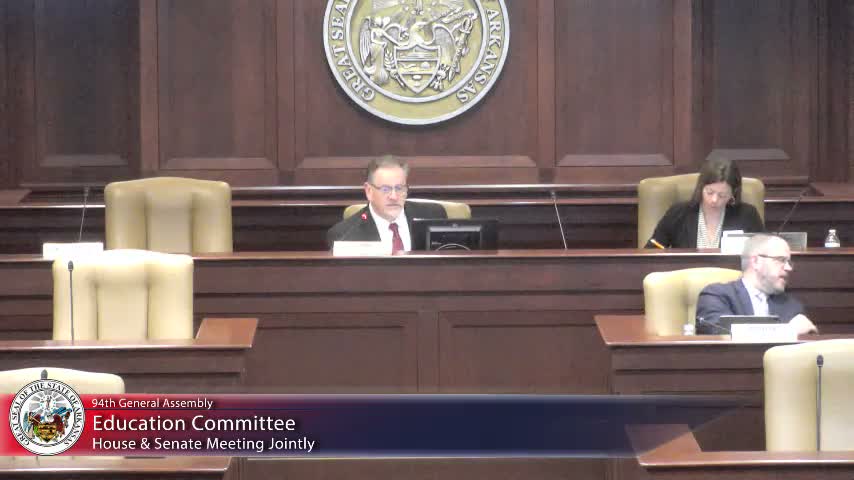
Actuarial advisers and the state employee benefits director told the Joint Committee on Education that Arkansas’ public school employee health fund is currently well‑capitalized but not automatically solvent long term.
Patrick Klein, an actuary with the Segal Group, said the fund is projected to close 2024 with about $265.7 million in assets, well above the 14% target reserve recommended for the plan. “If we do nothing to the funding, the expenses are gonna overtake the revenue, so we’re gonna start seeing a loss in 2025,” Klein said, summarizing baseline projections that rely on Milliman expense trends and updated pharmacy rebate assumptions after a July PBM change.
Klein presented three modeled approaches: leaving funding unchanged (baseline), indexing the minimum district contribution and the Department of Education subsidy to medical CPI (the group used 3.7% for that exercise), and two more intervention options — a steady multi‑year increase spread over a decade (roughly an 8.8% lift spread over 10 years) or a one‑time district contribution adjustment followed by annual indexing. Under the baseline, the fund’s trajectory turns negative in later years in Segal’s projections (Klein showed scenarios in which 2028 shortfalls ranged from tens of millions up to roughly $124 million depending on assumptions); a one‑time step‑up to a higher minimum district contribution (Segal modeled a $365 minimum in later years) followed by indexing produced a more manageable long‑term position.
Grant Wallace, director of the Employee Benefits Division, told the committee the office is working toward predictability and parity across the public‑school and state employee plans. He noted the bureau and EBD are in the second year of a five‑year strategy intended to move toward a 75/25 cost‑share model and said that once a five‑year alignment is reached the EBD plans to use a 6% growth peg across funding mechanisms.
Committee members pressed staff on the drivers of rising costs. Klein said medical claims are the largest single contributor — roughly three‑quarters of total medical and pharmacy spend — with pharmacy claims and administration fees also important. He explained administrative costs reflect per‑member‑per‑month (PMPM) units plus modest inflation on fixed fees and that enrollment growth increases total dollars paid even if unit rates remain flat.
Members also discussed whether a formula could automatically tie revenues to actual expense growth. Klein and Wallace said precise pegging is difficult because claims experience is only known after the fact and the fund relies on a reserve target to smooth year‑to‑year volatility.
The committee voted, by voice, to document that it will continue study of matrix funding amounts for public school health insurance and to submit the presentation materials to legislative leaders to satisfy a March 1 statutory notice requirement; the motion did not itself change funding policy.
Next steps for the committee include additional briefing materials and continued examination of indexing options, reserve targets and the role of one‑time versus recurring revenue adjustments.
Patrick Klein, an actuary with the Segal Group, said the fund is projected to close 2024 with about $265.7 million in assets, well above the 14% target reserve recommended for the plan. “If we do nothing to the funding, the expenses are gonna overtake the revenue, so we’re gonna start seeing a loss in 2025,” Klein said, summarizing baseline projections that rely on Milliman expense trends and updated pharmacy rebate assumptions after a July PBM change.
Klein presented three modeled approaches: leaving funding unchanged (baseline), indexing the minimum district contribution and the Department of Education subsidy to medical CPI (the group used 3.7% for that exercise), and two more intervention options — a steady multi‑year increase spread over a decade (roughly an 8.8% lift spread over 10 years) or a one‑time district contribution adjustment followed by annual indexing. Under the baseline, the fund’s trajectory turns negative in later years in Segal’s projections (Klein showed scenarios in which 2028 shortfalls ranged from tens of millions up to roughly $124 million depending on assumptions); a one‑time step‑up to a higher minimum district contribution (Segal modeled a $365 minimum in later years) followed by indexing produced a more manageable long‑term position.
Grant Wallace, director of the Employee Benefits Division, told the committee the office is working toward predictability and parity across the public‑school and state employee plans. He noted the bureau and EBD are in the second year of a five‑year strategy intended to move toward a 75/25 cost‑share model and said that once a five‑year alignment is reached the EBD plans to use a 6% growth peg across funding mechanisms.
Committee members pressed staff on the drivers of rising costs. Klein said medical claims are the largest single contributor — roughly three‑quarters of total medical and pharmacy spend — with pharmacy claims and administration fees also important. He explained administrative costs reflect per‑member‑per‑month (PMPM) units plus modest inflation on fixed fees and that enrollment growth increases total dollars paid even if unit rates remain flat.
Members also discussed whether a formula could automatically tie revenues to actual expense growth. Klein and Wallace said precise pegging is difficult because claims experience is only known after the fact and the fund relies on a reserve target to smooth year‑to‑year volatility.
The committee voted, by voice, to document that it will continue study of matrix funding amounts for public school health insurance and to submit the presentation materials to legislative leaders to satisfy a March 1 statutory notice requirement; the motion did not itself change funding policy.
Next steps for the committee include additional briefing materials and continued examination of indexing options, reserve targets and the role of one‑time versus recurring revenue adjustments.
Don't Miss a Word: See the Full Meeting!
Go beyond summaries. Unlock every video, transcript, and key insight with a Founder Membership.
✓
Get instant access to full meeting videos
✓
Search and clip any phrase from complete transcripts
✓
Receive AI-powered summaries & custom alerts
✓
Enjoy lifetime, unrestricted access to government data
30-day money-back guarantee
