BLR outlines adequacy options, flags preschool accounting and matrix limits
February 06, 2024 | EDUCATION COMMITTEE - SENATE, Senate, Committees, Legislative, Arkansas
This article was created by AI summarizing key points discussed. AI makes mistakes, so for full details and context, please refer to the video of the full meeting. Please report any errors so we can fix them. Report an error »
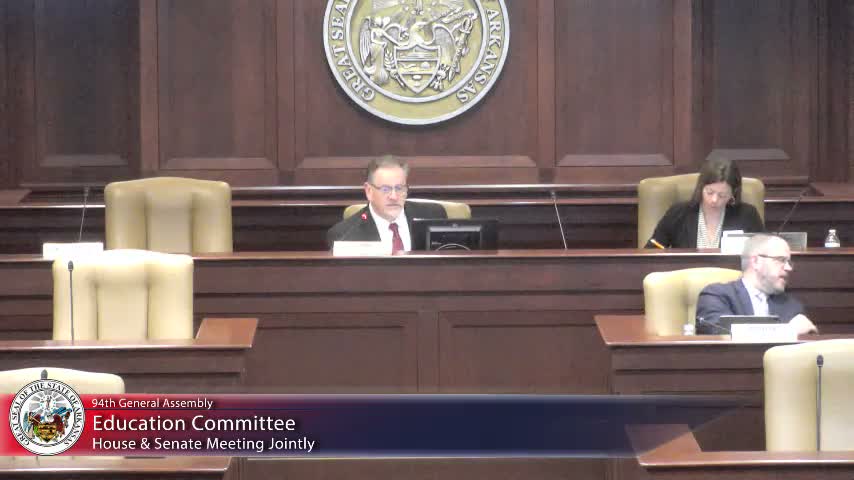
The Bureau of Legislative Research told the Joint Committee on Education that Arkansas uses an evidence‑based adequacy study and a foundation (per‑pupil) distribution model but faces specific implementation challenges.
Julie Holt, a BLR analyst, summarized national shifts that put states — not localities — primarily responsible for funding public education, and she cited landmark court rulings used in Arkansas’ funding history (Alma v. Dupree and Lakeview). In national comparisons using NCES data adjusted for cost of living, Holt said Arkansas had about $13,000 per student — roughly in the 40th position among states.
Holt described four approaches states use to set adequacy (evidence‑based, professional judgment, successful‑schools, cost‑function) and explained that Arkansas relies on an evidence‑based matrix that produces a per‑pupil foundation amount (the matrix provided $7,413 per student in 2023). She noted the matrix is a funding model, not a spending prescription; districts receive foundation dollars but are not restricted to spend them only on matrix items.
The presentation flagged several implementation concerns for committee follow‑up: most Arkansas schools are smaller than the matrix’s 500‑student baseline, which can create local mismatches in funded vs. needed staffing; embedded and stand‑alone preschools complicate average daily membership accounting — BLR reported roughly $35 million spent at 13 stand‑alone preschools but only about $2 million of that from foundation funding, with the rest coming from other state/local and federal sources; and the LEARNS Act allocations (BLR estimated ~$193 million in targeted supports) currently sit outside the adequacy matrix and could be integrated or left separate by legislative choice.
Holt reviewed categorical and supplemental funds (ALE, ELL, ESA, professional development, isolated/remote school funding, growth and decline funding, enhanced transportation, special‑education high‑cost reimbursements) and said BLR will provide more granular resource allocation reports in March and May. Committee members requested additional analyses comparing outcomes for districts that rely closely on the matrix versus those that do not, and Holt agreed to pursue those comparisons, while noting the need to control for variables such as poverty concentration.
The committee closed the meeting with a reminder of the next planned session in March; no adequacy policy changes were adopted at this session.
Julie Holt, a BLR analyst, summarized national shifts that put states — not localities — primarily responsible for funding public education, and she cited landmark court rulings used in Arkansas’ funding history (Alma v. Dupree and Lakeview). In national comparisons using NCES data adjusted for cost of living, Holt said Arkansas had about $13,000 per student — roughly in the 40th position among states.
Holt described four approaches states use to set adequacy (evidence‑based, professional judgment, successful‑schools, cost‑function) and explained that Arkansas relies on an evidence‑based matrix that produces a per‑pupil foundation amount (the matrix provided $7,413 per student in 2023). She noted the matrix is a funding model, not a spending prescription; districts receive foundation dollars but are not restricted to spend them only on matrix items.
The presentation flagged several implementation concerns for committee follow‑up: most Arkansas schools are smaller than the matrix’s 500‑student baseline, which can create local mismatches in funded vs. needed staffing; embedded and stand‑alone preschools complicate average daily membership accounting — BLR reported roughly $35 million spent at 13 stand‑alone preschools but only about $2 million of that from foundation funding, with the rest coming from other state/local and federal sources; and the LEARNS Act allocations (BLR estimated ~$193 million in targeted supports) currently sit outside the adequacy matrix and could be integrated or left separate by legislative choice.
Holt reviewed categorical and supplemental funds (ALE, ELL, ESA, professional development, isolated/remote school funding, growth and decline funding, enhanced transportation, special‑education high‑cost reimbursements) and said BLR will provide more granular resource allocation reports in March and May. Committee members requested additional analyses comparing outcomes for districts that rely closely on the matrix versus those that do not, and Holt agreed to pursue those comparisons, while noting the need to control for variables such as poverty concentration.
The committee closed the meeting with a reminder of the next planned session in March; no adequacy policy changes were adopted at this session.
Don't Miss a Word: See the Full Meeting!
Go beyond summaries. Unlock every video, transcript, and key insight with a Founder Membership.
✓
Get instant access to full meeting videos
✓
Search and clip any phrase from complete transcripts
✓
Receive AI-powered summaries & custom alerts
✓
Enjoy lifetime, unrestricted access to government data
30-day money-back guarantee
