Senate Education Committee reviews learning expectations, SmartCore and digital-learning findings
May 02, 2022 | EDUCATION COMMITTEE - SENATE, Senate, Committees, Legislative, Arkansas
This article was created by AI summarizing key points discussed. AI makes mistakes, so for full details and context, please refer to the video of the full meeting. Please report any errors so we can fix them. Report an error »
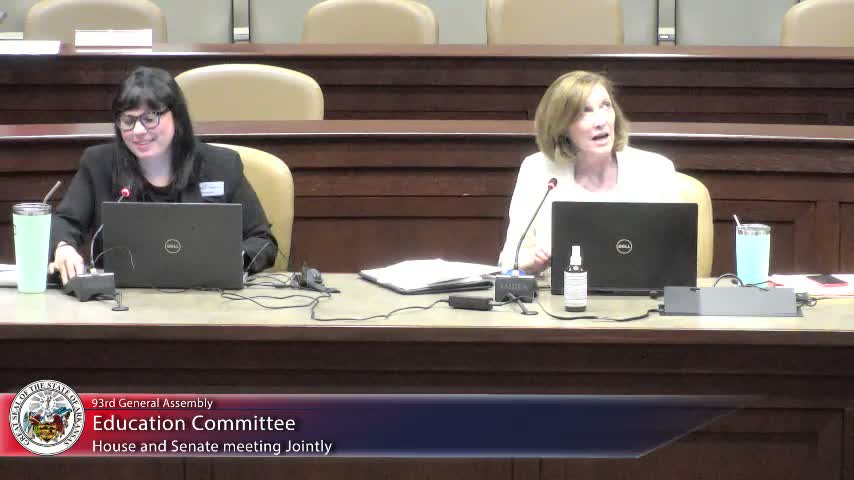
Julie Holt of the Bureau of Legislative Research opened the committee’s review of learning expectations by summarizing where Arkansas stands in defining what students should know, noting the adequacy study’s focus on standards and course offerings. "This is a tool for teachers, to use, but also parents could get on the site and see what their students are supposed to be taught each year," Holt said.
Holt described three sources of state guidance: the statute codifying the accountability system, DESE accreditation rules and the committee’s own adequacy definition, and pointed to a discrepancy in older language that still says a 38-course list must be "taught" even though current law requires those courses to be "offered." She reiterated that SmartCore is the default high-school pathway and that fewer than 3% of students in grades 7–12 had waivers from SmartCore in 2021.
The BLR presentation detailed advanced-course access and participation: AP course offerings were widespread in 2021, with 91% of districts reporting AP instruction, almost 48,000 AP enrollments representing roughly 28,000 individual students, and 268 high schools offering AP content. The presenters also reviewed concurrent-credit expansions enacted in recent acts and the Arkansas concurrent challenge scholarship (scholarship awards up to $125 to $500 per student), which DESE data showed served thousands of students in 2020–21.
On digital learning, Holt traced distance learning’s history through Arkansas statutes including Act 1280 of 2013 and described the sharp growth during the COVID-19 pandemic. Her team’s superintendent surveys showed roughly 25% of ESSER funds were spent on technology and that in the post‑pandemic surveys most districts reported broadband was sufficient most or all of the time; however, student-level analyses linked stronger ACT Aspire outcomes to in-class instruction, with hybrid students scoring slightly lower and fully remote students scoring lowest on average.
Members asked for follow-up detail on specific districts that did not show AP enrollments and on whether AP-course codes might be recorded under alternate labels. Representative Meeks asked that DESE examine whether districts "weren't teaching them" or whether courses were offered but had no enrollments. DESE staff said they would check specific districts and course code classifications.
The committee requested that presentation materials and datasets be posted to BLR and that DESE provide the district-level follow-up on AP and concurrent-credit access. The review concluded with the presenters noting the next adequacy presentations will address special-population learning programs and accountability measures.
Holt described three sources of state guidance: the statute codifying the accountability system, DESE accreditation rules and the committee’s own adequacy definition, and pointed to a discrepancy in older language that still says a 38-course list must be "taught" even though current law requires those courses to be "offered." She reiterated that SmartCore is the default high-school pathway and that fewer than 3% of students in grades 7–12 had waivers from SmartCore in 2021.
The BLR presentation detailed advanced-course access and participation: AP course offerings were widespread in 2021, with 91% of districts reporting AP instruction, almost 48,000 AP enrollments representing roughly 28,000 individual students, and 268 high schools offering AP content. The presenters also reviewed concurrent-credit expansions enacted in recent acts and the Arkansas concurrent challenge scholarship (scholarship awards up to $125 to $500 per student), which DESE data showed served thousands of students in 2020–21.
On digital learning, Holt traced distance learning’s history through Arkansas statutes including Act 1280 of 2013 and described the sharp growth during the COVID-19 pandemic. Her team’s superintendent surveys showed roughly 25% of ESSER funds were spent on technology and that in the post‑pandemic surveys most districts reported broadband was sufficient most or all of the time; however, student-level analyses linked stronger ACT Aspire outcomes to in-class instruction, with hybrid students scoring slightly lower and fully remote students scoring lowest on average.
Members asked for follow-up detail on specific districts that did not show AP enrollments and on whether AP-course codes might be recorded under alternate labels. Representative Meeks asked that DESE examine whether districts "weren't teaching them" or whether courses were offered but had no enrollments. DESE staff said they would check specific districts and course code classifications.
The committee requested that presentation materials and datasets be posted to BLR and that DESE provide the district-level follow-up on AP and concurrent-credit access. The review concluded with the presenters noting the next adequacy presentations will address special-population learning programs and accountability measures.
Don't Miss a Word: See the Full Meeting!
Go beyond summaries. Unlock every video, transcript, and key insight with a Founder Membership.
✓
Get instant access to full meeting videos
✓
Search and clip any phrase from complete transcripts
✓
Receive AI-powered summaries & custom alerts
✓
Enjoy lifetime, unrestricted access to government data
30-day money-back guarantee
