Committee examines career and technical education programs, funding and outcomes
May 02, 2022 | EDUCATION COMMITTEE - SENATE, Senate, Committees, Legislative, Arkansas
This article was created by AI summarizing key points discussed. AI makes mistakes, so for full details and context, please refer to the video of the full meeting. Please report any errors so we can fix them. Report an error »
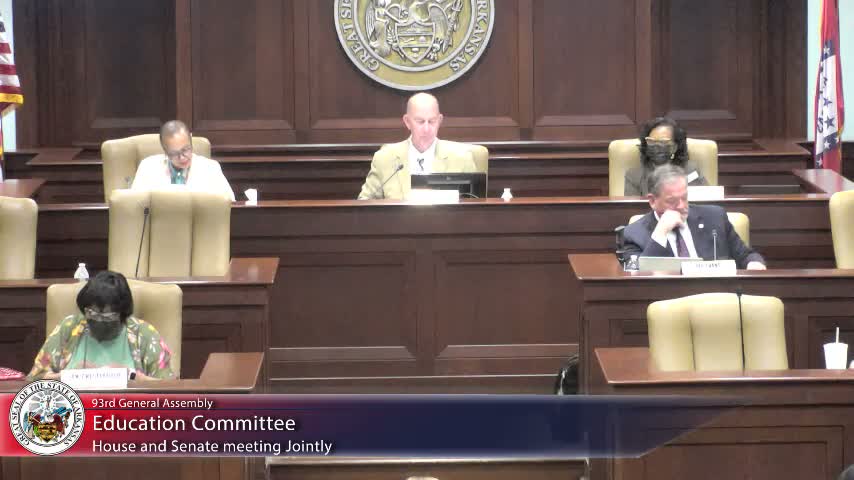
Jasmine Rose (Bureau of Legislative Research) delivered the committee’s requested review of career and technical education (CTE), framing statutory expectations that CTE link secondary and postsecondary education and that programs be structured sequences leading to credentialing opportunities. "Arkansas statute requires a rigorous CTE program of study, that links secondary and post‑secondary education," Rose said.
Rose summarized oversight: the State Board of Education and the Division of Career and Technical Education (DCTE) adopt rules, approve programs of study, and ensure instructors are licensed. She said districts must offer three different CTE programs (a nine‑unit sequence across three occupational areas) but students are not required to take CTE courses; the graduation requirement (six units of career‑focus or additional content) can be satisfied by non‑CTE courses.
On scale and funding, Rose reported there were 457 distinct CTE courses taught statewide in 2021, 48% of which were concurrent‑credit offerings. Perkins funding in 2021 provided roughly $3.8 million to secondary schools (with a larger Perkins total that also served postsecondary), state start‑up grants awarded about $2.4 million to 59 schools to start 35 new programs, and roughly $19 million was allocated to secondary technical centers (about $16.7M actually expended in 2021). She emphasized that CTE program approval requires industry input and that approved programs must offer credentialing opportunities from the state's approved list.
Rose also gave participant metrics for 2021 (presented as BLR/DCTE counts): roughly 113,000 participants, about 43,000 concentrators and a little over 18,000 completers. She noted Perkins performance targets were generally met in 2021 except for post‑secondary credential reporting, which DCTE believes is likely an underestimate during initial collection.
Legislators probed several practical issues: Rep. Chesterfield asked whether "education and training" cluster meant teacher‑prep opportunities; Rose said she would follow up with a precise definition. Members also sought clarification on how CTE expenditures are tagged in state accounting (one BLR table showed roughly $124 million tagged to teachers grades 1–12 within CTE expenditures), and whether that tag might misallocate amounts to early grades; BLR offered to disaggregate the tag on request.
The committee requested further detail on district‑level offerings, how concurrent credit compares to AP course access, and how CTE outcomes map to state workforce projections. Rose and BLR will supply the appendices and district‑level tables cited in the presentation for member review.
The presentation closed with members thanking the presenters and asking for follow‑up on both program definitions and funding breakdowns.
Rose summarized oversight: the State Board of Education and the Division of Career and Technical Education (DCTE) adopt rules, approve programs of study, and ensure instructors are licensed. She said districts must offer three different CTE programs (a nine‑unit sequence across three occupational areas) but students are not required to take CTE courses; the graduation requirement (six units of career‑focus or additional content) can be satisfied by non‑CTE courses.
On scale and funding, Rose reported there were 457 distinct CTE courses taught statewide in 2021, 48% of which were concurrent‑credit offerings. Perkins funding in 2021 provided roughly $3.8 million to secondary schools (with a larger Perkins total that also served postsecondary), state start‑up grants awarded about $2.4 million to 59 schools to start 35 new programs, and roughly $19 million was allocated to secondary technical centers (about $16.7M actually expended in 2021). She emphasized that CTE program approval requires industry input and that approved programs must offer credentialing opportunities from the state's approved list.
Rose also gave participant metrics for 2021 (presented as BLR/DCTE counts): roughly 113,000 participants, about 43,000 concentrators and a little over 18,000 completers. She noted Perkins performance targets were generally met in 2021 except for post‑secondary credential reporting, which DCTE believes is likely an underestimate during initial collection.
Legislators probed several practical issues: Rep. Chesterfield asked whether "education and training" cluster meant teacher‑prep opportunities; Rose said she would follow up with a precise definition. Members also sought clarification on how CTE expenditures are tagged in state accounting (one BLR table showed roughly $124 million tagged to teachers grades 1–12 within CTE expenditures), and whether that tag might misallocate amounts to early grades; BLR offered to disaggregate the tag on request.
The committee requested further detail on district‑level offerings, how concurrent credit compares to AP course access, and how CTE outcomes map to state workforce projections. Rose and BLR will supply the appendices and district‑level tables cited in the presentation for member review.
The presentation closed with members thanking the presenters and asking for follow‑up on both program definitions and funding breakdowns.
Don't Miss a Word: See the Full Meeting!
Go beyond summaries. Unlock every video, transcript, and key insight with a Founder Membership.
✓
Get instant access to full meeting videos
✓
Search and clip any phrase from complete transcripts
✓
Receive AI-powered summaries & custom alerts
✓
Enjoy lifetime, unrestricted access to government data
30-day money-back guarantee
