Committee hears detailed report on waiver pathways and widespread waiver use in Arkansas schools
May 02, 2022 | EDUCATION COMMITTEE - SENATE, Senate, Committees, Legislative, Arkansas
This article was created by AI summarizing key points discussed. AI makes mistakes, so for full details and context, please refer to the video of the full meeting. Please report any errors so we can fix them. Report an error »
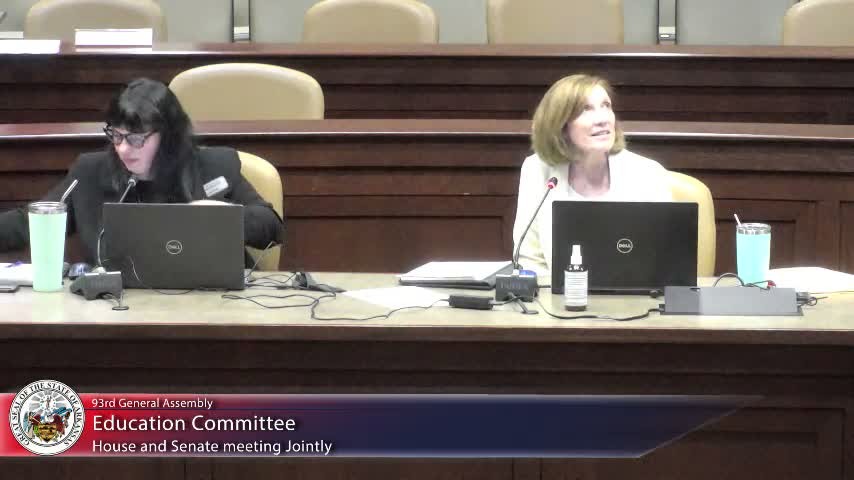
Julie Holt presented the committee’s waiver report, tracing waiver authority from early charter and conversion provisions in 1995 through successive expansions that now include five primary pathways: conversion charters, open‑enrollment charters, schools/districts of innovation, Act 1240/Act 815 pathways and digital‑learning waivers. "Waivers have been in use in Arkansas since the early 2000s," Holt said, and she walked the committee through the growth of waiver use and the 2021 snapshot.
Key figures in the presentation: BLR identified 11,427 waivers in use in 2021, covering 813 schools located in 195 of 235 districts and enrolling about 78% of Arkansas students. The most frequent waivers for open‑enrollment charters concerned teacher salary and licensure, superintendent reporting duties, requirement to employ a library media specialist or counselor, and alternative learning‑environment programming. The digital‑learning pathway (created in response to COVID) packaged typical Act 1240 waivers for districts operating remotely and covered common exceptions such as instructional day, recess and attendance rules; BLR noted many of those waivers remain valid through 2024.
Holt showed comparison charts indicating there were not large, consistent achievement differences between schools with waivers and those without, though she warned that the patterns are nuanced and vary by subgroup (for example ELA and math differences by subgroup). BLR also compared expenditures and found mixed patterns: schools with waivers spent more on principals in some cases and less on counselors and nurses relative to schools without waivers; BLR offered to provide deeper disaggregation.
During questioning, Representative Meeks urged the committee to treat common waiver requests as a potential signal that a statutory requirement should be reconsidered: "If 80% of the schools are asking for a waiver from law x y z, that's probably a flag that we need to change law x y z," he said. Holt agreed BLR tracks common waiver requests and highlighted that some spikes (for example start‑date waivers) reflected calendar anomalies that were later resolved by legislation.
DESE staff (Ivy Pfeffer and Johnny Key) joined the discussion to clarify data‑coding questions and to note that concurrent credit can provide access to advanced coursework where AP is not offered. The committee asked BLR and DESE for follow‑up: district‑level waiver lists, analyses of waiver types that cluster by region, and disaggregated expenditure tables that explain why certain payroll tags (for example teacher tags across grades 1–12) appear within CTE or waiver‑related spending reports.
The presentation closed with BLR agreeing to provide appendices and a deeper slice of the data for the June adequacy presentations.
Key figures in the presentation: BLR identified 11,427 waivers in use in 2021, covering 813 schools located in 195 of 235 districts and enrolling about 78% of Arkansas students. The most frequent waivers for open‑enrollment charters concerned teacher salary and licensure, superintendent reporting duties, requirement to employ a library media specialist or counselor, and alternative learning‑environment programming. The digital‑learning pathway (created in response to COVID) packaged typical Act 1240 waivers for districts operating remotely and covered common exceptions such as instructional day, recess and attendance rules; BLR noted many of those waivers remain valid through 2024.
Holt showed comparison charts indicating there were not large, consistent achievement differences between schools with waivers and those without, though she warned that the patterns are nuanced and vary by subgroup (for example ELA and math differences by subgroup). BLR also compared expenditures and found mixed patterns: schools with waivers spent more on principals in some cases and less on counselors and nurses relative to schools without waivers; BLR offered to provide deeper disaggregation.
During questioning, Representative Meeks urged the committee to treat common waiver requests as a potential signal that a statutory requirement should be reconsidered: "If 80% of the schools are asking for a waiver from law x y z, that's probably a flag that we need to change law x y z," he said. Holt agreed BLR tracks common waiver requests and highlighted that some spikes (for example start‑date waivers) reflected calendar anomalies that were later resolved by legislation.
DESE staff (Ivy Pfeffer and Johnny Key) joined the discussion to clarify data‑coding questions and to note that concurrent credit can provide access to advanced coursework where AP is not offered. The committee asked BLR and DESE for follow‑up: district‑level waiver lists, analyses of waiver types that cluster by region, and disaggregated expenditure tables that explain why certain payroll tags (for example teacher tags across grades 1–12) appear within CTE or waiver‑related spending reports.
The presentation closed with BLR agreeing to provide appendices and a deeper slice of the data for the June adequacy presentations.
Don't Miss a Word: See the Full Meeting!
Go beyond summaries. Unlock every video, transcript, and key insight with a Founder Membership.
✓
Get instant access to full meeting videos
✓
Search and clip any phrase from complete transcripts
✓
Receive AI-powered summaries & custom alerts
✓
Enjoy lifetime, unrestricted access to government data
30-day money-back guarantee
