Senate committee advances 'Quincy’s Law' to require differential diagnosis in child‑maltreatment cases
April 19, 2021 | JUDICIARY COMMITTEE - SENATE, Senate, Committees, Legislative, Arkansas
This article was created by AI summarizing key points discussed. AI makes mistakes, so for full details and context, please refer to the video of the full meeting. Please report any errors so we can fix them. Report an error »
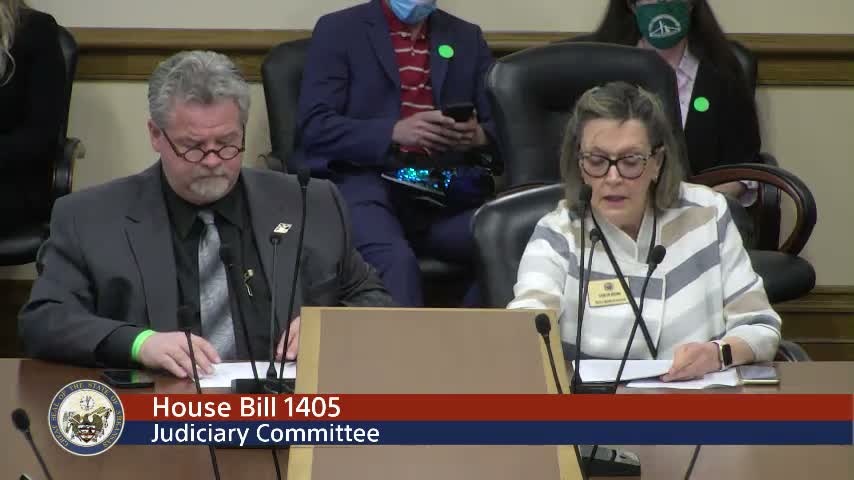
The Senate Judiciary Committee voted to advance HB 1405, commonly called "Quincy’s Law," after hearing emotional testimony from the bill’s sponsor and the mother of the child whose case inspired the legislation.
Representative Carolyn Brown introduced the measure, saying it would require consideration of a differential diagnosis in investigations that allege abuse under the Child Maltreatment Act. Brown described the case that prompted the proposal: Quincy, an infant later clinically diagnosed with Stickler syndrome (a connective‑tissue disorder related to Ehlers‑Danlos), was initially evaluated as an abuse case after physicians found numerous fractures and a hematoma. Brown said the bill is intended to prevent families from suffering avoidable social, financial and emotional harm when a rare medical condition explains injuries.
Sarah Culp, Quincy’s mother, testified she and her family were accused when Quincy was weeks old, that medical records later suggested some fractures predated birth, and that a geneticist’s review and additional testing led to a clinical diagnosis. "I would appreciate a good vote," Culp said, asking the committee to pass the bill to protect other families from similar distress.
Misha (Michelle) Martin, director of the Division of Children and Family Services, described how a second medical opinion would be used: a specialist would determine whether an underlying condition existed and present that finding to DCFS as part of a holistic review alongside the initial opinion; the agency would then weigh the medical opinions, timelines and provider credentials when making a finding about abuse. Committee members pressed about timing and how a second opinion would be obtained and used; Martin and the sponsor said implementation details would be developed with DCFS after passage.
Assistant Attorney General Adam Jackson and other supporters told the committee the attorney general’s office and prosecutors back the bill; the sponsor closed and the committee passed the measure by voice vote.
Representative Carolyn Brown introduced the measure, saying it would require consideration of a differential diagnosis in investigations that allege abuse under the Child Maltreatment Act. Brown described the case that prompted the proposal: Quincy, an infant later clinically diagnosed with Stickler syndrome (a connective‑tissue disorder related to Ehlers‑Danlos), was initially evaluated as an abuse case after physicians found numerous fractures and a hematoma. Brown said the bill is intended to prevent families from suffering avoidable social, financial and emotional harm when a rare medical condition explains injuries.
Sarah Culp, Quincy’s mother, testified she and her family were accused when Quincy was weeks old, that medical records later suggested some fractures predated birth, and that a geneticist’s review and additional testing led to a clinical diagnosis. "I would appreciate a good vote," Culp said, asking the committee to pass the bill to protect other families from similar distress.
Misha (Michelle) Martin, director of the Division of Children and Family Services, described how a second medical opinion would be used: a specialist would determine whether an underlying condition existed and present that finding to DCFS as part of a holistic review alongside the initial opinion; the agency would then weigh the medical opinions, timelines and provider credentials when making a finding about abuse. Committee members pressed about timing and how a second opinion would be obtained and used; Martin and the sponsor said implementation details would be developed with DCFS after passage.
Assistant Attorney General Adam Jackson and other supporters told the committee the attorney general’s office and prosecutors back the bill; the sponsor closed and the committee passed the measure by voice vote.
Don't Miss a Word: See the Full Meeting!
Go beyond summaries. Unlock every video, transcript, and key insight with a Founder Membership.
✓
Get instant access to full meeting videos
✓
Search and clip any phrase from complete transcripts
✓
Receive AI-powered summaries & custom alerts
✓
Enjoy lifetime, unrestricted access to government data
30-day money-back guarantee
