Arkansas educational cooperatives defend their $188 million budget, lawmakers press for outcome measures
November 07, 2023 | EDUCATION COMMITTEE - SENATE, Senate, Committees, Legislative, Arkansas
This article was created by AI summarizing key points discussed. AI makes mistakes, so for full details and context, please refer to the video of the full meeting. Please report any errors so we can fix them. Report an error »
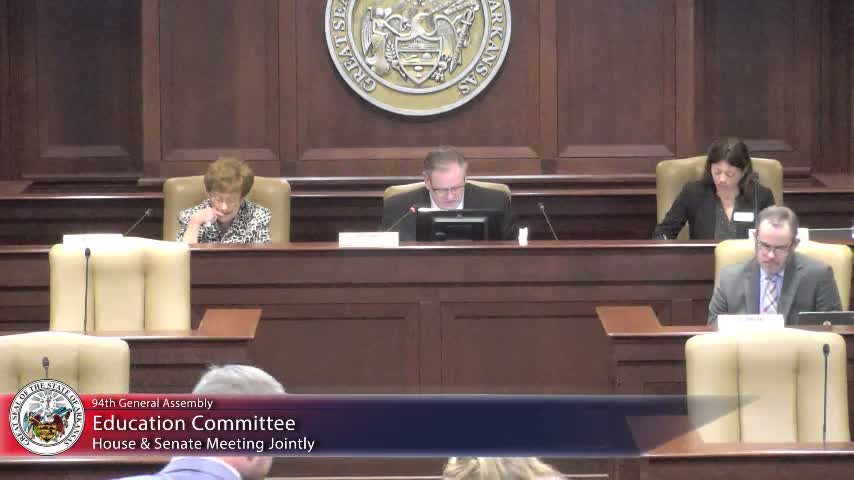
Directors representing Arkansas’ 15 regional educational cooperatives presented a consolidated FY23 financial snapshot and staffing overview to the Senate Education Committee, and lawmakers used the session to press for more granular accountability tied to student outcomes.
Daryl Blaxton (Northeast Education Cooperative) said consolidated FY23 revenues were approximately $187,922,167 and that funding sources were roughly one‑third state, one‑third local and one‑third federal. He outlined operating fund balances, restricted vs. discretionary funds, federal grant reporting rules and the role of co‑ops in administering grants and reimbursing districts post‑expenditure. Gerald Cooper described required financial controls, legislative audits, monthly board approvals for financial reports and FOIA compliance, and noted that co‑ops — like districts — can be placed on fiscal distress.
Karen K. McMahon reviewed staffing patterns, explaining that many certified staff are embedded in districts rather than working 100% on co‑op property; co‑ops run programs such as Virtual Arkansas, ABC pre‑K and early‑childhood services and sometimes house ADE‑funded personnel. Directors said the composition of staff varies by cooperative depending on local needs.
Lawmakers raised multiple concerns. Senator Chesterfield cited long‑term declines in literacy and math and asked why outcomes remain weak despite cooperative funding; directors pointed to recent investments in science‑of‑reading initiatives, RISE training for nearly 6,000 teachers, targeted interventions in Level 3 districts and efforts to align essential standards with high‑quality materials. Representative Eubanks and others said past co‑op evaluations felt subjective and requested clearer, co‑op‑level measures tied to student achievement; presenters said co‑op evaluations run on a five‑year cycle and that many grants already include performance metrics.
Other questions sought details on interest income and investment safeguards (directors said common instruments include CDs or interest bearing checking accounts), whether co‑ops charge for services (responses varied by program), breakdowns of salaries versus overhead, and disclosure of fund balances and per‑co‑op budget data. Directors repeatedly offered to supply coop‑level breakdowns and cited BLR (Bureau of Legislative Research) reports as a source for FY22 data.
On recruitment and retention, co‑ops described 'grow‑your‑own' strategies to convert paraprofessionals into licensed teachers, mentoring programs for novice teachers (supported in law) and summer bootcamps and coaching to keep teachers in classrooms. Directors acknowledged that some districts still face ongoing staffing gaps and that co‑ops partner with districts to provide consortium services when districts cannot hire full‑time specialists.
Committee members asked for follow‑up documents including co‑op breakdowns of operating expenditures, detailed fund balances, counts of staff by role (certified vs classified), and evidence tying co‑op programs to student outcomes. The committee did not take formal action; presenters invited legislators to visit co‑ops and offered additional materials.
Daryl Blaxton (Northeast Education Cooperative) said consolidated FY23 revenues were approximately $187,922,167 and that funding sources were roughly one‑third state, one‑third local and one‑third federal. He outlined operating fund balances, restricted vs. discretionary funds, federal grant reporting rules and the role of co‑ops in administering grants and reimbursing districts post‑expenditure. Gerald Cooper described required financial controls, legislative audits, monthly board approvals for financial reports and FOIA compliance, and noted that co‑ops — like districts — can be placed on fiscal distress.
Karen K. McMahon reviewed staffing patterns, explaining that many certified staff are embedded in districts rather than working 100% on co‑op property; co‑ops run programs such as Virtual Arkansas, ABC pre‑K and early‑childhood services and sometimes house ADE‑funded personnel. Directors said the composition of staff varies by cooperative depending on local needs.
Lawmakers raised multiple concerns. Senator Chesterfield cited long‑term declines in literacy and math and asked why outcomes remain weak despite cooperative funding; directors pointed to recent investments in science‑of‑reading initiatives, RISE training for nearly 6,000 teachers, targeted interventions in Level 3 districts and efforts to align essential standards with high‑quality materials. Representative Eubanks and others said past co‑op evaluations felt subjective and requested clearer, co‑op‑level measures tied to student achievement; presenters said co‑op evaluations run on a five‑year cycle and that many grants already include performance metrics.
Other questions sought details on interest income and investment safeguards (directors said common instruments include CDs or interest bearing checking accounts), whether co‑ops charge for services (responses varied by program), breakdowns of salaries versus overhead, and disclosure of fund balances and per‑co‑op budget data. Directors repeatedly offered to supply coop‑level breakdowns and cited BLR (Bureau of Legislative Research) reports as a source for FY22 data.
On recruitment and retention, co‑ops described 'grow‑your‑own' strategies to convert paraprofessionals into licensed teachers, mentoring programs for novice teachers (supported in law) and summer bootcamps and coaching to keep teachers in classrooms. Directors acknowledged that some districts still face ongoing staffing gaps and that co‑ops partner with districts to provide consortium services when districts cannot hire full‑time specialists.
Committee members asked for follow‑up documents including co‑op breakdowns of operating expenditures, detailed fund balances, counts of staff by role (certified vs classified), and evidence tying co‑op programs to student outcomes. The committee did not take formal action; presenters invited legislators to visit co‑ops and offered additional materials.
Don't Miss a Word: See the Full Meeting!
Go beyond summaries. Unlock every video, transcript, and key insight with a Founder Membership.
✓
Get instant access to full meeting videos
✓
Search and clip any phrase from complete transcripts
✓
Receive AI-powered summaries & custom alerts
✓
Enjoy lifetime, unrestricted access to government data
30-day money-back guarantee
