Judiciary committee hears that criminal dockets and public‑defender access remain strained amid COVID waves
January 10, 2022 | JUDICIARY COMMITTEE - SENATE, Senate, Committees, Legislative, Arkansas
This article was created by AI summarizing key points discussed. AI makes mistakes, so for full details and context, please refer to the video of the full meeting. Please report any errors so we can fix them. Report an error »
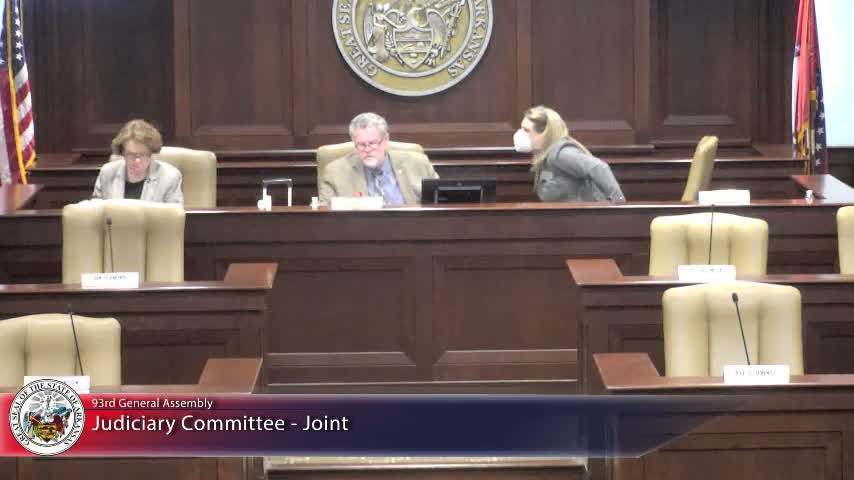
At a Senate Judiciary Committee hearing, Administrative Office of the Courts officials and criminal justice stakeholders described how the COVID‑19 pandemic and pre‑existing capacity constraints have combined to strain Arkansas criminal dockets, jails and public‑defender services.
Kristen Clark, director of the Legal Services Division at the Administrative Office of the Courts, told the committee that the Supreme Court has urged courts to remain open and to balance public‑health protections with access to justice. "When we look at the number of cases that have been filed and then we look at the number of cases that have been disposed of during that 1 year period, the clearance rate is 91 percent," Clark said, referencing 2020 data and saying judges had worked under "very unusual circumstances."
Scott Graves, director of research and statistics for the AOC, gave numerical context: he reported about 1,006,632 incoming filings for 2020 with 912,860 dispositions, compared with roughly 1,251,908 filings and 1,037,194 dispositions in 2019. Graves said filings declined more sharply than dispositions during the pandemic, producing a build‑up of pending cases but not the full collapse many feared.
Local prosecutors, public defenders and sheriffs who testified said conditions vary widely by jurisdiction and that some areas are in a state of crisis. "In my opinion, it's the worst right now that it's ever been," said a public defender commission representative about felony caseloads; the panel described individual judges and prosecutors carrying thousands of active cases in some districts and said local jails are near capacity in multiple counties.
County sheriffs said jails have been constrained by quarantine requirements, staffing shortages and the lack of additional prison capacity upstream. Lonoke County Sheriff John Staley said his jail is full and that the county is sometimes forced to delay services such as serving warrants because state penitentiary capacity is constrained.
Access to counsel: The public defender commission told members that local public defenders are handling an average of 350–400 felony cases each, substantially above NAC/ABA workload guidance of about 150 felonies per attorney. That heavy caseload contributes to delayed interviews, difficulties completing investigations and longer pretrial detention for defendants who cannot promptly meet with counsel.
Speedy‑trial and scheduling: Prosecutors and court staff said per curiam orders issued during the emergency provided mechanisms to exclude time for speedy‑trial computations, but emphasized the need for careful scheduling orders to avoid dismissals. Bob McMahon, a prosecutor coordinator, said his office provided a scheduling order template to prosecutors to protect speedy‑trial rights during the pandemic.
Potential responses: Committee members and witnesses discussed a mix of immediate and longer‑term actions: creating more courtroom capacity (including funding for jury space), expanding specialty courts (drug, mental‑health, veterans), adding judges and ensuring those new judges have staffed public‑defender and prosecutor positions, and exploring available federal relief funding to support backlog mitigation.
Next steps: Chair Senator Clark asked staff to circulate the AOC data exhibit and requested additional five‑year caseflow snapshots and other materials; members flagged public‑defender staffing and jail capacity as likely topics for future committee work.
Kristen Clark, director of the Legal Services Division at the Administrative Office of the Courts, told the committee that the Supreme Court has urged courts to remain open and to balance public‑health protections with access to justice. "When we look at the number of cases that have been filed and then we look at the number of cases that have been disposed of during that 1 year period, the clearance rate is 91 percent," Clark said, referencing 2020 data and saying judges had worked under "very unusual circumstances."
Scott Graves, director of research and statistics for the AOC, gave numerical context: he reported about 1,006,632 incoming filings for 2020 with 912,860 dispositions, compared with roughly 1,251,908 filings and 1,037,194 dispositions in 2019. Graves said filings declined more sharply than dispositions during the pandemic, producing a build‑up of pending cases but not the full collapse many feared.
Local prosecutors, public defenders and sheriffs who testified said conditions vary widely by jurisdiction and that some areas are in a state of crisis. "In my opinion, it's the worst right now that it's ever been," said a public defender commission representative about felony caseloads; the panel described individual judges and prosecutors carrying thousands of active cases in some districts and said local jails are near capacity in multiple counties.
County sheriffs said jails have been constrained by quarantine requirements, staffing shortages and the lack of additional prison capacity upstream. Lonoke County Sheriff John Staley said his jail is full and that the county is sometimes forced to delay services such as serving warrants because state penitentiary capacity is constrained.
Access to counsel: The public defender commission told members that local public defenders are handling an average of 350–400 felony cases each, substantially above NAC/ABA workload guidance of about 150 felonies per attorney. That heavy caseload contributes to delayed interviews, difficulties completing investigations and longer pretrial detention for defendants who cannot promptly meet with counsel.
Speedy‑trial and scheduling: Prosecutors and court staff said per curiam orders issued during the emergency provided mechanisms to exclude time for speedy‑trial computations, but emphasized the need for careful scheduling orders to avoid dismissals. Bob McMahon, a prosecutor coordinator, said his office provided a scheduling order template to prosecutors to protect speedy‑trial rights during the pandemic.
Potential responses: Committee members and witnesses discussed a mix of immediate and longer‑term actions: creating more courtroom capacity (including funding for jury space), expanding specialty courts (drug, mental‑health, veterans), adding judges and ensuring those new judges have staffed public‑defender and prosecutor positions, and exploring available federal relief funding to support backlog mitigation.
Next steps: Chair Senator Clark asked staff to circulate the AOC data exhibit and requested additional five‑year caseflow snapshots and other materials; members flagged public‑defender staffing and jail capacity as likely topics for future committee work.
View the Full Meeting & All Its Details
This article offers just a summary. Unlock complete video, transcripts, and insights as a Founder Member.
✓
Watch full, unedited meeting videos
✓
Search every word spoken in unlimited transcripts
✓
AI summaries & real-time alerts (all government levels)
✓
Permanent access to expanding government content
30-day money-back guarantee
