KARK investigation prompts Senate Judiciary scrutiny of district-court public defender denials
February 08, 2022 | JUDICIARY COMMITTEE - SENATE, Senate, Committees, Legislative, Arkansas
This article was created by AI summarizing key points discussed. AI makes mistakes, so for full details and context, please refer to the video of the full meeting. Please report any errors so we can fix them. Report an error »
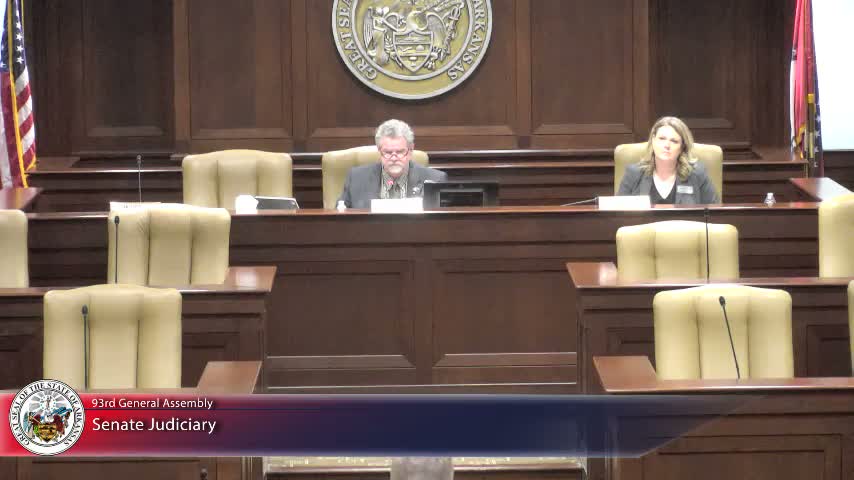
At a meeting of the Senate Judiciary Committee, investigative reporter Mitch McCoy told lawmakers his team spent months documenting cases in which people seeking court-appointed counsel were denied in some district courts, and he provided broadcast material and court records to the committee.
"For the last 4 months, I've been investigating and reporting on public defender issues across our state," McCoy told the committee as he summarized his KARK reporting and asked the panel to view excerpts of his broadcast. He said his team found court records indicating the public defender handled only 48 district-court cases over nine years in Polk County, a number he described as unusually low for a court of that size.
McCoy cited individual examples his team reviewed, including an affidavit showing a defendant with limited cash and modest monthly expenses who was denied counsel, and the case of Kelly Young Franklin, a teacher who told McCoy she was receiving government assistance at the time she says she was denied a public defender, forced to represent herself and later convicted. "To this day, she believes she was wrongfully convicted," McCoy said.
Kelly Ward, an attorney who relocated from prosecutorial work to criminal defense, described taking a Polk County matter pro bono after concluding the accused could not fairly represent himself. "I would just go ahead and represent him pro bono, because there was no way, someone like my client could represent himself and that would be anything close to justice," Ward said.
Greg Parrish, executive director of the Arkansas Public Defender Commission, told the committee the appointment of counsel and indigency review is governed by statute and by court rules. Parrish said the commission has worked to change rules so judges address indigency at first appearance hearings (commonly called 8.1 hearings in some parts of the state) but that practice varies by jurisdiction. "The court shall not appoint an attorney prior to review of the submitted certificate of indigency," Parrish read from statute during his testimony and explained that the law requires an affidavit and a judicial determination.
Parrish also told lawmakers the commission receives monthly data on cases appointed and dispositions but that the agency does not routinely maintain per-court appointment logs in an easily searchable format; he said reporting improvements are being discussed with the Administrative Office of the Courts.
Committee members probed whether the commission is notified when judges deny a request for counsel and whether the authority to appoint lies strictly with judges by statute or by constitutional rule-making. Parrish answered that appointment and the affidavit requirement are statutory and described recent rule changes intended to address indigency earlier in the process.
Members also pressed on structural causes: part-time public-defender positions, workload and pay. Ward estimated a part-time public-defender grade that expects 20 hours per week would be in the $28,000–$29,000 annual range, and she said the workload she encountered exceeded those hours during an eight-week assignment.
The committee did not take formal action during the meeting. Members requested follow-up materials, including county-level appointment data, and signaled interest in further review of whether district courts are consistently applying statutory indigency factors that include the seriousness of charges, monthly expenses, income and public assistance.
The hearing record includes reporter-provided documents and statements from individuals who said they were denied counsel; Parrish said the Judicial Discipline and Disability Commission has launched an inquiry in at least one instance referenced by the reporting. The committee said it would consider inviting court representatives or providing additional data requests to better understand whether the patterns McCoy reported are localized or systemic.
"For the last 4 months, I've been investigating and reporting on public defender issues across our state," McCoy told the committee as he summarized his KARK reporting and asked the panel to view excerpts of his broadcast. He said his team found court records indicating the public defender handled only 48 district-court cases over nine years in Polk County, a number he described as unusually low for a court of that size.
McCoy cited individual examples his team reviewed, including an affidavit showing a defendant with limited cash and modest monthly expenses who was denied counsel, and the case of Kelly Young Franklin, a teacher who told McCoy she was receiving government assistance at the time she says she was denied a public defender, forced to represent herself and later convicted. "To this day, she believes she was wrongfully convicted," McCoy said.
Kelly Ward, an attorney who relocated from prosecutorial work to criminal defense, described taking a Polk County matter pro bono after concluding the accused could not fairly represent himself. "I would just go ahead and represent him pro bono, because there was no way, someone like my client could represent himself and that would be anything close to justice," Ward said.
Greg Parrish, executive director of the Arkansas Public Defender Commission, told the committee the appointment of counsel and indigency review is governed by statute and by court rules. Parrish said the commission has worked to change rules so judges address indigency at first appearance hearings (commonly called 8.1 hearings in some parts of the state) but that practice varies by jurisdiction. "The court shall not appoint an attorney prior to review of the submitted certificate of indigency," Parrish read from statute during his testimony and explained that the law requires an affidavit and a judicial determination.
Parrish also told lawmakers the commission receives monthly data on cases appointed and dispositions but that the agency does not routinely maintain per-court appointment logs in an easily searchable format; he said reporting improvements are being discussed with the Administrative Office of the Courts.
Committee members probed whether the commission is notified when judges deny a request for counsel and whether the authority to appoint lies strictly with judges by statute or by constitutional rule-making. Parrish answered that appointment and the affidavit requirement are statutory and described recent rule changes intended to address indigency earlier in the process.
Members also pressed on structural causes: part-time public-defender positions, workload and pay. Ward estimated a part-time public-defender grade that expects 20 hours per week would be in the $28,000–$29,000 annual range, and she said the workload she encountered exceeded those hours during an eight-week assignment.
The committee did not take formal action during the meeting. Members requested follow-up materials, including county-level appointment data, and signaled interest in further review of whether district courts are consistently applying statutory indigency factors that include the seriousness of charges, monthly expenses, income and public assistance.
The hearing record includes reporter-provided documents and statements from individuals who said they were denied counsel; Parrish said the Judicial Discipline and Disability Commission has launched an inquiry in at least one instance referenced by the reporting. The committee said it would consider inviting court representatives or providing additional data requests to better understand whether the patterns McCoy reported are localized or systemic.
View the Full Meeting & All Its Details
This article offers just a summary. Unlock complete video, transcripts, and insights as a Founder Member.
✓
Watch full, unedited meeting videos
✓
Search every word spoken in unlimited transcripts
✓
AI summaries & real-time alerts (all government levels)
✓
Permanent access to expanding government content
30-day money-back guarantee
