Senate Judiciary Committee hears DOC briefing on jail backup, recidivism and reentry plans
March 28, 2022 | JUDICIARY COMMITTEE - SENATE, Senate, Committees, Legislative, Arkansas
This article was created by AI summarizing key points discussed. AI makes mistakes, so for full details and context, please refer to the video of the full meeting. Please report any errors so we can fix them. Report an error »
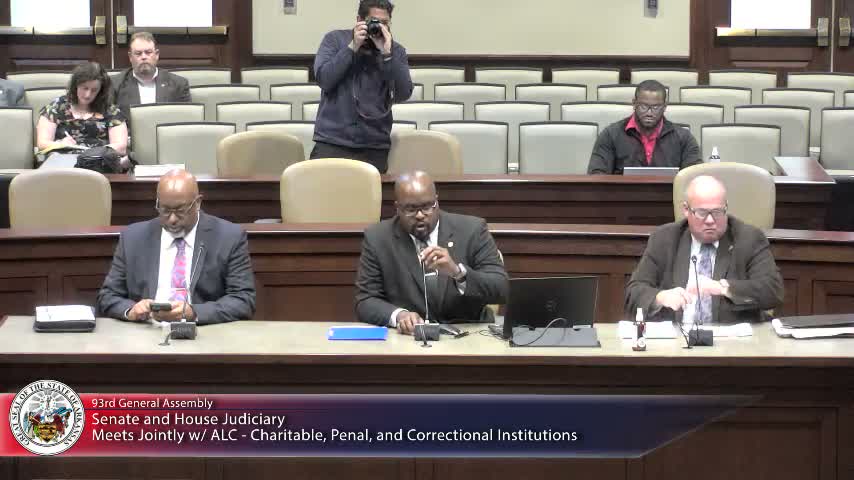
Department of Corrections officials told the Senate Judiciary Committee on an informational briefing that Arkansas is seeing a rebound in correctional populations since the COVID drop but remains challenged by county jail backups and high recidivism.
Secretary Solomon Grove said the state’s county jail backup peaked in December and briefly crossed 2,500 inmates in January before falling to about 1,500 as of the prior week. "We have been able to administratively transfer just over 200 offenders from the Division of Correction to the Division of Community Correction," Grove said, citing a rule change implemented under Act 55 of the 2021 regular session that allows transfers when a sentencing court did not affirmatively object.
Grove also outlined public‑health and operational changes the department has used to accelerate intakes, including adoption of updated CDC congregate‑setting guidance issued in late 2021 and use of overflow intake housing at Ouachita River (male) and the McPherson Unit (female) to conduct quarantine so designated intake beds remain available for new commits.
On emergency release mechanisms, Grove described the Emergency Powers Act (EPA) as two distinct options: a 90‑day EPA that can move approved parole dates up to 90 days when capacity exceeds 98% for 30 consecutive days, and a 1‑year EPA that can move eligible parole, transfer or discharge dates by up to a year when county jail backup exceeds 500 offenders for 30 consecutive days. He told the committee the EPAs expand look‑back windows but do not create new categories of eligibility for release.
The committee also pressed officials on recidivism and reentry. Grove said the department’s 36‑month recidivism rate is 46.1% overall, 47.8% in the Division of Correction and 37.5% in the Division of Community Correction, and called those rates "unacceptably high." He said the department has created a quality‑improvement unit to evaluate programs and is building a recidivism profile to target evidence‑based interventions, especially for youthful offenders and the first 14 months after release.
Wendy Ware, the state’s population projection contractor, presented model results showing the COVID decline in 2020 was driven largely by reduced admissions (court slowdowns) rather than increased releases and that the department is projecting a rebound with sustained growth in the jurisdictional population over the coming years. Ware said her office’s simulation model is typically within about 2% month‑to‑month and within roughly 5% at five years.
Members asked for additional detail and follow‑up data. Committee members requested the projection slides and pressed on whether the department can better separate violent offenders from lower‑severity offenders for placement, whether adequate maximum‑security beds exist, and how parole and probation staffing and mobile‑reporting tools can reduce pressure on jails. Secretary Grove and Director Jerry Bradshaw said vacancies for probation/parole officers have fallen after recent raises (from about 48 to 21 vacancies) and highlighted mobile reporting and voice verification apps used for minimum‑risk supervision.
Public witnesses who had been incarcerated urged additional reforms to reduce recidivism: Ruby Welch advocated for expanded employment access ("ban the box" and automatic sealing), broader postsecondary education and vocational training inside prisons, and temporary waivers of fines and fees during reentry; Laura Berry Nicks urged expanded programming and consideration of elderly parole for long‑term, older inmates.
The committee took no formal policy votes at the hearing beyond approving minutes at the start of the session. Members asked DOC staff to provide the projection slide deck and follow up on data and program outcomes at a future meeting.
Secretary Solomon Grove said the state’s county jail backup peaked in December and briefly crossed 2,500 inmates in January before falling to about 1,500 as of the prior week. "We have been able to administratively transfer just over 200 offenders from the Division of Correction to the Division of Community Correction," Grove said, citing a rule change implemented under Act 55 of the 2021 regular session that allows transfers when a sentencing court did not affirmatively object.
Grove also outlined public‑health and operational changes the department has used to accelerate intakes, including adoption of updated CDC congregate‑setting guidance issued in late 2021 and use of overflow intake housing at Ouachita River (male) and the McPherson Unit (female) to conduct quarantine so designated intake beds remain available for new commits.
On emergency release mechanisms, Grove described the Emergency Powers Act (EPA) as two distinct options: a 90‑day EPA that can move approved parole dates up to 90 days when capacity exceeds 98% for 30 consecutive days, and a 1‑year EPA that can move eligible parole, transfer or discharge dates by up to a year when county jail backup exceeds 500 offenders for 30 consecutive days. He told the committee the EPAs expand look‑back windows but do not create new categories of eligibility for release.
The committee also pressed officials on recidivism and reentry. Grove said the department’s 36‑month recidivism rate is 46.1% overall, 47.8% in the Division of Correction and 37.5% in the Division of Community Correction, and called those rates "unacceptably high." He said the department has created a quality‑improvement unit to evaluate programs and is building a recidivism profile to target evidence‑based interventions, especially for youthful offenders and the first 14 months after release.
Wendy Ware, the state’s population projection contractor, presented model results showing the COVID decline in 2020 was driven largely by reduced admissions (court slowdowns) rather than increased releases and that the department is projecting a rebound with sustained growth in the jurisdictional population over the coming years. Ware said her office’s simulation model is typically within about 2% month‑to‑month and within roughly 5% at five years.
Members asked for additional detail and follow‑up data. Committee members requested the projection slides and pressed on whether the department can better separate violent offenders from lower‑severity offenders for placement, whether adequate maximum‑security beds exist, and how parole and probation staffing and mobile‑reporting tools can reduce pressure on jails. Secretary Grove and Director Jerry Bradshaw said vacancies for probation/parole officers have fallen after recent raises (from about 48 to 21 vacancies) and highlighted mobile reporting and voice verification apps used for minimum‑risk supervision.
Public witnesses who had been incarcerated urged additional reforms to reduce recidivism: Ruby Welch advocated for expanded employment access ("ban the box" and automatic sealing), broader postsecondary education and vocational training inside prisons, and temporary waivers of fines and fees during reentry; Laura Berry Nicks urged expanded programming and consideration of elderly parole for long‑term, older inmates.
The committee took no formal policy votes at the hearing beyond approving minutes at the start of the session. Members asked DOC staff to provide the projection slide deck and follow up on data and program outcomes at a future meeting.
View the Full Meeting & All Its Details
This article offers just a summary. Unlock complete video, transcripts, and insights as a Founder Member.
✓
Watch full, unedited meeting videos
✓
Search every word spoken in unlimited transcripts
✓
AI summaries & real-time alerts (all government levels)
✓
Permanent access to expanding government content
30-day money-back guarantee
